
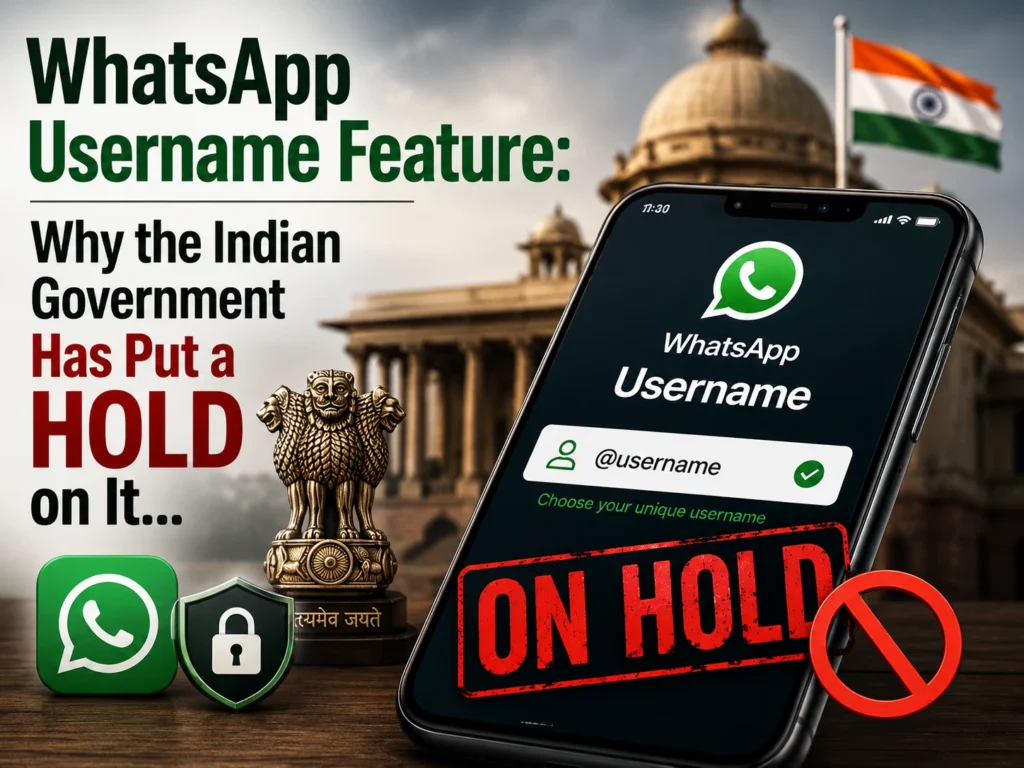
For nearly two decades, a WhatsApp account has meant one thing above all else: your phone number. It’s how people find you, how they save you as a contact, and how a stranger can reach you the moment they have your digits. That is now changing, and the change has landed WhatsApp in the middle of a fresh regulatory standoff with the Indian government, its single largest market in the world.
Here is the complete picture of what WhatsApp’s new username feature actually is, why India has stepped in to pause it, and what happens next.
What Is WhatsApp New Username Feature?
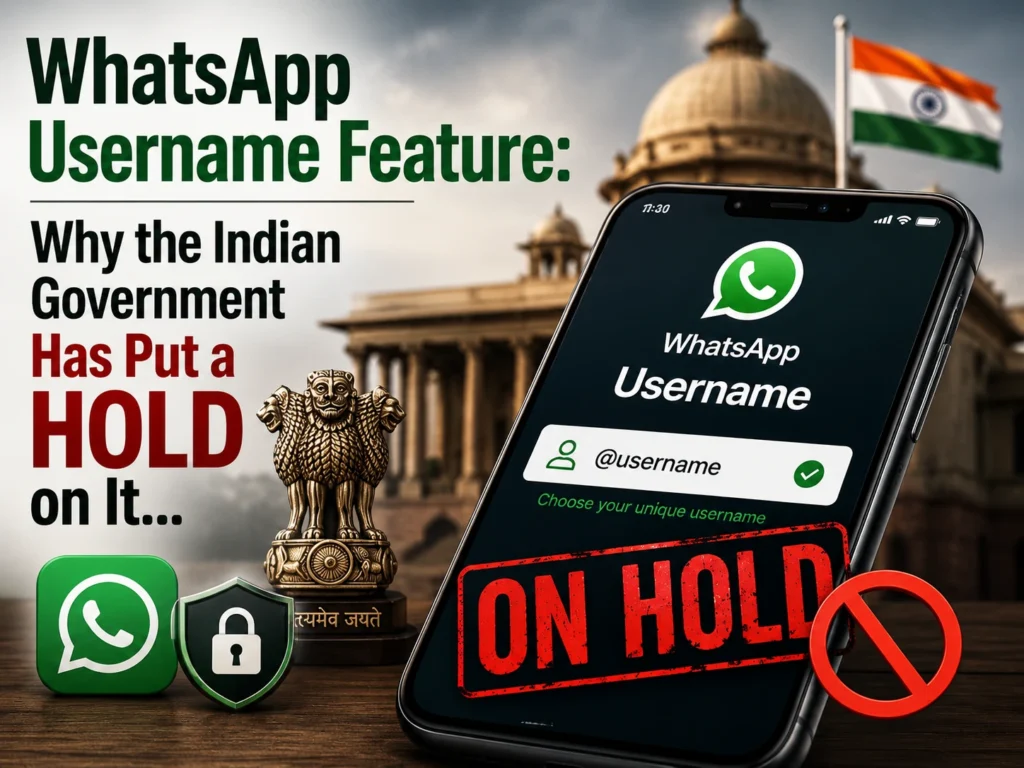
On June 29, 2026, WhatsApp announced one of its biggest privacy changes in years: the ability for users to create and use a unique username, similar to how apps like Telegram, Discord, or X operate. Instead of needing to know someone’s phone number to start a chat, a person will eventually be able to simply use their handle, something like @username, to begin a conversation.
Here is how the feature is designed to work, based on WhatsApp’s own announcement and early reporting:
- A phone number will still be required to create and register a WhatsApp account. Usernames do not replace this requirement; they simply give people another way to be contacted.
- Once a person sets a username, new contacts who don’t already have their number saved will only see the username, not the phone number, when starting a conversation for the first time.
- There is no public directory or searchable list of usernames. WhatsApp has stated that someone needs to know your exact username to message you, meaning it is not designed to work like a social media discovery feature.
- Users can also turn on an optional “username key,” an additional code that a new contact must enter correctly before their first message or call goes through. This applies to voice and video calls too, not just text.
- Usernames must be between three and thirty-five characters, made up of lowercase letters, numbers, periods, or underscores, and cannot resemble a website address.
- To prevent impersonation, WhatsApp says it has proactively reserved usernames connected to public figures, celebrities, government departments, and verified accounts, so ordinary users cannot claim handles like @rbi_india or well-known politicians’ names.
- The feature is being rolled out gradually. Username reservations opened first, allowing people to lock in their preferred handle, while the ability to actually use usernames for messaging is expected to arrive later in 2026, market by market.
WhatsApp has positioned this as a genuine privacy upgrade, one that closes a long-standing gap where anyone who obtained your number, even through a public group or a data leak, could contact you directly with no barrier at all.
WhatsApp Username Feature : Why Has the Indian Government Stepped In?
Despite the privacy framing, India’s Ministry of Electronics and Information Technology, commonly known as MeitY, moved quickly and firmly. Within about 48 hours of Meta’s global announcement, the Ministry issued a formal notice addressed to WhatsApp’s Chief Compliance Officer for India, directing the company to explain the feature in detail and, crucially, to not roll it out in India until the government’s concerns have been resolved.
The government has given Meta a window of three days to submit a detailed report, supported by documentation, on how the feature works and what safeguards are built into it. If WhatsApp fails to provide a satisfactory explanation, the Ministry has indicated it could pursue further regulatory action under the Information Technology Act and related IT Rules.
The core of the government’s concern comes down to one word: traceability. Under current WhatsApp design, a phone number is a strong, verifiable link to a real person, one that law enforcement can trace back through telecom operators when investigating fraud or crime. Usernames threaten to weaken that link, since a person could now approach a stranger without ever revealing the number tied to their identity.
Specifically, officials have flagged the following risks:
- Impersonation of officials and institutions: Authorities worry that fraudsters could create usernames closely resembling banks, government departments, police officers, or judicial officials, making scam messages look more credible.
- The “digital arrest” scam problem: This has been a particularly urgent concern for Indian regulators. Digital arrest scams involve fraudsters posing as CBI officers, customs officials, or judges, convincing victims over video calls that they are under investigation and must transfer money immediately to avoid arrest. This scam has exploded across urban India in the past two years, with victims ranging from ordinary citizens to retired government officials, and losses running into crores of rupees in some individual cases. Prime Minister Narendra Modi himself referenced the danger of digital arrest scams in a Mann Ki Baat address in 2024, calling them one of the most dangerous cyber threats facing citizens today.
- Loss of traceability tied to international numbers: Officials are especially concerned that scammers using foreign SIM cards or international numbers could now approach Indian users through a username, without the recipient ever seeing a suspicious international number that might otherwise have raised a red flag.
- Phishing and fraud at scale: Since usernames can be shared widely without exposing a phone number, officials worry the feature could make it easier to run large-scale phishing operations while staying harder to trace back to a real identity.
You May Also Like:
WhatsApp Username Feature: How Has Meta Responded So Far?
Following the notice becoming public, a WhatsApp spokesperson clarified that the feature is not yet live for actual use in India. The company confirmed that only the reservation step, letting users lock in a preferred username ahead of time, has been rolled out, and that the ability to actually message people using a username will be introduced “slowly later this year.”
Meta has also pointed to its existing safeguards as a response to concerns around impersonation, noting that it has already reserved usernames tied to public figures, celebrities, and government entities specifically to prevent bad actors from claiming those identities. The company continues to describe usernames as a net privacy gain for users, arguing that reducing reliance on phone numbers protects people from SIM-swap attacks and numbers being harvested from large public groups.
As of the most recent updates, Meta had not issued a detailed public response addressing the government’s specific traceability and digital arrest scam concerns, and the formal three-day window given by MeitY was still running.
Why This Matters More in India Than Anywhere Else
WhatsApp is not just another app in India, it is closer to a digital utility. With over 500 million users, India is WhatsApp’s largest market anywhere in the world, and the platform has expanded well beyond messaging into payments, business communication, and customer service for everything from grocery delivery to government schemes.
That scale is exactly why India has become the only major market where the username feature has been paused before it could even reach the messaging stage. Regulators are treating this less as a product feature and more as a matter of national cybersecurity policy, particularly given how large and fast-growing India’s digital fraud problem has become.
It’s also worth noting the broader regulatory backdrop. This notice to Meta comes shortly after Telegram faced scrutiny in India, including a temporary ban, following concerns that leaked exam papers were being circulated on the platform, with usernames and message-editing features drawing particular attention during that episode. Indian regulators appear to be increasingly wary of messaging features that can weaken the link between an online identity and a verifiable real-world identity, especially at a time when digital fraud cases are rising sharply across the country.
WhatsApp Username Feature: What Happens Next?
At the moment, here is where things stand:
- WhatsApp usernames remain restricted to the reservation stage globally, and the ability to message using a username has not launched anywhere yet, including in markets outside India.
- In India specifically, even the eventual messaging rollout has been explicitly paused by government order until consultations are completed to the Ministry’s satisfaction.
- Meta has a three-day window from the date of the notice to submit a detailed, documented explanation of the feature’s safeguards.
- If the government is not satisfied with Meta’s response, it has reserved the right to pursue further regulatory action under India’s IT Act and IT Rules.
- No final decision has been announced yet on whether India will eventually allow the feature with modifications, require additional safeguards such as stronger identity verification, or continue blocking it altogether.
This is very much an evolving story, and given how quickly the back-and-forth between Meta and Indian regulators has moved so far, readers should expect updates within days rather than weeks.
Frequently Asked Questions About WhatsApp Username Feature and the India Rollout Pause
What is the WhatsApp username feature?
It is a new feature that lets WhatsApp users create a unique handle, similar to @username, that others can use to start a conversation without needing to know the person’s phone number. A phone number is still required to create the account itself, but it no longer needs to be shared with new contacts.
Is the WhatsApp username feature live in India right now?
No. As of the most recent update, only username reservations are open in select markets. The ability to actually message someone using a username has not launched anywhere globally, and in India, the Indian government has specifically directed Meta not to roll out the feature at all until its concerns are resolved.
Why did the Indian government ask Meta to halt the rollout?
The Ministry of Electronics and Information Technology is concerned that the feature could make it easier for scammers and fraudsters to impersonate officials, banks, or government agencies, and could reduce the traceability of people involved in cybercrime, particularly fast-growing threats like digital arrest scams and phishing attacks.
What is a “digital arrest” scam, and why does it matter here?
A digital arrest scam is a form of fraud where criminals pose as police officers, CBI officials, customs officers, or judges and convince victims, often over a video call, that they are under investigation and must transfer money immediately to avoid arrest. This type of scam has grown rapidly in India over the past two years, and officials worry that usernames could make it easier for scammers to approach victims without exposing a traceable phone number.
How much time has Meta been given to respond?
The Ministry of Electronics and Information Technology has given Meta three days from the date of the notice to submit a detailed report, backed by documentation, explaining how the feature works and what safeguards are in place.
What happens if Meta doesn’t respond satisfactorily?
According to the government’s notice, if WhatsApp fails to provide an adequate explanation within the given timeframe, the Ministry has reserved the right to pursue further regulatory action under the Information Technology Act and applicable IT Rules.
Does the username feature remove the need for a phone number entirely?
No. A phone number is still mandatory to create, verify, and recover a WhatsApp account. Usernames only change what a new contact sees when they try to reach you for the first time; your phone number stays hidden from people who don’t already have it saved.
What safeguards has WhatsApp already built into the feature?
WhatsApp has said there is no public, searchable directory of usernames, meaning someone needs to know your exact handle to contact you. The company has also proactively reserved usernames linked to public figures, celebrities, and government entities to prevent impersonation, and it offers an optional “username key” that a new contact must enter correctly before they can message or call you for the first time.
Does this affect WhatsApp’s end-to-end encryption?
No. The username feature is entirely separate from WhatsApp’s message encryption. It only changes how a conversation is initiated and what contact information is visible to a new contact; it does not change how messages themselves are secured.
Is India the only country where the feature has faced pushback?
As of now, reporting indicates India is the only major market where the government has formally intervened to pause the feature before its messaging component even launched. Other markets have seen the reservation stage roll out without a comparable regulatory halt so far.
Will WhatsApp usernames eventually launch in India?
That remains uncertain. It will depend on whether Meta can satisfy the Indian government’s concerns around traceability and fraud prevention, potentially through additional safeguards, and whether the Ministry is convinced those measures are sufficient. No final decision has been announced yet.
Where can I get the most reliable updates on this issue?
Since this is an active regulatory matter, the most reliable sources going forward will be official statements from the Ministry of Electronics and Information Technology, official WhatsApp or Meta newsroom updates, and established Indian technology and policy news outlets covering the story as it develops.
Disclaimer: This article is based on official statements, government notices, and news coverage available as of early July 2026. The situation described here is still developing, since Meta has been given a limited window to respond to the Indian government and the outcome of that consultation is not yet known. Details such as feature specifications, rollout timelines, and regulatory outcomes may change. This piece is intended purely for general information and does not constitute legal, regulatory, or cybersecurity advice. Readers should refer to official statements from the Ministry of Electronics and Information Technology and Meta for the most current and authoritative updates.

Hi, I’m Prashant Jain — a film enthusiast and critic who lives and breathes cinema. From big-screen releases to the latest drops on OTT, I watch extensively and review honestly, without hype or bias.
I believe a good review should go beyond just “good” or “bad.” It should help you understand what works, what doesn’t, and whether a film is truly worth your time. My reviews focus on storytelling, performances, direction, and overall impact — all through the lens of a genuine viewer.
I regularly cover new movie releases and trending web series across OTT, bringing clear, no-nonsense insights for audiences who want real opinions, not paid praise.
Through PopNewsBlend, I aim to cut through the noise and give you reviews you can trust — whether you’re deciding what to watch next or just love discussing cinema as much as I do.
Discover more from Popnewsblend
Subscribe to get the latest posts sent to your email.
Related posts:
 Dreaming of a U.S. Green Card? Here’s the New Citizenship Rule Every Indian Must Know
 Apollo Tyres Takes Over as Indian Cricket Team’s Jersey Sponsor: A Deep Dive
 Fatima Bosch from Mexico Crowned Miss Universe 2025: Complete Highlights, Winner Breakdown, Runners-Up and India’s Final Position
 Asha Bhosle (1933–2026): A Voice That Defined Generations, A Legacy That Will Never Fade


Great content! Keep up the good work!