
India is going digital at lightning speed — UPI, online banking, instant loans, stock trading apps, everything is just a tap away.
But here’s the uncomfortable truth.
The same speed has opened the floodgates for fraud.
In 2025 alone, Indians lost a staggering ₹22,495 crore to cyber frauds, with cases rising sharply across the country.
That’s not just a number — that’s life savings, retirement funds, business capital… gone in minutes.
And it’s getting worse.
From fake investment apps to “digital arrest” scams, fraudsters today are more organized, more convincing, and more dangerous than ever. In fact, cybercrime cases have jumped by 24% in a single year, showing how fast this threat is growing.
This is not someone else’s problem anymore.
This is happening to people like you and me — every single day.
Let’s break this down clearly so you know exactly what’s happening, how it happens, and how you can protect yourself.
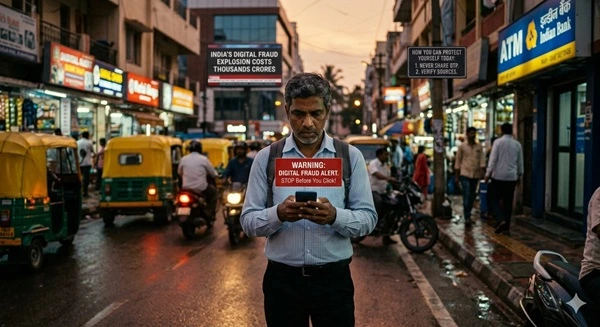
Most Common Digital Frauds in India (And How They Actually Work)
1. UPI & Payment Request Scams
This is one of the most common frauds today.
How it happens:
- You receive a “request” instead of a payment
- Fraudster calls pretending to send money
- Asks you to “approve” or “enter PIN”
- The moment you enter your PIN — money is debited
Reality check:
UPI PIN is only used to send money, never to receive it.
2. Fake Investment & Trading Scams
These scams are exploding right now.
How it happens:
- You see ads on social media promising high returns
- You’re added to WhatsApp or Telegram groups
- “Experts” guide you to invest
- Fake profits are shown initially
- When you try to withdraw — more money is demanded
Investment scams alone account for over 75% of total fraud losses in India.
3. Digital Arrest Scam (New & Dangerous)
This is one of the most shocking frauds.
How it happens:
- You get a call from someone posing as police, CBI, or RBI
- They accuse you of illegal activity
- You’re told you are under “digital arrest”
- You’re threatened and isolated
- Money is transferred under pressure
A recent case showed a victim losing over ₹1 crore in such a scam.
4. KYC Update / Bank Account Freeze Scam
How it happens:
- SMS or call saying your account will be blocked
- Link is shared for “KYC update”
- You enter card details, OTP, or login info
- Account gets emptied instantly
5. Job & Work From Home Scams
How it happens:
- You’re offered easy online work
- Asked to pay a “registration fee”
- Later, more payments are demanded
- No job, no money
6. QR Code Scam
How it happens:
- Fraudster sends QR code saying “scan to receive money”
- You scan and enter PIN
- Money gets deducted
7. SIM Swap Fraud
How it happens:
- Fraudster gets your SIM deactivated
- New SIM is issued in your name
- They gain access to OTPs
- Bank accounts get drained
Why These Frauds Are Increasing So Fast
Let’s be honest.
It’s not just technology — it’s human psychology.
- People trust easily
- Fear tactics work
- Greed for quick returns
- Lack of awareness
On top of that:
- Organized gangs operate across states
- Fake bank accounts & SIMs are used
- Even AI is now being used to create scams faster
What Government & RBI Are Doing to Stop This
India is not ignoring this problem.
Key actions taken:
- National Cyber Crime Reporting Portal launched
- Real-time fraud tracking systems introduced
- ₹660 crore fraud prevented in just 6 months using risk indicators
- Banks mandated to monitor suspicious transactions
- Strict cybersecurity rules by RBI
- Faster complaint resolution timelines (within 90 days)
Also:
- Thousands of cyber criminals are being arrested
- Crores of stolen money are being recovered
But here’s the truth:
Prevention is still your strongest protection.
How You Can Protect Yourself (Practical, No-Nonsense Tips)
Golden Rules You Should Never Break
- Never share OTP with anyone
- Never share UPI PIN — not even with bank staff
- Never click unknown links
- Never install unknown apps
- Never trust “urgent” calls asking for money
Smart Habits That Can Save You
- Always verify before sending money
- Check URLs before entering details
- Use official apps only
- Enable SMS/email alerts
- Keep limits on transactions
Red Flags You Should Never Ignore
- “Act now or account will be blocked”
- “Guaranteed profit”
- “Police case against you”
- “Scan QR to receive money”
If it creates fear or urgency — it’s likely a scam.
If You Become a Victim — ACT FAST
Time is everything here.
Step 1: Call 1930 Immediately
This is India’s cyber fraud helpline.
Step 2: Report Online
Go to the National Cyber Crime Reporting Portal
File complaint under financial fraud
Step 3: Inform Your Bank
- Block account/cards immediately
- Request transaction freeze
Step 4: Preserve Evidence
- Screenshots
- Call logs
- Messages
Things You Should Always Be Aware Of
- Banks never ask for OTP or PIN
- Police never ask money on call
- No legal authority will “digitally arrest” you
- No genuine investment guarantees fixed returns
Final Thoughts: This Is Not Just Cyber Crime — It’s a Trust Crisis
Digital fraud is not just about money.
It’s about:
- Trust being broken
- Fear being exploited
- People losing confidence in digital systems
India is growing digitally — but awareness has to grow faster.
Because at the end of the day:
Fraud doesn’t start with technology.
It starts with one mistake.
And that one mistake… is what you now know how to avoid.
For the latest Trending Reports , Please Visit Popnewsblend.com

Hi, I’m Prashant Jain — a film enthusiast and critic who lives and breathes cinema. From big-screen releases to the latest drops on OTT, I watch extensively and review honestly, without hype or bias.
I believe a good review should go beyond just “good” or “bad.” It should help you understand what works, what doesn’t, and whether a film is truly worth your time. My reviews focus on storytelling, performances, direction, and overall impact — all through the lens of a genuine viewer.
I regularly cover new movie releases and trending web series across OTT, bringing clear, no-nonsense insights for audiences who want real opinions, not paid praise.
Through PopNewsBlend, I aim to cut through the noise and give you reviews you can trust — whether you’re deciding what to watch next or just love discussing cinema as much as I do.
Discover more from Popnewsblend
Subscribe to get the latest posts sent to your email.
Related posts:
 Dreaming of a U.S. Green Card? Here’s the New Citizenship Rule Every Indian Must Know
 Apollo Tyres Takes Over as Indian Cricket Team’s Jersey Sponsor: A Deep Dive
 Fatima Bosch from Mexico Crowned Miss Universe 2025: Complete Highlights, Winner Breakdown, Runners-Up and India’s Final Position
 International Women’s Day 2026: Celebrating the Women Who Are Redefining India’s Entrepreneurial Future