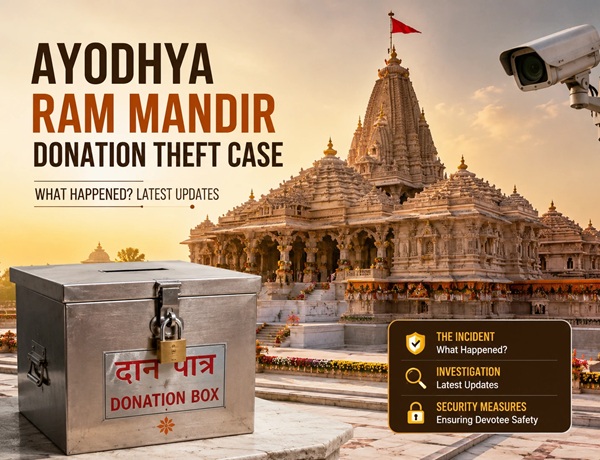
There are very few institutions in India that carry the kind of public trust that the Ram Janmabhoomi Temple in Ayodhya does. Millions of devotees, from daily wage earners to industrialists, have dropped cash, gold, and cheques into its donation boxes since the temple opened its doors in January 2024. So when news broke in June 2026 that crores of rupees from those very donation boxes may have been quietly siphoned off by the people entrusted to count them, it did not just make headlines. It shook something deeper.
This is a running, still-developing case, and new details are surfacing almost every week. Below is a complete, carefully verified account of what has happened so far, who is involved, what the investigation has uncovered, and how the government, the temple trust, and political parties are responding.
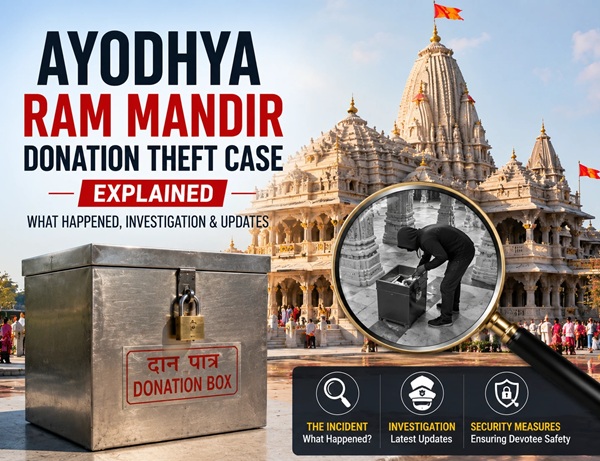
Ayodhya Ram Mandir Donation Theft Case : How the Controversy Began
The story starts on June 7, 2026, when Samajwadi Party leader Tej Narayan “Pawan” Pandey publicly alleged that somewhere between ₹5 crore and ₹7.5 crore had gone missing from the donations collected at the Ram Temple. It was an explosive claim, and one that could not be brushed aside given the temple’s stature and the scale of money flowing through it.
Rather than let the allegation fester, the Ram Janmabhoomi Teerth Kshetra Trust itself requested an official probe. On June 13, 2026, the Uttar Pradesh government responded by setting up a Special Investigation Team, commonly referred to as the SIT, to look into the matter. The SIT spent nearly a week, from June 15 to June 20, examining how donations were being counted, recorded, and deposited. What it found was described as “prima facie irregularities” in the cash-handling process, enough to justify a full criminal investigation.
Based on the SIT’s preliminary findings, a First Information Report, or FIR, was formally registered on June 25, 2026, at the Ram Janmabhoomi police station. The case was booked under several sections of the Bharatiya Nyaya Sanhita dealing with theft, criminal breach of trust, cheating, and criminal conspiracy, along with sections of the Prevention of Corruption Act. That combination of charges makes clear that investigators are not treating this as a simple case of petty theft, but as an organized, deliberate scheme.
Ayodhya Ram Mandir Donation Theft Case: Who Has Been Arrested
A day after the FIR was filed, on June 26, 2026, police arrested eight people, all of whom were directly connected to the temple’s donation cash-counting operations. The accused are:
- Ramshankar Yadav, alias Tinnu Yadav, a resident of Swarg Dwar locality in Ayodhya Dham, who was in charge of overseeing donation boxes and moving them to the counting area in the temple basement. Investigators believe he used the stolen money to buy properties in and around Ayodhya.
- Anukalp Mishra, part of the cash-counting team from Kaushalpuri Colony, who is accused of hiding stolen cash inside a bathroom at his home and building up assets far beyond his known income.
- Lavkush Mishra, another member of the counting staff, who reportedly earned around ₹12,000 a month but somehow built a ₹25 lakh house in his wife’s name. Around ₹12 lakh in cash was found concealed under cow dung at his ancestral home, one of the more striking details to emerge from the raids.
- Subhash Chandra Srivastava, a retired banker and former union leader from Bank Colony, Anjanipuram, who supervised the counting staff and is accused of negligence and complicity in the theft.
- Avinash Shukla, from whose residence investigators recovered a large stash of cash, including thousands of ₹500 notes, along with US dollars, pointing to possible foreign currency conversion.
- Manish Kumar Yadav, Karunesh Pandey, and Ramashankar Mishra, the remaining three among the eight, all linked to the same cash-counting operation.
All eight were first produced before a remand magistrate and sent to three days of judicial custody. That was later extended, and on June 30, 2026, a court in Ayodhya sent all eight to 14 days of judicial custody, with remand running until July 13.
Interestingly, investigators later discovered that six of the eight accused were not directly employed by the temple trust at all. They worked for a private security agency based in Varanasi, Sainik Security Services, which had supplied personnel to the State Bank of India branch operating inside the temple complex for cash-counting duties. This has opened up an entirely new thread of the investigation, since it raises questions about how outsourced, third-party staff ended up handling such large volumes of temple donations with apparently limited oversight.
How Much Money Has Been Recovered
The financial trail uncovered so far paints a picture of fairly brazen embezzlement. As the investigation widened, police carried out raids at the homes of all eight accused, with a revenue official, or Lekhpal, accompanying the teams to ensure transparency. Family members of the accused were also questioned.
According to the latest figures reported by investigators, the total cash recovered has crossed ₹1.4 crore, spread across the residences of the accused. Some of the individual recoveries include:
- Around ₹20 lakh from Avinash Shukla’s home, along with more than 3,600 five-hundred-rupee notes and over a thousand US dollars.
- ₹18 lakh recovered from Karunesh Pandey’s residence.
- ₹16 lakh from Anukalp Mishra’s house.
- ₹12 lakh, hidden under cow dung, from Lavkush Mishra’s ancestral property.
- ₹36 lakh reportedly recovered from Manish Kumar Yadav’s residence.
- Cash, jewellery, and property documents seized from Ramshankar Yadav alias Tinnu Yadav’s home.
Police say that Avinash Shukla had already disclosed information leading to the recovery of nearly ₹89 lakh even before the FIR was formally registered, and a further ₹5 lakh was seized during a raid at a yoga centre linked to his family.
Given the disproportionate assets uncovered relative to the modest salaries these individuals were drawing, roughly ₹20,000 a month in several cases, investigators have now roped in the Income Tax Department to examine bank transactions and are preparing to request an Enforcement Directorate probe into the broader money trail, particularly to establish how the funds were converted into property and other assets.
You May Also Like To Read :
Shakeup Inside the Temple Trust
The case has not stayed confined to the eight arrested individuals. It has also triggered a significant shakeup within the Ram Janmabhoomi Teerth Kshetra Trust itself. Champat Rai, the Trust’s General Secretary and one of the most recognizable faces of the temple’s construction and management, along with trustee Anil Mishra, tendered their resignations on what the Trust described as moral grounds.
The Trust’s treasurer, Swami Govind Dev Giri Maharaj, confirmed that the resignations had been received and said they would be taken up for discussion at the appropriate forum. He also moved to reassure devotees that the donated valuables and offerings held by the temple remain completely safe, and that this case is limited to irregularities in cash handling rather than a breach of the temple’s larger assets.
Adding to the scrutiny, reports indicate that Champat Rai himself was questioned by the SIT for close to three hours as part of the investigation, though sources say several questions put to him went unanswered. His resignation, following that questioning, has fuelled further debate about how much oversight the Trust’s senior leadership had over the day-to-day handling of donations.
The Legal and Political Battle
As the case has grown, it has spilled well beyond the police station and into the courts and the political arena.
The Ayodhya Bar Association made an unusual and firm move, passing a resolution stating that its members would not represent any of the eight accused in court. Lawyers who chose to defy the resolution were warned they could face a fine of ₹5 lakh. This kind of collective stand by a local bar body is relatively rare and reflects how strongly the local legal community feels about the sanctity of the temple’s donations.
Separately, a Public Interest Litigation was filed in the Supreme Court by two advocates, seeking a court-monitored investigation led by the Central Bureau of Investigation rather than the state police. The petitioners argued that the ongoing Uttar Pradesh Police investigation did not inspire confidence and that crucial evidence risked not being properly preserved. However, on June 29, 2026, a Supreme Court bench of Justices M M Sundresh and Sheel Nagu declined to grant an urgent hearing, remarking that the matter did not need to be heard immediately and that nothing drastic would happen if it was taken up once the court resumed regular functioning after the summer break.
On the political front, the case has become a flashpoint between the ruling Bharatiya Janata Party and the opposition in Uttar Pradesh. Samajwadi Party chief Akhilesh Yadav has been particularly vocal, accusing the state’s BJP government of following what he called a “4C formula,” standing for “chanda, chori, chaturai and chalaki,” which translates roughly to donation, theft, cunning, and deceit. He has repeatedly questioned how such large-scale irregularities could occur under the government’s watch and has called for greater transparency in how the investigation is being conducted.
Uttar Pradesh Chief Minister Yogi Adityanath has hit back sharply at these criticisms. Rather than directly engaging with the allegations around the donation case, he challenged Akhilesh Yadav to openly support a similar temple reclamation movement at the Krishna Janmabhoomi site in Mathura, turning the exchange into a broader debate over religious politics in the state.
Meanwhile, the Vishva Hindu Parishad, or VHP, which has been closely associated with the temple’s construction since the beginning, has taken a different position from the PIL petitioners. VHP International President Alok Kumar publicly backed the decision to extend the SIT’s probe by 15 additional days, stating that the police investigation was being conducted transparently and describing the demand for a CBI probe as a political stunt rather than a genuine concern for justice.
Where the Investigation Stands Now
As things stand, here is a snapshot of where the case currently is:
- The SIT’s investigation has been extended by 15 days to allow for a more thorough examination of the money trail, financial records, and the roles of everyone connected to the donation counting process.
- All eight arrested individuals remain in judicial custody until at least July 13, 2026.
- The Income Tax Department has been asked to scrutinize the financial transactions and bank accounts of the accused.
- Police are preparing to seek an Enforcement Directorate investigation to trace how the allegedly stolen money moved through the financial system and into real estate and other assets.
- Investigators are digging deeper into the Varanasi-based security agency that supplied several of the accused as outsourced staff, to understand how vetting and oversight failed at that stage.
- The Supreme Court has left the door open for the PIL seeking a CBI probe to be heard once its summer break ends, meaning the demand for a central investigation has not been closed, only deferred.
- More arrests have not been ruled out, with police saying that questioning of key figures and analysis of financial records are still ongoing.
What This Means Going Forward
What makes this case resonate so widely is not just the amount of money involved, though ₹1.4 crore and counting is no small sum, but the symbolism attached to it. The Ram Mandir was built on decades of public sentiment, legal battles, and, ultimately, enormous voluntary contributions from ordinary devotees who trusted that their money would go toward the temple and its upkeep. An alleged betrayal of that trust by the very staff responsible for counting those donations strikes at something far more emotional than a routine financial crime.
For now, the investigation is very much active. The SIT has been given more time to complete its work, senior figures within the Trust have already stepped down, and the courts and political parties continue to debate how the case should be handled. Whether the final outcome involves a state-led prosecution or an eventual central agency probe, the coming weeks are likely to bring more clarity on how deep the alleged embezzlement actually runs, and who else, if anyone, was involved beyond the eight people currently in custody.
This is a developing story, and given how quickly new details have emerged over the past few weeks, readers following the case should expect further updates as the SIT submits its findings and the courts take up the pending petitions.
Frequently Asked Questions About the Ram Mandir Donation Theft Case
What exactly is the Ram Mandir donation theft case?
It is an ongoing investigation into the alleged embezzlement of donation money collected at the Shri Ram Janmabhoomi Temple in Ayodhya. Allegations first surfaced in June 2026 that several crores of rupees had gone missing from the temple’s donation boxes, allegedly siphoned off by members of the cash-counting staff rather than deposited in full.
When did the case first come to light?
The controversy became public on June 7, 2026, when Samajwadi Party leader Tej Narayan “Pawan” Pandey alleged that between ₹5 crore and ₹7.5 crore was missing from temple donations. The Ram Janmabhoomi Trust itself requested a probe, and the Uttar Pradesh government formed a Special Investigation Team on June 13, 2026.
Who has been arrested in the case?
Eight people connected to the temple’s donation cash-counting operations have been arrested so far: Ramshankar Yadav (alias Tinnu Yadav), Anukalp Mishra, Lavkush Mishra, Subhash Chandra Srivastava, Avinash Shukla, Manish Kumar Yadav, Karunesh Pandey, and Ramashankar Mishra. All eight are currently in judicial custody.
How much money has been recovered so far?
As of the most recent updates, investigators have recovered more than ₹1.4 crore in cash from the residences of the accused, along with foreign currency, jewellery, and property documents. This figure could change as the investigation continues and more financial records are examined.
Were the accused directly employed by the Ram Mandir Trust?
Not all of them. Investigators found that six of the eight accused were actually employed by a Varanasi-based private security agency, Sainik Security Services, which had supplied staff to the State Bank of India branch operating inside the temple complex for cash-counting duties. This outsourcing arrangement is now a key part of the ongoing investigation.
Has anyone in the temple trust leadership resigned over this case?
Yes. Champat Rai, the General Secretary of the Shri Ram Janmabhoomi Teerth Kshetra Trust, and trustee Anil Mishra both resigned on what the Trust described as moral grounds, following questioning by the SIT. The Trust’s treasurer has assured the public that the temple’s donated valuables and offerings remain safe.
Is the Central Bureau of Investigation (CBI) involved in the case?
Not currently. A Public Interest Litigation seeking a CBI-led, court-monitored investigation was filed in the Supreme Court, but on June 29, 2026, the Court declined to grant an urgent hearing, saying the matter could wait until after its summer break. The state-level SIT continues to lead the investigation for now, though the CBI demand has not been permanently ruled out.
What has the Uttar Pradesh government done in response?
The state government formed the SIT to investigate the allegations and has since extended its probe by 15 additional days. Police have also involved the Income Tax Department to examine the accused’s financial transactions and plan to seek an Enforcement Directorate investigation into the broader money trail.
What are political parties saying about the case?
Samajwadi Party chief Akhilesh Yadav has been sharply critical, accusing the ruling BJP government in Uttar Pradesh of what he called a “4C” pattern of donation, theft, cunning, and deceit. Chief Minister Yogi Adityanath has responded by shifting the debate toward a separate temple movement in Mathura rather than directly addressing the allegations. The Vishva Hindu Parishad has backed the state SIT’s investigation and dismissed calls for a CBI probe as politically motivated.
Are the accused proven guilty?
No. As of now, all eight individuals are only accused and are undergoing judicial custody as the investigation continues. Under Indian law, they are presumed innocent until proven guilty in a court of law, and the final outcome of the case will depend on the evidence gathered by investigators and the subsequent trial.
Where can I follow further updates on this case?
Since this is an active investigation, the most reliable way to stay updated is through established Indian news outlets covering Uttar Pradesh and Ayodhya affairs, as well as official statements from the Uttar Pradesh Police, the SIT, and the Ram Janmabhoomi Teerth Kshetra Trust.
Disclaimer: This article is based on ongoing police investigations, court proceedings, and official statements as reported by credible news outlets as of early July 2026. All individuals named in this case are currently under investigation and have only been accused; none have been convicted by any court of law. Under Indian law, every accused person is presumed innocent until proven guilty. This piece is intended purely for informational purposes and does not seek to make any final judgment on the guilt or innocence of any individual named. Details of this case may change as the investigation progresses, and readers are encouraged to follow official updates for the latest developments.
Hi, I’m Prashant Jain — a film enthusiast and critic who lives and breathes cinema. From big-screen releases to the latest drops on OTT, I watch extensively and review honestly, without hype or bias.
I believe a good review should go beyond just “good” or “bad.” It should help you understand what works, what doesn’t, and whether a film is truly worth your time. My reviews focus on storytelling, performances, direction, and overall impact — all through the lens of a genuine viewer.
I regularly cover new movie releases and trending web series across OTT, bringing clear, no-nonsense insights for audiences who want real opinions, not paid praise.
Through PopNewsBlend, I aim to cut through the noise and give you reviews you can trust — whether you’re deciding what to watch next or just love discussing cinema as much as I do.
Discover more from Popnewsblend
Subscribe to get the latest posts sent to your email.
Related posts:
 Dreaming of a U.S. Green Card? Here’s the New Citizenship Rule Every Indian Must Know
 Apollo Tyres Takes Over as Indian Cricket Team’s Jersey Sponsor: A Deep Dive
 Is Diwali Only a Hindu Festival? Exploring the Universal Spirit of the Festival of Lights
 Fatima Bosch from Mexico Crowned Miss Universe 2025: Complete Highlights, Winner Breakdown, Runners-Up and India’s Final Position