

Amarnath Yatra 2026: A Complete Guide to Baba Barfani’s Sacred Abode — Dates, Registration, Route and Everything a Pilgrim Must Know
There’s a moment every Amarnath pilgrim talks about long after they’re home. It isn’t the first glimpse of the cave, and it isn’t even the darshan of the ice lingam itself. It’s the moment somewhere on the climb — cold wind cutting through your jacket, legs burning, breath short in the thin mountain air — when you stop complaining and start chanting instead. Something shifts. The mountain has a way of stripping away everything except faith.
If you’ve felt the pull to do this yatra in 2026, you’re not alone. Lakhs of devotees make this journey every year to seek the blessings of Baba Barfani, and the registration window for Amarnath Yatra 2026 is open right now. So let’s walk through everything you need to know — practically and spiritually — before you take this journey to Lord Shiva’s Himalayan abode.
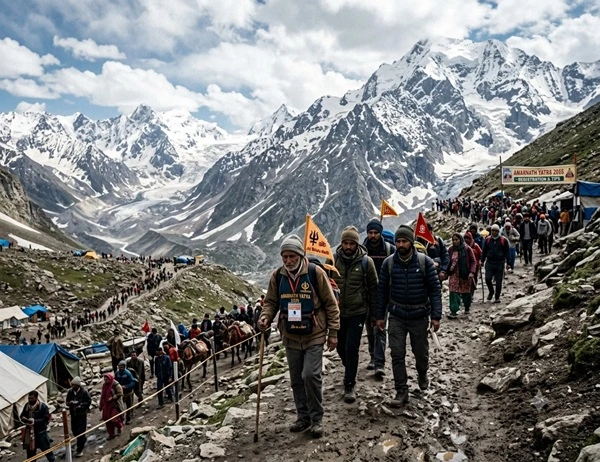
What Is the Amarnath Yatra, Really
Deep in the Kashmir Himalayas, at a height of nearly 3,888 metres, sits a cave that Hindus consider one of the most sacred sites in the world. Inside it, an ice formation rises naturally from the cave floor — the Amarnath Shivling, popularly called Baba Barfani. It waxes and wanes with the lunar cycle, growing and shrinking through the yatra season, and devotees believe it is Lord Shiva himself, manifesting in his most elemental form: ice, born of the mountain, melting back into it.
According to legend, this is the very cave where Lord Shiva narrated the secret of immortality — the Amar Katha — to Goddess Parvati. To ensure no living being overheard this secret, Shiva is said to have shed every companion along the way: he left his bull Nandi at Pahalgam, released the moon from his hair at Chandanwari, let go of the snakes around his neck at Sheshnag, abandoned his son Ganesha at Mahagunas Top, and finally left behind the five elements at Panchtarni before entering the cave. Even today, a pair of pigeons is said to be spotted near the cave — believed to be the same divine birds who overheard Shiva’s secret and were blessed with immortality for it.
That story is the soul of this yatra. The trek itself is the body.
You May Also Like:
Amarnath Yatra 2026 Dates
This year’s yatra is scheduled to begin on 3rd July 2026 and conclude on 28th August 2026, running for 57 days. It’s no coincidence that the yatra closes on Raksha Bandhan — the final day coincides with the sacred Shravan Purnima, when the Chhari Mubarak, the holy ceremonial mace, reaches the cave to mark the symbolic end of the pilgrimage season.
Before all this, the Pratham Pujan — the first ceremonial worship seeking Shiva’s blessings for a safe and smooth yatra — takes place a little earlier, setting the spiritual tone for the entire season.
If you’re trying to decide when within this window to go, here’s a tip pilgrims who’ve done this before will tell you: the early weeks of July tend to be a sweet spot. The trails are usually a little less crowded than peak season, the ice lingam is closer to its fullest form before the warmer weather causes it to shrink, and the weather is generally more stable than later in August when the monsoon can complicate the climb.
Registration for Amarnath Yatra 2026 — How and Where
Registration is not optional. No pilgrim is allowed onto either route without a valid Yatra Permit, a Compulsory Health Certificate, and an RFID card. The Shri Amarnathji Shrine Board (SASB) takes this seriously, and for good reason — this is a high-altitude trek, and the systems exist to keep pilgrims safe.
Advance registration for 2026 first opened back in April, and a further registration window has now opened from 3rd July to 12th August 2026, with additional registration becoming available in due course beyond that. If you haven’t registered yet, this is your window — don’t wait until the last moment, because daily pilgrim quotas apply on both routes, and slots for your preferred dates can fill up.
Online registration is the easiest route for most people. Head to the official SASB website (jksasb.nic.in) or use the official “Shri Amarnathji Yatra” mobile app. You’ll need to create an account, fill in your personal details, upload a valid photo ID (Aadhaar is accepted), a passport-size photograph, and your Compulsory Health Certificate. Then select your preferred route — Baltal or Pahalgam — and your travel date, pay the registration fee, and download your permit.
Offline registration is available too, at over 550 designated bank branches across the country, including SBI, Punjab National Bank, J&K Bank, and Yes Bank. This option works well if you’d rather have someone walk you through the paperwork in person.
The registration fee is ₹150 per pilgrim. Keep this in mind: registrations typically close about a week before your intended start date, so don’t cut it close.
A note for those travelling from abroad or applying as part of a group — there’s a separate application form for Group and NRI/Ex-India Pilgrims/Foreign Nationals, available on the official portal.
The Compulsory Health Certificate — Don’t Skip This
This is where a lot of devotees get caught off guard. The CHC isn’t a formality — it genuinely is your fitness clearance for a demanding high-altitude trek, and the Shrine Board is strict about it. For 2026, your certificate needs to be issued on or after 8th April 2026 by an authorised doctor, with your photograph properly attested. Without this, your registration simply won’t be processed.
If you have any pre-existing health conditions — heart issues, respiratory problems, high blood pressure — be completely honest with your doctor during this check-up. The mountain doesn’t care how much faith you carry if your body isn’t ready for the altitude.
Choosing Your Route: Pahalgam or Baltal
This is probably the single biggest decision you’ll make for this yatra, and it deserves real thought rather than picking whichever sounds more convenient.
The Pahalgam Route is the traditional path, roughly 46–48 kilometres long, starting from Nunwan in Anantnag district. It’s longer, but it’s also gentler — spread across 3 to 5 days, which gives your body time to acclimatize gradually as you pass through legendary stops like Chandanwari, Sheshnag, and Panchtarni. Each of these isn’t just a campsite; it’s a place tied directly to the Shiva legend. This route is widely recommended for first-timers, families, and anyone not used to high-altitude trekking, simply because the gradual ascent is far easier on the body and significantly reduces the risk of altitude sickness.
The Baltal Route is the shorter alternative — about 14 kilometres from Baltal near Sonamarg in Ganderbal district. It can technically be completed in a single day, which sounds appealing until you realise that’s because it’s steep, fast, and far more physically demanding. There’s no gradual acclimatization built in here. This route suits pilgrims who are already very fit, experienced with mountain treks, and pressed for time.
Both routes converge near the final stretch and lead to the same destination — the cave, about 6 kilometres from Panchtarni.
One important update for 2026: helicopter services will not be available this year. SASB has declared the entire yatra area a “No Flying Zone” from 1st July until the yatra concludes, so this season, every pilgrim travels on foot, pony, or palki. Plan your physical preparation accordingly — there’s no shortcut option this time.
Who Can Undertake the Yatra, and Who Should Wait
The SASB enforces age and health limits strictly, and they won’t register you outside these limits even with a medical certificate, because the physical demands of the trek are genuinely serious at this altitude.
Pilgrims between 13 and 70 years of age are eligible to register, provided they’re medically fit and carry a valid Compulsory Health Certificate.
Women who are pregnant beyond six weeks of gestation are not permitted to undertake the yatra, for their own safety and that of the child — the altitude and physical strain pose real risks.
If you have serious heart conditions, chronic respiratory illness, or other conditions your doctor flags as high-risk at altitude, please listen to that advice. Devotion doesn’t require you to ignore your body’s limits — Shiva understands surrender, not recklessness.
How to Prepare for the Yatra — Body, Mind and Soul
Physical preparation should start at least 4 to 6 weeks before you leave, not the week before. Build up your stamina with daily walks, stair climbing, and light cardio. If you can, practice walking with a loaded backpack so your body gets used to carrying weight uphill. Breathing exercises — even simple pranayama — genuinely help your lungs adapt to working harder for oxygen, which matters a lot at this altitude.
Acclimatization matters more than most people realize. Spend at least a day in Srinagar or your base camp before starting the actual trek, letting your body adjust to the altitude before you push it further. Rushing this step is one of the most common reasons pilgrims struggle with altitude sickness.
What to pack matters because weather here changes without warning. Carry warm layered clothing (temperatures can fall sharply even in July and August), a good waterproof jacket, sturdy trekking shoes that are already broken in (never wear new shoes for this), trekking poles, a torch, a basic first-aid kit, and your registration documents in a waterproof pouch. Carry dry fruits and energy snacks — you’ll want quick fuel on the climb, and langars along the route, while generous, shouldn’t be your only plan.
Mentally and spiritually, many pilgrims find it helpful to begin a simple daily practice in the weeks before departure — chanting “Om Namah Shivaya,” reading about the legend of the cave, or simply sitting in quiet reflection. The yatra tests your body, but it rewards a mind that’s already turned inward.
Where the Yatra Begins and How to Reach the Base Camps
Most pilgrims fly into Srinagar, which has the nearest major airport, or travel up via Jammu by road or rail before continuing onward. From Srinagar or Jammu, you’ll head to your chosen base camp — Pahalgam if you’ve selected that route, or Baltal/Sonamarg if you’ve chosen the shorter path. Local transport, shared taxis, and SASB-arranged transit camps make this last stretch manageable, but book your stay near the base camp in advance during peak season, since accommodation fills up fast.
After registering, remember you’ll also need to collect your RFID card from designated centers in Jammu or Kashmir before you actually begin the trek — this card isn’t optional either; it’s how the Shrine Board tracks pilgrim safety along the route.
A Few Things the Mountain Asks of You
This yatra passes through a fragile Himalayan ecosystem, and the Shrine Board is firm about a few rules that exist for everyone’s safety and the sanctity of the region. Never attempt shortcuts on the route, however tempting they look — the terrain here has claimed lives precisely because of this. Avoid carrying or using plastic anywhere in the yatra area; it’s banned and punishable by law. And try to leave the trail exactly as you found it — no littering, no disturbing the environment that millions of pilgrims will walk through after you.
Final Thoughts
The Amarnath Yatra isn’t really about reaching a cave. It’s about what happens to you on the way there — the exhaustion that turns into surrender, the strangers who become family over a shared cup of tea at a langar tent, the silence at 13,000 feet that somehow says more than any prayer you know by heart. If you’re called to make this journey in 2026, register early, prepare seriously, respect the mountain, and go with an open heart. Baba Barfani has been waiting in that cave for devotees far longer than any of us have been alive — he’ll be there when you arrive too.
Har Har Mahadev.
Frequently Asked Questions
When does Amarnath Yatra 2026 start and end? The yatra begins on 3rd July 2026 and concludes on 28th August 2026, running for a total of 57 days, ending on Raksha Bandhan.
Where can I register for Amarnath Yatra 2026? You can register online through the official SASB website (jksasb.nic.in) or the official mobile app, or offline at over 550 designated bank branches including SBI, PNB, J&K Bank, and Yes Bank.
Has registration for Amarnath Yatra 2026 started? Yes. Advance registration opened earlier in April 2026, and a further registration window is currently open from 3rd July to 12th August 2026, with more slots expected to open in due course.
What is the registration fee for Amarnath Yatra 2026? The registration fee is ₹150 per pilgrim.
What documents do I need to register? A valid government photo ID (Aadhaar, passport, voter ID, or driving license), a passport-size photograph, and a Compulsory Health Certificate (CHC) issued on or after 8th April 2026 by an authorised doctor.
Who can undertake the Amarnath Yatra? Pilgrims between the ages of 13 and 70 who are medically fit and hold a valid CHC can register for the yatra.
Who cannot undertake the yatra? Pregnant women beyond six weeks of gestation are not permitted, and anyone with serious heart, lung, or other high-risk medical conditions should consult their doctor seriously before attempting this high-altitude trek.
Which route is better — Baltal or Pahalgam? The Pahalgam route (about 46–48 km, 3–5 days) is longer but gentler, and is generally recommended for first-time pilgrims and families. The Baltal route (about 14 km) is shorter but much steeper, suited to fit, experienced trekkers.
Is helicopter service available for Amarnath Yatra 2026? No. SASB has declared the entire yatra area a No Flying Zone from 1st July 2026 until the yatra ends, so helicopter services are not available this season. Pilgrims can travel only on foot, pony, or palki.
What is the RFID card and is it mandatory? Yes, it’s mandatory. The RFID card is a tracking device issued after registration that helps the Shrine Board monitor pilgrim safety along the route. It must be collected before starting the trek.
How should I prepare physically for the yatra? Start building stamina at least 4–6 weeks in advance with walking, stair climbing, and light cardio, practice walking with a loaded backpack, and spend at least a day acclimatizing at your base camp before beginning the actual trek.
What should I pack for the Amarnath Yatra? Warm layered clothing, a waterproof jacket, broken-in trekking shoes, trekking poles, a torch, a basic first-aid kit, energy snacks, and your registration documents kept in a waterproof pouch.
Can foreign nationals or NRIs participate in the yatra? Yes, there’s a separate application form available on the official SASB portal for group pilgrims, NRIs, and foreign nationals.
What is the best time within the yatra season to go? The early weeks of July are often considered ideal — trails are comparatively less crowded, the ice lingam tends to be fuller, and weather is typically more stable than later in the season.

Hi, I’m Prashant Jain — a film enthusiast and critic who lives and breathes cinema. From big-screen releases to the latest drops on OTT, I watch extensively and review honestly, without hype or bias.
I believe a good review should go beyond just “good” or “bad.” It should help you understand what works, what doesn’t, and whether a film is truly worth your time. My reviews focus on storytelling, performances, direction, and overall impact — all through the lens of a genuine viewer.
I regularly cover new movie releases and trending web series across OTT, bringing clear, no-nonsense insights for audiences who want real opinions, not paid praise.
Through PopNewsBlend, I aim to cut through the noise and give you reviews you can trust — whether you’re deciding what to watch next or just love discussing cinema as much as I do.
Discover more from Popnewsblend
Subscribe to get the latest posts sent to your email.
Related posts:
 International Yoga Day 2025: A Global Celebration of Mind-Body Harmony
 Is Diwali Only a Hindu Festival? Exploring the Universal Spirit of the Festival of Lights
 Vishu Festival 2026: Meaning, Significance, Rituals, Celebrations & Traditions Explained
 Char Dham Yatra 2026: A Divine Journey Begins on Akshaya Tritiya – A Shiv Bhakt’s Calling


Pingback: Ayodhya Ram Mandir Donation Theft Case Explained: Latest Updates