
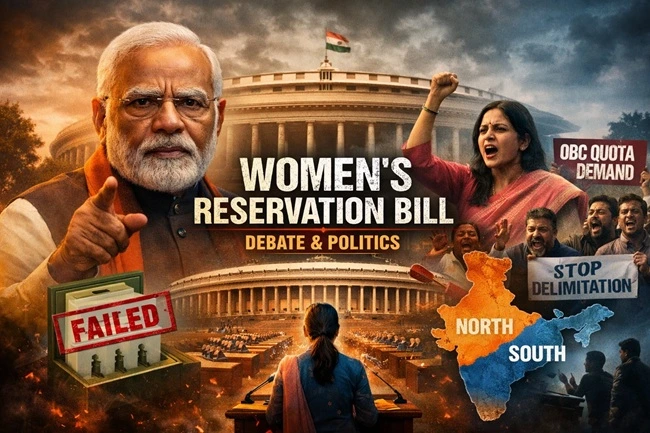
Why Women’s Reservation Bill 2026 Debate Is Bigger Than It Looks
What if one decision in Parliament could change who holds power in India for the next 20–30 years?
That’s exactly why the recent debate around the Women’s Reservation Bill has grabbed national attention—and sparked one of the most intense political face-offs in recent times.
At first glance, it sounds simple: give 33% reservation to women in Parliament. A long-pending reform, a step toward equality, something almost everyone agrees on. But when the bill was finally brought to the table, it didn’t pass. Not because India rejected women’s empowerment—but because the politics behind it became far more complicated than the idea itself.
- Why did it fail despite strong support?
- Why are opposition parties protesting something they’ve demanded for years?
- Why is there suddenly a debate about North vs South?
- And most importantly—what’s the real game being played behind the scenes?
This isn’t just about a bill anymore. It’s about power, elections, strategy, and the future shape of Indian politics.
Let’s break it all down in the simplest way possible.
What Did the Government Actually Propose in Women’s Reservation Bill?
The proposal brought forward by the government led by Narendra Modi and the Bharatiya Janata Party was not just a standalone women’s reservation move.
It combined multiple major structural changes.
1. 33% Reservation for Women
- One-third of seats in Lok Sabha and state assemblies reserved for women
This aligns with the already passed framework of the Constitution (One Hundred and Sixth Amendment) Act, 2023.
2. Expansion of Lok Sabha Seats
- Proposal to increase seats from 543 to over 800 in future
This is linked to population growth and representation.
3. Delimitation of Constituencies
- Redrawing electoral boundaries based on updated population data
- Redistribution of seats across states
4. Conditional Implementation
The reservation would only be implemented:
- After the next census
- After delimitation exercise
This condition became the biggest point of conflict.
Why Did the Bill Fail in Parliament?
This is where the situation becomes very important.
For a constitutional amendment to pass:
- It requires a two-thirds majority in Parliament
What happened during voting:
- Votes in favour: 298
- Votes against: 230
- Required majority: Around 362 votes
The bill failed to pass because it did not meet the required majority.
Why Did Opposition Parties Oppose It?
Here’s the reality—opposition parties were not rejecting women’s reservation. They were rejecting the structure and timing of the proposal.
Key parties raising concerns included the Indian National Congress, Samajwadi Party, and Rashtriya Janata Dal.
Let’s understand their demands clearly.
1. Immediate Implementation
Opposition’s biggest point:
- Apply 33% reservation in the current Lok Sabha itself
- Do not delay it with census and delimitation
Their argument:
“If the intent is genuine, why wait?”
2. Remove Delimitation Link
They strongly objected to combining:
- Women’s reservation
- Seat redistribution
Concern:
This changes the entire political balance of the country, not just representation.
3. Reservation Within Reservation (OBC Women)
Opposition demanded:
- Specific quota for OBC women
Their concern:
Without this, representation may go mainly to socially and politically stronger groups.
4. Fear of Political Advantage
Opposition accused the government of:
- Using delimitation to reshape electoral power
- Creating long-term structural advantage
This is where the discussion becomes more strategic.
For the Latest Trending News, Please Follow Popnewsblend.com
The “Real Math” Behind the Bill
Let’s simplify the political calculation behind all this.
1. Seat Expansion Impact
If Lok Sabha expands:
- More seats will be allocated based on population
States with higher population gain more representation.
2. BJP’s Strong Regions
The Bharatiya Janata Party has strong presence in:
- Uttar Pradesh
- Bihar
- Madhya Pradesh
- Rajasthan
These are high-population states.
More seats here = potential long-term political advantage.
3. Coalition Reality After 2024 Elections
After the 2024 Indian General Election:
- BJP did not get full majority on its own
- It depended on allies
This made passing a constitutional amendment much harder
Even small opposition resistance became decisive
Why Is There a “North vs South Divide” Debate?
This is one of the most sensitive aspects of the entire issue.
What Happens After Delimitation?
Seats in Parliament are allocated based on population.
- Northern states → higher population → more seats
- Southern states → controlled population → relatively fewer seats
Why Southern States Are Concerned
States like Tamil Nadu and Kerala argue:
- “We controlled population growth successfully”
- “Now we are being penalized for it”
Their fear:
Loss of political influence at the national level.
Why It Became Linked to This Bill
Since the bill depends on delimitation:
- It indirectly triggers this regional imbalance debate
That’s why opposition strongly resisted the linkage.
What Did PM Narendra Modi Say After the Bill Failed?
After the bill did not pass, Narendra Modi responded strongly.
Key points from his reaction:
- He expressed disappointment over the outcome
- Emphasised commitment to women’s empowerment
- Criticised opposition for blocking the proposal
- Reaffirmed focus on “Nari Shakti” (women-led development)
The tone was clear:
Government will continue pushing for women’s political representation
What Was Said in Mann Ki Baat?
In his radio program Mann Ki Baat, the Prime Minister has repeatedly highlighted:
- Importance of women in nation-building
- Growing role of women in governance and leadership
- Need to create more opportunities for women
While not focused on parliamentary voting details, the messaging has been consistent:
India’s growth is incomplete without women’s leadership.
How Will This Affect Upcoming Elections?
This is where the political impact becomes very clear.
1. Women Voters Become the Key Focus
Women voters are now:
- More aware
- More active
- More decisive
This issue will strongly influence voting patterns.
2. BJP’s Likely Strategy
Even though the bill failed, BJP can project:
- “We tried to bring reservation”
- “Opposition stopped it”
This creates a strong emotional narrative.
3. Opposition’s Counter Strategy
Opposition will respond with:
- “We support reservation”
- “We opposed delay and political manipulation”
Their narrative:
“Implement it honestly, not strategically.”
4. Regional Politics Will Intensify
The North vs South issue may:
- Gain more attention
- Influence alliances and campaigns
What Real Change Could This Bill Bring (If Passed)?
If implemented properly:
1. Representation Boost
Women MPs could rise from ~15% to 33%.
2. Policy Impact
More focus on:
- Health
- Education
- Women safety
- Social welfare
3. Leadership Pipeline
More women leaders at national and state levels.
4. Cultural Shift
Gradual change in political mindset and participation.
Key Challenges That Still Remain
Even beyond politics:
- Delay due to census and delimitation
- No clarity on timeline
- Debate over OBC inclusion
- Risk of proxy candidates
- Rotation of seats affecting continuity
Final Conclusion
The Women’s Reservation Bill is no longer just about giving seats to women.
It has become a powerful mix of:
- Social reform
- Political strategy
- Regional balance
- Electoral calculations
Everyone agrees on one thing—women deserve greater representation.
But the disagreement lies in:
- When it should happen
- How it should happen
- And who benefits from it
Until these questions are resolved, this issue will remain at the center of India’s political conversation—especially during elections.
Detailed FAQ
1. What is the Women’s Reservation Bill?
It proposes 33% reservation for women in Lok Sabha and state assemblies.
2. Why did it fail in Parliament?
It did not get the required two-thirds majority.
3. Is the opposition against women reservation?
No. They support it but oppose the current structure and delay.
4. What is delimitation?
It is the process of redrawing electoral boundaries based on population.
5. Why is delimitation controversial?
It can shift political power between regions, especially North and South India.
6. What did PM Modi say after the failure?
He expressed disappointment and reiterated commitment to women empowerment.
7. Will the bill come again?
Very likely, especially before future elections.
8. How will this impact voters?
Women voters will become even more important in shaping election outcomes.

Hi, I’m Prashant Jain — a film enthusiast and critic who lives and breathes cinema. From big-screen releases to the latest drops on OTT, I watch extensively and review honestly, without hype or bias.
I believe a good review should go beyond just “good” or “bad.” It should help you understand what works, what doesn’t, and whether a film is truly worth your time. My reviews focus on storytelling, performances, direction, and overall impact — all through the lens of a genuine viewer.
I regularly cover new movie releases and trending web series across OTT, bringing clear, no-nonsense insights for audiences who want real opinions, not paid praise.
Through PopNewsBlend, I aim to cut through the noise and give you reviews you can trust — whether you’re deciding what to watch next or just love discussing cinema as much as I do.
Discover more from Popnewsblend
Subscribe to get the latest posts sent to your email.
Related posts:
 Dreaming of a U.S. Green Card? Here’s the New Citizenship Rule Every Indian Must Know
 Apollo Tyres Takes Over as Indian Cricket Team’s Jersey Sponsor: A Deep Dive
 Fatima Bosch from Mexico Crowned Miss Universe 2025: Complete Highlights, Winner Breakdown, Runners-Up and India’s Final Position
 Asha Bhosle (1933–2026): A Voice That Defined Generations, A Legacy That Will Never Fade


Pingback: WhatsApp Username Feature Delayed: Why India Put It on Hold