
It is two in the morning. You tiptoe into your child’s room for the fifth time that night, gently pull the blanket back over their tiny shoulders, and creep back to bed, hoping this time it sticks. Twenty minutes later, you hear the familiar rustle. You peek in again. The blanket is somewhere near their feet, half on the floor, and your child is sleeping like nothing happened at all.
If this sounds painfully familiar, take a breath. You are not doing anything wrong, your child is not being difficult on purpose, and no, there is nothing broken about your parenting. This is one of the most common, most universal, and most misunderstood sleep struggles that almost every parent goes through at some point. And once you understand what is actually happening inside your child’s body while they sleep, the whole thing starts to make a lot more sense.
Let us actually get into it.
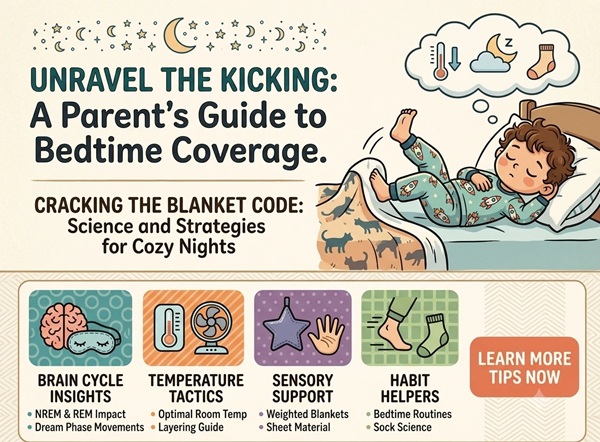
It Is Not Just A Habit, It Is Biology
Most parents assume their kid is simply restless, or maybe just does not like being covered. But the truth is far more interesting than that, and it has almost nothing to do with willpower or preference. It comes down to how a child’s body regulates temperature, and how differently that process works compared to adults.
Kids Run Warmer Than Adults, Literally
Children have a higher metabolic rate than adults. Their little bodies are working overtime, growing, repairing, building bone and muscle, and all of that activity generates heat. On top of that, kids have a larger surface area to body weight ratio compared to grown-ups, which means heat escapes their bodies faster too. Put those two things together, and you get a small human who heats up quickly and needs to release that heat just as quickly to stay comfortable.
So when your child kicks off the blanket in the middle of the night, their body might genuinely be doing exactly what it is supposed to do, cooling itself down before it gets uncomfortably warm.
Their Thermoregulation System Is Still A Work In Progress
Thermoregulation is the fancy term for how the body keeps its internal temperature steady, no matter what is happening outside. In adults, this system is fully developed and works quietly in the background all night. In young children, especially toddlers and preschoolers, this system is still maturing.
Because their internal thermostat has not fully calibrated yet, kids tend to swing between feeling too warm and needing to cool off, which very often means physically kicking away anything covering them, even if the room itself is not particularly hot.
Sleep Cycles Play A Bigger Role Than You Think
Here is something most parents never realise. Kids spend more time in lighter stages of sleep and in REM sleep compared to adults, especially in the first few years of life. REM sleep is the stage associated with dreaming, and it comes with a very specific physical trait, increased movement and twitching.
During REM cycles, muscle activity briefly increases even though the body is technically resting, and this is often when you will see arms flailing, legs kicking, and blankets migrating clear across the bed. It is not restlessness in the way we usually think about it. It is simply what an active, developing brain looks like while it processes and dreams.
Growth Spurts Make It Worse
If you have noticed your child kicking off blankets more aggressively during certain weeks and then settling down again, growth spurts are very likely the reason. Growth hormone is released in bursts during deep sleep, and this process itself can raise body temperature slightly and increase physical restlessness during the night. So those particularly wild, blanket-flinging nights you have noticed right before a growth spurt or a jump in shoe size are not a coincidence at all.
Don’t Miss out on more interesting parenting tips , follow us on Instagram
Other Reasons Your Child Might Be Throwing Off The Blanket
Beyond the core biology, there are a handful of everyday factors that make the kicking worse, and thankfully, these are things you can actually control.
The room is warmer than it feels to you. Adults often keep bedrooms slightly warmer than what is ideal for a child’s comfort. What feels just right to you as you tuck them in might already feel too warm for their faster-heating little body an hour later.
The blanket itself is the wrong material. Heavy, non-breathable fabrics trap heat rather than letting it escape, which means a child will naturally push it away the moment they start warming up.
Overdressing at bedtime. A cosy fleece onesie under a thick blanket is a common recipe for a hot, uncomfortable child who kicks everything off within the first sleep cycle.
Sensory sensitivity. Some children are simply more sensitive to the feeling of fabric against their skin, and a blanket that feels heavy, scratchy, or restrictive can trigger an almost automatic urge to push it away, even in their sleep.
Illness or fever. If the blanket-kicking has suddenly become extreme, paired with flushed cheeks, sweating, or a warm forehead, it is worth checking your child’s temperature, since fever significantly increases how much a child needs to cool off during sleep.
So What Actually Works? Practical, Tested Solutions
Now for the part every tired parent actually wants, real solutions that make a genuine difference, not just another blanket rearranging ritual at midnight.
Try A Wearable Blanket Or Sleep Sack
This is, hands down, the most effective fix for younger children. A sleep sack or wearable blanket cannot be kicked off because it is worn like a garment rather than laid on top of the body. It keeps a consistent, safe level of warmth throughout the night without needing to stay in one position, which solves the entire problem at its root.
Get The Room Temperature Right, Not Just Comfortable For You
A slightly cooler room, generally recommended in the range of 20 to 22 degrees Celsius for most children, tends to support deeper, more uninterrupted sleep. Instead of relying on how the room feels to you as an adult, use a simple room thermometer to keep it consistent night after night.
Dress For The Room, Not For Extra Warmth
Light, breathable sleepwear made from cotton or bamboo fabric works far better than heavy fleece pajamas in most home environments. A simple rule many sleep experts recommend is dressing your child in roughly one layer more than you would wear yourself for the same room temperature, not several layers more.
Choose Breathable Bedding Materials
Cotton, muslin, and bamboo fabrics allow heat and moisture to escape far more effectively than synthetic or heavily quilted materials. Lighter, breathable blankets are far less likely to be kicked away simply because they do not trap heat in the first place.
Layer Instead Of Using One Heavy Blanket
Rather than one thick blanket, try two lighter layers instead. This way, if your child kicks off the outer layer, they are still left with a lighter layer of warmth rather than being completely uncovered.
For Older Kids, Consider A Weighted Blanket
For children generally above the age of two, and only after checking with your pediatrician about appropriate weight and safety guidelines, a lightweight weighted blanket can sometimes help by providing gentle, even pressure that some children find calming and are less likely to push away compared to a traditional loose blanket.
Keep A Consistent Bedtime Routine
A calm, predictable wind-down routine helps regulate a child’s nervous system before sleep, which in turn can reduce excessive movement during the night. Consistency in bedtime, lighting, and pre-sleep activities genuinely does make a measurable difference over a few weeks.
When To Actually Talk To Your Pediatrician
In most cases, blanket-kicking is completely normal and nothing to worry about. However, it is worth mentioning it to your child’s doctor if it comes with heavy night sweating regularly, if your child seems unusually restless every single night without improvement, or if you notice it alongside other symptoms like frequent waking, snoring, or breathing difficulty during sleep.
The Bigger Picture Every Parent Needs To Hear
Here is the honest truth that often gets lost in all the sleep advice out there. Your child kicking off their blanket at night is, in the vast majority of cases, a sign of a healthy, actively developing body doing exactly what it is designed to do. It is not a parenting failure, it is not a sign that something is wrong, and it is definitely not something that will last forever.
As their thermoregulation system matures over the next few years, this phase naturally settles down on its own. In the meantime, the goal is not to win a nightly battle against a blanket, it is to set up their sleep environment so that whether the blanket stays on or ends up on the floor, your child stays safe, comfortable, and gets the deep, restorative sleep growing bodies need so much.
So the next time you walk in at 2 a.m. to find that blanket kicked halfway across the room, you can smile a little instead of sighing. It is not a losing battle. It is just biology doing its job.
Frequently Asked Questions
Why does my toddler kick off the blanket every single night? This is mostly due to their higher body heat production, an immature thermoregulation system, and increased movement during lighter stages of sleep, all of which are completely normal for young children.
Is it safe for my baby or toddler to sleep without a blanket? For infants under 12 months, loose blankets are generally not recommended due to suffocation risk, and a wearable sleep sack is the safer alternative. For toddlers, sleeping without a blanket for part of the night is usually not harmful as long as the room temperature is appropriate.
What is the ideal room temperature to stop a child from kicking off the blanket? Most sleep guidelines recommend keeping a child’s bedroom between 20 and 22 degrees Celsius, cooler than many parents assume is comfortable.
Do weighted blankets actually help kids stop kicking off their covers? For children above the recommended age, usually two years and older, and used at the correct weight, some children do respond well to the calming pressure of a lightweight weighted blanket. Always confirm suitability with a pediatrician first.
At what age do kids stop kicking off their blankets? There is no fixed age, but many parents notice significant improvement as a child’s nervous system and thermoregulation matures, often somewhere between five and eight years old, though it varies widely from child to child.
Could my child kicking off the blanket be a sign of a health problem? In most cases, no. However, if it is paired with heavy sweating, frequent night waking, snoring, or visible discomfort every night, it is worth discussing with your pediatrician.
What is the best type of blanket for a child who kicks covers off constantly? A sleep sack or wearable blanket tends to work best for younger children since it cannot physically be kicked away, while lightweight, breathable cotton blankets work well for older kids who sleep under traditional bedding.
Does overdressing my child at bedtime make blanket kicking worse? Yes, overdressing is one of the most common and easily fixable causes. Lighter sleepwear paired with an appropriately cool room usually reduces the need for a child to kick off their covers.

Hi, I’m Prashant Jain — a film enthusiast and critic who lives and breathes cinema. From big-screen releases to the latest drops on OTT, I watch extensively and review honestly, without hype or bias.
I believe a good review should go beyond just “good” or “bad.” It should help you understand what works, what doesn’t, and whether a film is truly worth your time. My reviews focus on storytelling, performances, direction, and overall impact — all through the lens of a genuine viewer.
I regularly cover new movie releases and trending web series across OTT, bringing clear, no-nonsense insights for audiences who want real opinions, not paid praise.
Through PopNewsBlend, I aim to cut through the noise and give you reviews you can trust — whether you’re deciding what to watch next or just love discussing cinema as much as I do.
Discover more from Popnewsblend
Subscribe to get the latest posts sent to your email.
Related posts:
 How to Reduce Screen Time for Kids Without Stress: A Friendly Parent’s Guide
 Mental Health of Kids: Are We Failing Them by Not Talking About It Early?
 How To Protect Kids From Bullying : A Parent’s Guide to Understanding, Preventing, and Responding the Right Way
 Helping Your Child Overcome Fear: A Parent’s Guide to Raising a Confident, Emotionally Secure Kid