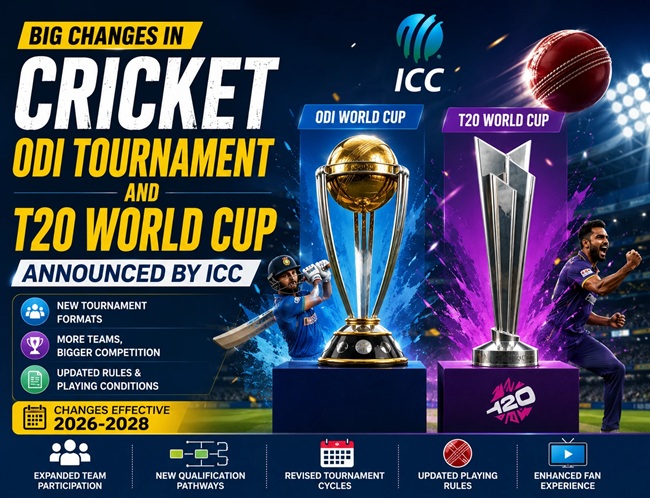
If you’ve watched even one cricket highlights reel in the last few weeks, you’ve probably seen people arguing about “Super Series,” “Super 7,” and whether India and Pakistan might actually play each other three times in a single World Cup. That last bit alone is enough to make any cricket fan sit up, because it has literally never happened before.
I’ve been following ICC tournament structures and playing condition tweaks for years now, mostly because they quietly decide how exciting or dull a tournament ends up being, and this round of changes is genuinely one of the biggest the sport has seen in a decade. We’re not talking about a minor tweak to net run rate. We’re talking about a completely reworked path to the trophy for both the ODI World Cup and the T20 World Cup, plus a fresh batch of playing condition changes that will affect everything from how bowlers get punished for slow over rates to how a boundary catch is judged.
So let’s break all of it down properly, in plain language, the way I’d explain it to a friend who just wants to know what’s actually different and why it matters.
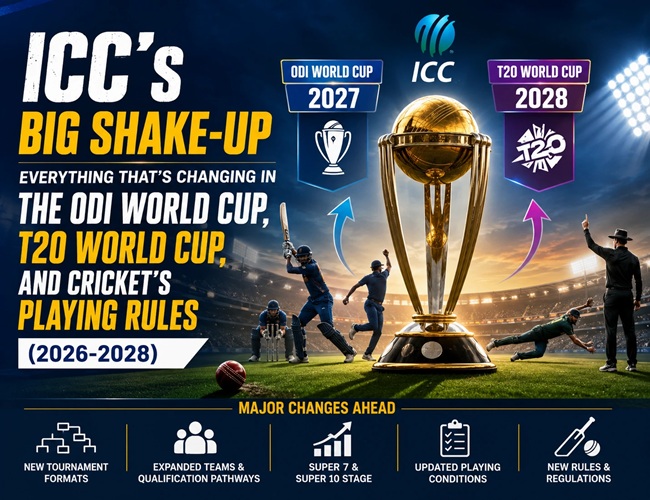
Why did the ICC even bother changing the format?
Cricket administrators have been chewing on this problem for a while: how do you keep a 14-team tournament exciting for six weeks without either boring people with lopsided group games or making the whole thing feel like a lottery? The old ODI World Cup format (used in 2023) had all 10 teams play each other once in a giant round robin, and then the top four went to the semis. It worked reasonably well with 10 teams, but once the ICC decided to expand back to 14 teams for the 2027 edition in South Africa, Zimbabwe, and Namibia, a straight round robin with 14 sides would have meant a brutal, months-long slog, with plenty of matches between minnows and top sides that nobody outside those two teams particularly cared about.
The fix the ICC landed on borrows a bit from football tournaments and a bit from franchise cricket. It layers the competition into stages, each one trimming the field and raising the stakes, while still guaranteeing every team a real shot at qualifying on merit rather than by name alone.
The new ODI World Cup 2027 format, explained step by step
Here’s the exact journey a team will take to lift the trophy in 2027, broken into the stages the ICC has approved.
Stage one: the Super Series (this is where the bottom three teams start)
Out of the 14 qualified teams, the three ranked lowest going into the tournament, referred to simply as Teams 12, 13, and 14, are put into a mini round robin called the Super Series. They play each other, and only the team that tops this mini-league survives and moves on to the main draw. The other two go home before the “real” tournament even properly begins.
If you’re a fan of a top-eight or top-ten side like India, Australia, England, South Africa, New Zealand, or Pakistan, this stage barely concerns you directly. Your team is expected to skip straight past it and land in the next round. But it does mean two associate or lower-ranked teams get eliminated in what is essentially a play-in round, which keeps the rest of the tournament tighter.
Stage two: the 12-team group phase
Once the Super Series produces its one survivor, you’re left with 12 teams. These get split into two groups of six. Every team plays the other five sides in its group, so that’s five matches each in this stage alone.
From here, qualification isn’t as simple as “top two go through.” The top three teams from each of the two groups automatically qualify, which accounts for six spots. The seventh and final spot goes to the best-placed fourth-ranked team when you compare both groups against each other. So a team could technically finish fourth in a tough group and still sneak into the next stage if their numbers are better than the fourth-placed team in the other group.
Stage three: the Super 7
This is where things get properly interesting. The seven teams that made it through now play a single round robin against each other, meaning every side plays six matches, one against each of the other six qualifiers. Because this stage carries forward and isn’t reset, a team’s form from the very start of the tournament genuinely matters right up until the final league game.
The top four teams after this round robin qualify for the semi-finals. And the pairings aren’t random either. The team that finishes first in the Super 7 plays the team that finishes fourth, while second plays third. That means where you finish in this round robin directly shapes who you’ll face in the knockouts, which adds a strategic layer to even the “dead” matches late in the group stage.
Stage four: semi-finals and the final
Standard knockout cricket from here. Win your semi-final, and you’re in the final.
So how many matches could a team like India actually play?
If India were to go all the way to the title as a team ranked highly enough to skip the Super Series, the path looks like this: five matches in the 12-team group stage, six matches in the Super 7, one semi-final, and the final. That adds up to 13 matches across the whole tournament, which is a noticeably longer and tougher road than the 2023 format, where the most any team played (accounting for the round robin plus semis and final) was around 11 games.
Could India and Pakistan really face each other three times?
This is the headline that’s got everyone talking, and it’s a legitimate possibility, though not a guarantee. Here’s how it could unfold.
First meeting: if India and Pakistan are drawn into the same six-team group during stage two, they’d play each other once in that group phase. Given how ICC draws have gone in recent years, both teams landing in the same group isn’t unusual at all.
Second meeting: if both teams then qualify for the Super 7, they’d play each other again automatically, because the Super 7 is a full round robin where everyone plays everyone.
Third meeting: if both sides finish high enough in the Super 7 to reach the semi-finals, and the semi-final pairings work out so they’re drawn against each other (remember, first plays fourth and second plays third), you could see a third India-Pakistan match, this time in a semi-final or even, in a wilder scenario, the final itself.
For context on why this is such a big deal: India and Pakistan have met eight times across ODI World Cup history, and India has won every single one of those matches. But the two sides have never played each other more than once in the same edition of the tournament. Given that India and Pakistan haven’t played a bilateral series since 2012 due to political tensions between the two countries, ICC events remain pretty much the only place fans get to see this fixture at all. A format that could produce it three times in six weeks is a genuinely massive deal for broadcasters, sponsors, and obviously the fans on both sides of the border.
I’d add a note of caution here though: this is a possibility created by the structure, not a scheduled certainty. It depends entirely on the draw for the group stage (which hadn’t been announced at the time of writing) and both teams actually winning enough matches to keep progressing. If either team stumbles early, the “three clashes” storyline evaporates quickly.
Get the regular updates on Cricket, Follow us on Popnewsblend.com
What about the T20 World Cup? It’s changing too, from the 2028 edition
This one’s important to get right on the details, so let’s be precise: the new format applies to the 2028 T20 World Cup, co-hosted by Australia and New Zealand, not the 2026 edition (which already took place in India and Sri Lanka, won by India). Both this T20 revamp and the ODI World Cup changes above were approved together at the ICC Annual General Meeting in Edinburgh in mid-July 2026.
Twenty teams will still take part, but the opening group stage changes shape: instead of four groups of five teams, it becomes five groups of four. That trims the group stage from 40 matches down to 30. The top two teams from each of the five groups, ten sides in total, advance to a new “Super 10” stage, replacing what used to be called the Super Eight.
Here’s where it gets more layered than a simple “top two go through” system. The ten Super 10 qualifiers are split into two groups of five, playing a full round robin against the other teams in their group. Only the team that finishes on top of each Super 10 group goes straight through to the semi-finals. The teams that finish second and third don’t get an automatic pass, but they’re not eliminated either. Instead, they play two crossover Eliminator matches: the second-placed team from one Super 10 group faces the third-placed team from the other group, and the same happens in reverse. The two winners of those Eliminators complete the semi-final line-up alongside the two group winners. Whichever team finishes fourth in its Super 10 group is out.
So really, four different outcomes are possible after the Super 10 stage: finish first and you’re straight into the semis, finish second or third and you get one more knockout match to fight for a semi-final spot, and finish fourth and your tournament ends there. The ICC has said this change is partly a response to how well several emerging teams performed at the 2026 tournament, and the idea is to give those sides more matches and a longer route to try and cause an upset, rather than a straight cutoff after the group stage. As of now, twelve teams have already secured their place in the 2028 field, including India, Pakistan, England, Australia, New Zealand, South Africa, Sri Lanka, West Indies, Zimbabwe, Afghanistan, Bangladesh, and Ireland, either as co-hosts, through their finish at the 2026 tournament, or via T20I rankings. The remaining eight spots will be decided through a Global Qualifier involving teams like Netherlands, Nepal, USA, Oman, UAE, Namibia, Italy, Canada, and Scotland.
Beyond the World Cups: the new ICC playing conditions everyone should know about
Format changes get the headlines, but the ICC has also updated the actual playing conditions of the game itself, and this happened in two separate rounds that are worth telling apart, since they came from different meetings at different times. The first batch was recommended by the ICC Men’s Cricket Committee (headed by Sourav Ganguly) and has been in effect since around July 2025. The second batch was approved at ICC board meetings in Ahmedabad in mid-2026 and takes effect from October 2026. Here’s what’s new in each, and more importantly, what it actually means when you’re watching a match.
Changes already in effect since 2025
Two balls in ODIs, but only for part of the innings
For a long time now, ODIs have used two new balls, one from each end, for the entire 50 overs. It kept the white ball visible under lights, but bowlers hated it because the ball simply never got old enough to reverse swing, which made the last ten overs feel one-dimensional. The new rule keeps two balls for the first 34 overs of an innings, but after that, the fielding side has to pick just one of the two balls to bowl the rest of the innings with. It’s a small tweak on paper, but it should bring a bit of reverse swing and unpredictability back into the death overs, something bowlers have wanted for years.
A stop clock, now in Test cricket too
White-ball cricket already had a stop clock to speed up over rates, and now Tests are getting one as well. The bowling side has 60 seconds after the completion of an over to be ready to bowl the first ball of the next one. Miss that window a third time in an innings (after two warnings), and it costs the fielding team five runs, added directly to the batting side’s total. The warning count resets every 80 overs, roughly matching up with when a new ball becomes available. This turns a slow over rate from something that used to just cost fines and points at the end of a match into something that costs runs right there in the middle of play, which changes the incentive completely.
Tighter rules on boundary catches
This one exists because of viral catches where fielders were essentially playing mid-air volleyball with the ball along the boundary rope, tapping it back into play multiple times while airborne outside the field. Under the new rule, once a fielder makes contact with the ball beyond the boundary and lands outside the field, they get exactly one more airborne touch before they must land and stay fully inside the boundary. It doesn’t kill spectacular diving saves, it just puts a firm limit on how many times a fielder can hang in the air outside the rope before the catch has to be completed properly within the field.
A more lenient wide-ball rule for batters who shuffle around (originally a trial)
Batters moving around the crease before a delivery, especially shuffling across to the off side, used to sometimes turn a completely normal delivery into a wide simply because of where the batter ended up standing. This rule fixed the reference point: umpires now judge a wide based on where the batter’s legs were positioned at the actual point of delivery, not where they moved to afterward. This gives bowlers a fairer shake when a batter is dancing around trying to manufacture width. This started life as a trial in 2025, and as you’ll see below, it has since been made a permanent part of the playing conditions.
The DRS wicket zone is now the actual stumps and bails
For lbw reviews, the “wicket zone” used by the Decision Review System is now defined as the literal outline of the stumps and bails, tightening up what used to be a slightly more generous target zone.
Deliberate short runs now cost you a choice of striker too
Deliberate short running, where a batter doesn’t ground the bat properly while turning for an extra run, already carried a five-run penalty and a disallowed run. Now, on top of that, the fielding side also gets to choose which batter takes strike for the next ball, adding a tactical sting to what was already a costly mistake.
Concussion substitute rules got stricter
Teams now must name their designated concussion replacements before the match rather than picking from a wider pool afterward, which closes a loophole that mostly benefited home teams with deeper squads on hand. On top of that, any player diagnosed with a concussion during a match now has to sit out for a minimum of seven days before they’re allowed back on the field, a change pushed by the ICC’s medical advisory group purely on player safety grounds.
New changes coming from October 2026, approved at the Ahmedabad board meeting
This second, more recent batch of changes was approved by the ICC Board following its meeting in Ahmedabad in mid-2026, and takes effect from October 2026 onward, alongside the formal adoption of related MCC Laws of Cricket amendments.
The leg-side wide trial is now permanent
The wide-ball reference-point rule described above had been running as an experimental trial since 2025. The ICC Board has now made it a standard, permanent part of the playing conditions rather than something under review.
Pink ball as a bad-light backup in Tests
If a Test match looks like it’s heading for interruptions due to poor light, both teams can now mutually agree beforehand to use a pink ball instead of the traditional red one, since the pink ball is more visible under floodlights. This is meant to keep play going rather than losing overs to bad light stoppages, and the ICC is also working with the MCC on longer-term lighting technology research to tackle the same problem.
Hawk-Eye for suspected illegal bowling actions
Match officials will now be permitted to use Hawk-Eye ball-tracking data specifically when reviewing a bowler’s action for suspected throwing, which should make these assessments more consistent and less reliant purely on the naked eye of an umpire watching in real time.
Coaches can talk to players during drinks breaks now
A small but noticeable change: head coaches or a designated representative are now allowed to walk onto the field and communicate directly with players during scheduled drinks intervals. Previously this wasn’t permitted at all.
Shorter innings breaks in T20Is
All T20 Internationals will now have a mandatory 15-minute innings break instead of 20 minutes, and batters have to be ready to resume play immediately once that window closes. It’s a small pacing change but it adds up over a tournament with dozens of matches back to back.
To be clear about the timeline: the two-ball ODI change, the Test stop clock, the boundary-catch rule, the DRS wicket-zone update, the short-run penalty, and the concussion rules have already been live since around July 2025. The leg-side wide rule going permanent, the pink-ball Test trial, Hawk-Eye for bowling-action reviews, in-field coach access, and the shorter T20 innings break are the newer additions, rolling out from October 2026.
What all of this actually means if you’re just watching as a fan
Put simply: tournaments are going to feel tighter and more dramatic. The ODI World Cup path is longer and tougher for the top teams, which sounds bad on the surface but actually means more high-stakes cricket rather than dead group games against sides that were never really in contention. The T20 World Cup’s new Eliminator round for the second- and third-placed Super 10 teams means there’s a genuine second life for teams that stumble once, but also no guarantee, one bad run at the wrong time in the Eliminator and a good campaign can still end abruptly.
On the playing conditions side, the common thread is pace and fairness. The stop clock in Tests, the shorter T20 innings breaks, and the tighter DRS wicket zone are all about tightening up the experience of the game itself, while the two-ball ODI change and the boundary catch rule are aimed squarely at bringing skill and balance back into moments that had started to feel a bit too one-sided in favour of either bowlers or fielders.
Final thoughts
I’ll be honest, the first time I read through the new ODI World Cup structure, my instinct was that it looked overly complicated on paper, Super Series, Super 7, best fourth-placed team across two groups. But once you actually trace a team’s path through it, it makes a lot of sense. Every stage has real jeopardy attached to it, and nobody is coasting through on reputation alone. The possibility of India and Pakistan meeting three times is the flashy headline, but the deeper story here is that the ICC has built a format where almost every single match in the back half of the tournament carries genuine weight.
The playing condition changes, meanwhile, feel like the product of years of umpires, players, and fans complaining about specific, narrow problems, slow over rates, one-sided catches, batters gaming the wide rule, and the ICC finally sitting down and fixing them one by one rather than leaving them to fester. None of these changes is going to fundamentally alter what cricket is, but together they should make the next couple of years of international cricket noticeably sharper to watch.
Whichever part of this excites you most, a possible India-Pakistan trilogy, the sudden-death drama of the new T20 format, or something as small as bowlers finally getting a fair wide-ball call, one thing is clear: the sport isn’t standing still, and neither is the conversation around it.
Frequently Asked Questions
1. When does the new ODI World Cup format come into effect? It applies starting with the 2027 ODI World Cup, which is scheduled to be jointly hosted by South Africa, Zimbabwe, and Namibia. The tournament will still feature 14 teams, but the path to the final is structured very differently from 2023.
2. How many teams get eliminated before the “main” tournament even starts? Two. The three lowest-ranked qualified teams play a mini round robin called the Super Series, and only one of those three advances. The other two are out before the 12-team group stage begins.
3. Is it confirmed that India and Pakistan will play each other three times in the 2027 World Cup? No, it’s not confirmed or guaranteed. It’s a genuine possibility created by the new format, but it depends on both teams being drawn into the same group, both qualifying for the Super 7, and then both reaching the semi-finals in a way that puts them on a collision course. If either side is eliminated early, it won’t happen.
4. How many matches can a top team like India play if they reach the final? Up to 13 matches: five in the 12-team group stage, six in the Super 7 round robin, one semi-final, and the final itself, assuming they’re ranked highly enough to skip the opening Super Series.
5. What’s the biggest change to the T20 World Cup format, and which edition does it start from? It starts from the 2028 T20 World Cup, co-hosted by Australia and New Zealand. The old Super Eight stage is replaced by a Super 10: two groups of five teams, where only the group winner goes straight to the semis. The teams finishing second and third don’t qualify automatically anymore, but they get a second chance through two crossover Eliminator matches (second place from one group faces third place from the other) to claim the last two semi-final spots. Whichever team finishes fourth in its group is eliminated outright.
6. What is the “stop clock” rule in Test cricket? Bowling teams now have 60 seconds after an over ends to be ready to start the next one. Miss that deadline for a third time in an innings and it costs the fielding team five penalty runs, added to the batting side’s score.
7. Has the two-new-ball rule in ODIs been scrapped completely? Not completely. Two balls are still used for the first 34 overs of an innings. After that point, the fielding team has to choose one ball to use for the rest of the innings, which should bring back a bit more reverse swing in the closing overs.
8. What changed with boundary catches? Fielders can no longer make unlimited airborne touches to a ball outside the boundary rope. After their first touch outside the field, they get one more airborne contact before they must land fully inside the boundary to complete a legal catch.
9. Can coaches talk to players during a match now? Yes, but only during scheduled drinks breaks. Head coaches or a nominated representative are now allowed onto the field to communicate with players during these intervals, which wasn’t permitted before.
10. Are these playing condition changes already active? Some are, some aren’t yet. The two-ball ODI rule, the Test stop clock, the boundary-catch limit, the DRS wicket-zone change, the short-run penalty update, and the concussion rules have been in effect since around July 2025. The leg-side wide rule going permanent, the pink-ball Test trial, Hawk-Eye for bowling-action reviews, in-field coach access during drinks breaks, and the shorter T20 innings break were approved at the 2026 Ahmedabad board meeting and take effect from October 2026, alongside a wider set of related amendments to the MCC Laws of Cricket.
11. Where do these changes come from, and who decides them? They’re approved by the ICC Board, based on recommendations from bodies like the ICC Men’s Cricket Committee and the Chief Executives Committee, following meetings involving representatives from all major cricketing nations. Player safety recommendations, such as the concussion substitute rules, typically come through the ICC’s Medical Advisory Committee.
12. Will these format changes apply to the Women’s World Cups too? The format overhaul detailed here specifically covers the men’s ODI World Cup and men’s T20 World Cup. Women’s tournaments have their own separate playing conditions and competition structures, which are reviewed and updated independently.

Hi, I’m Prashant Jain — a film enthusiast and critic who lives and breathes cinema. From big-screen releases to the latest drops on OTT, I watch extensively and review honestly, without hype or bias.
I believe a good review should go beyond just “good” or “bad.” It should help you understand what works, what doesn’t, and whether a film is truly worth your time. My reviews focus on storytelling, performances, direction, and overall impact — all through the lens of a genuine viewer.
I regularly cover new movie releases and trending web series across OTT, bringing clear, no-nonsense insights for audiences who want real opinions, not paid praise.
Through PopNewsBlend, I aim to cut through the noise and give you reviews you can trust — whether you’re deciding what to watch next or just love discussing cinema as much as I do.
Discover more from Popnewsblend
Subscribe to get the latest posts sent to your email.
Related posts:
 GT vs DC IPL 2025: Jos Buttler’s Heroics Lead Gujarat Titans to a Thrilling Win at Narendra Modi Stadium
 PBKS vs DC IPL 2025 Match 66 – Full Match Recap and Key Highlights
 Epic Chase in Vadodara: India Beat New Zealand in Thrilling 1st ODI After Chasing 301
 Thunder in Colombo: New Zealand Crush Sri Lanka in Super 8 T20 World Cup Thriller