
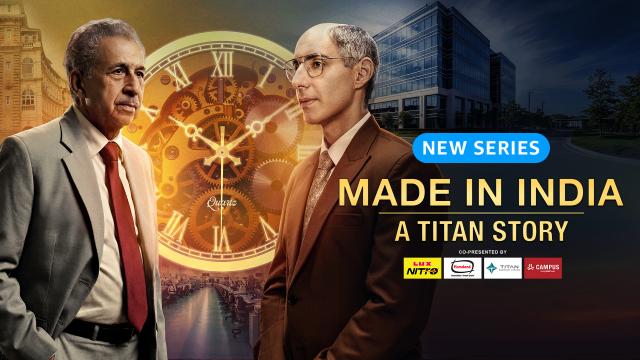
There is a watch sitting on your wrist, in your drawer, or on the wall of your home. There is a reasonable chance it says Titan on the dial. You probably know the name. You have heard the melody — that sweeping, unmistakable theme that has played on Indian television since the late eighties. But do you know the story behind it? Do you know the humiliations, the bureaucratic nightmares, the failed prototypes, the sleepless nights, and the sheer stubborn audacity that brought that watch into existence?
If you don’t, Amazon MX Player’s newest original series Made in India: A Titan Story has arrived on June 3, 2026, to fill that gap — and it does so with a force, a grace, and a cinematic maturity that Indian web series rarely achieve.
This is not just a brand story. This is not a corporate documentary dressed up in drama. This is a deeply human story about what it takes to dream something impossible in a country that hadn’t yet learned to believe in itself. It is the story of Xerxes Desai, JRD Tata, and a small band of believers who decided that India could build a world-class watch brand when the rest of the world laughed at the very idea.
After watching all six episodes back to back, I can say with complete conviction that Made in India: A Titan Story is not only the best Indian streaming series of 2026 so far — it is one of the finest business dramas ever produced in this country.

Where to Watch Made in India: A Titan Story
The series streams exclusively and completely free on Amazon MX Player from June 3, 2026. You do not need a subscription. You do not need a Prime membership.
You can watch it on the Amazon MX Player app available on Android and iOS, through the Amazon shopping app, on Prime Video, on Fire TV, on JioTV, and on Airtel Xstream. It is also accessible on Connected TVs. There is no paywall, no trial period, and no hidden charge. The entire six-episode series is available to stream immediately.
This free availability is itself a statement — a story about national pride being freely offered to every Indian, regardless of whether they can afford a paid streaming service.
Made in India: A Titan Story Series Details at a Glance
Title: Made in India: A Titan Story
Platform: Amazon MX Player (Free)
Release Date: June 3, 2026
Number of Episodes: 6
Director: Robbie Grewal
Writer: Karan Vyas
Producers: Almighty Motion Picture and T-Series Films
Based On: “TITAN: Inside India’s Most Successful Consumer Brand” by Vinay Kamath
Lead Cast: Jim Sarbh, Naseeruddin Shah, Vaibhav Tatwawadi
Language: Hindi
Genre: Period Drama / Business Drama / Historical Fiction
Setting: 1970s–1980s Bombay and Hosur
Made in India: A Titan Story Cast
Jim Sarbh as Xerxes Desai
Jim Sarbh plays the lead role of Xerxes Desai, the visionary first Managing Director of Titan who transformed a small Tata project into India’s most iconic consumer brand. For anyone who has watched Sarbh since Neerja or Rocket Boys, this performance will still manage to surprise you. He is utterly committed to the role, and from the moment he appears on screen as the bald, intense, restlessly brilliant Xerxes, he owns every frame.
Naseeruddin Shah as JRD Tata
Naseeruddin Shah takes on the role of Jehangir Ratanji Dadabhoy Tata — J.R.D., the patriarch, the mentor, the visionary who gave Xerxes the room to dream. Shah plays this with the kind of quiet, controlled authority that only a performer of his stature can summon. This is not a showy performance. It is surgical and deeply wise.
Vaibhav Tatwawadi as Akash Dikshit
Vaibhav Tatwawadi plays Akash Dikshit, Xerxes’s co-founder and the practical counterweight to Xerxes’s romanticism. Tatwawadi delivers a sincere and emotionally resonant performance that gives the story its moral grounding.
**Kaveri Seth, Lakshvir Singh Saran, and Ashwath Bhatt** appear in strong supporting roles, each contributing layers to the founding story of Titan and to the personal lives that get tested in the pursuit of an impossible dream.
You May Also Like:
Made in India: A Titan Story The Direction: Robbie Grewal’s Finest Hour
Robbie Grewal directs all six episodes, and the result is his most accomplished work to date. What makes his direction stand out is a simple but crucial decision: he always puts people before product.
In a lesser director’s hands, this could have been a slick, glossy corporate hagiography — a long advertisement disguised as drama. Grewal refuses to let that happen. Every scene about watch mechanisms, manufacturing challenges, and boardroom battles is filtered through the emotional reality of the characters experiencing those moments. You do not just watch Titan being built. You feel what it costs to build it.
His recreation of 1970s and 1980s Bombay is deeply convincing without ever becoming a museum exhibit. The production design and costumes do their work and then get out of the way of the performances. The editing maintains a steady, confident rhythm, and the clever use of actual archival photographs from Titan’s real journey — woven into the narrative from the second episode onwards rather than saved for a final-credits montage — adds a layer of documentary authenticity that the drama earns.
The music deserves a special mention. Rather than leaning entirely on an original score, Grewal uses iconic Hindi songs from the era as emotional punctuation marks. This choice works beautifully, evoking nostalgia without becoming sentimental. Though it must be said that the background score does occasionally become a touch too eager to underline emotions that the actors are already expressing perfectly well on their own.
The Plot: What Made in India: A Titan Story Is Really About
The story begins in 1978. Xerxes Desai has just returned to the Tata fold after spending five years managing the construction of the Vashi Bridge near Bombay. The desk work feels claustrophobic to a man of his nature, and he tells JRD Tata as much. Tata responds with a challenge: pull Tata Press out of losses. Xerxes takes on the task and during that process, he encounters the seed of an idea — India imports foreign watches at a rate that makes no sense for a country of India’s size and ambition. Why can India not build its own world-class watch?
The humiliation that crystallises this question is a particular scene that hits with unexpected force: JRD Tata, one of the most respected industrialists in the world, is dismissed and condescended to by a Swiss watchmaker who cannot imagine that an Indian company could ever produce a watch of quality. That moment of humiliation does not break Tata. It forges his resolve.
What follows across six episodes is the story of how Xerxes Desai, backed by JRD Tata’s belief and fronted by his own relentless energy, assembles a team, fights bureaucracy, navigates a government-controlled economy that viewed enterprise with suspicion, fails repeatedly, and eventually brings Titan into existence — and then fights to keep it alive once the market reacts with indifference.
The show does not romanticise this journey. The NBIDC (New Bombay Industrial Development Corporation) obstruction is real. The failed prototypes are real. The financial dead ends are real. The personal sacrifices — a woman navigating expectations around marriage, a man whose father’s dementia creates emotional weight at home — are treated with tenderness and respect.
What the show understands, and what makes it resonate far beyond a business story, is that the founding of Titan was fundamentally an act of national self-belief. This was India, in the 1970s and 80s, deciding that it deserved to have beautiful things of its own making. And that idea lands with the full weight it deserves.
The Performances: Where the Series Truly Lives
This show could have been intellectually interesting but emotionally cold. The performances prevent that completely.
Jim Sarbh gives one of the defining performances of his career. The thing that makes Xerxes Desai such a complex character to play is that he is charming and difficult simultaneously. He is capable of extraordinary loyalty and occasional manipulation — sending teammates on holiday to make ‘uncontested’ changes in their absence, for instance. Sarbh never smooths these edges out. He gives Desai an ambiguity, a playful edginess, that makes him completely believable as a real human being rather than a biographical saint. His struggle with Hindi — Xerxes was more comfortable in English and Gujarati — becomes one of the show’s most quietly telling details, a man navigating a country’s complexity through language itself.
Naseeruddin Shah’s portrayal of JRD Tata may be the more technically demanding performance, simply because it requires the actor to convey enormous authority through restraint. Shah does not explain JRD. He embodies him. The hairdo is perfect, the mannerisms are considered, the silences are more eloquent than most actors’ speeches. Some of the finest moments in the entire series occur when Desai and Tata are simply talking about failure — not strategy, not the business — just failure, and what it means to continue in the face of it.
The dynamic between Desai and Akash Dikshit — the romantic and the pragmatist, the bold dial and the reliable strap of a watch — is one of the show’s most cleverly constructed emotional relationships. Vaibhav Tatwawadi understands his role’s function and executes it with sincerity and warmth.
What Worked Brilliantly
The show’s greatest triumph is the humanisation of business. Most business dramas get so caught up in the mechanics — the deals, the numbers, the meetings — that they forget that businesses are built by people with fears and egos and families. Made in India never forgets this. Every boardroom scene is grounded in human stakes. Every failure is felt rather than just reported.
The period recreation is exceptional. The India of the 1970s and 80s — still finding its industrial confidence, still suspicious of ambition, still governed by a License Raj that treated entrepreneurship as a problem to be managed rather than a force to be harnessed — is brought to life with intelligence and specificity. You understand, viscerally, why building Titan was so hard. And that understanding makes Titan’s eventual success feel genuinely earned.
The writing by Karan Vyas handles the source material — Vinay Kamath’s book — with intelligence. Rather than treating the book as a list of facts to be dramatised, it finds the emotional architecture beneath the events. The story of how the word ‘Titan’ was chosen, the story behind that iconic Titan theme, the internal debates about design — these details are woven in naturally rather than dropped in as trivia.
The show also earns real credit for not pretending that Titan’s story is a straightforward triumph. The birth, rise, fall, and eventual redemption of the brand form the arc of the series, and the darkness in the middle is treated with the same seriousness as the triumph at the end. This show does not feel like a brand campaign. It feels like a reckoning.
What Did Not Work
The most consistent criticism from reviewers — and it is fair — is that episodes five and six feel rushed compared to the confident pacing of the first four. The final stretch of the story, which involves Titan’s entry into the market and the challenges that follow the launch, feels compressed. Storylines that have been developed with care through the earlier episodes are resolved with less nuance than they deserve.
There is also the occasional moment where the background score does the emotional work that the scene was already doing on its own. In a show whose greatest strength is its restraint, these moments of musical over-insistence stand out.
And there is a structural risk in any production of this kind — the risk of hagiography. Made in India mostly avoids it, but not entirely. There are scenes, particularly involving JRD Tata, where the show tips slightly into reverence rather than portraiture. The man is shown as so consistently wise and so unfailingly supportive that some of the human texture of the real relationship is softened.
These are not fatal flaws. They are the mild imperfections of a show that gets far more right than wrong.
Comparison with Similar Shows: Where It Stands
If you have watched Rocket Boys on SonyLIV — which dramatised the story of Homi Bhabha and Vikram Sarabhai — you will recognise the template that Made in India is working within. The story of Indian brilliance operating against institutional resistance, the partnership between visionaries, the period recreation, the emotional weight of national aspiration.
Made in India draws from the same well, and in some ways it is the more immediately accessible of the two. Titan is a brand that most Indians have a direct emotional relationship with. The stakes feel personal in a way that even the space programme, for all its grandeur, does not quite match.
It also shares DNA with Mission Mangal — the story of an underdog Indian team achieving something the world did not expect India to achieve. But where Mission Mangal leaned on the feel-good mechanics of a mainstream Bollywood film, Made in India operates with the restraint and complexity of the best prestige television.
Made in India: A Titan Story My Personal View and Rating
I want to be honest about why this series affected me the way it did.
There is something about a story told in the present tense that is different from a story told in the past. We know Titan succeeded. We can look up the numbers — over 150 million watches sold, one of India’s most beloved consumer brands, a company that went on to give India Tanishq and Fastrack and a dozen other things that are woven into daily Indian life. The ending is not a surprise.
And yet, watching Made in India, I felt anxiety for Xerxes and his team. I felt the weight of the bureaucratic stone walls. I felt the exhaustion of people who believed in something when no one else did. That is the mark of great storytelling — it makes the known feel unknown. It gives you back the suspense of history.
Jim Sarbh and Naseeruddin Shah deliver two performances that belong in any serious conversation about the finest acting in Indian streaming. Robbie Grewal has directed a show that respects its audience’s intelligence while never losing sight of the emotional experience it is trying to create.
Is it perfect? No. The final two episodes deserved more room to breathe. The musical score occasionally oversells what the cast is already delivering. But these are minor disappointments in the context of something that is, overall, a genuine achievement.
Rating: 4.2 out of 5
Watch it because this is the story of something that was made in India before it was fashionable to say so. Watch it because Jim Sarbh is extraordinary. Watch it because Naseeruddin Shah shows you, once again, what acting at its highest level actually looks like. And watch it because the next time you see that Titan dial, you will understand something about it that you did not understand before.
Made in India: A Titan Story Frequently Asked Questions
Where can I watch Made in India: A Titan Story?
The series is streaming exclusively on Amazon MX Player from June 3, 2026. It is available completely free — no subscription required. You can watch it on the Amazon MX Player app (Android/iOS), through Prime Video, the Amazon shopping app, Fire TV, JioTV, and Airtel Xstream, including on Connected TVs.
How many episodes does Made in India: A Titan Story have?
The series has six episodes. All six episodes released at once on June 3, 2026, making it available for binge watching.
Who plays JRD Tata in Made in India: A Titan Story?
Naseeruddin Shah plays J.R.D. Tata in the series. His performance has been widely praised as one of the finest portrayals of a real historical figure in Indian streaming history.
Who plays Xerxes Desai in Made in India: A Titan Story?
Jim Sarbh plays Xerxes Desai, the visionary first Managing Director of Titan who is the central protagonist of the series.
Is Made in India: A Titan Story based on a true story?
Yes. The series is inspired by the true story of the founding and rise of the Titan watch brand. It is adapted from Vinay Kamath’s book “TITAN: Inside India’s Most Successful Consumer Brand.” While the dramatisation takes creative liberties, the core events — the challenges, the people, and the eventual triumph — are rooted in real history.
Who directed Made in India: A Titan Story?
The series was directed by Robbie Grewal. The screenplay was written by Karan Vyas.
Who produced Made in India: A Titan Story?
The series was produced by Almighty Motion Picture and T-Series Films. Bhushan Kumar of T-Series Films was among the producers.
What is the Made in India: A Titan Story release date?
The series premiered on June 3, 2026, on Amazon MX Player.
Is Made in India: A Titan Story free to watch?
Yes. The entire series is available to stream for free on Amazon MX Player, which is India’s free, ad-supported video streaming platform. You do not need to pay anything or subscribe to any service.
What time period is Made in India: A Titan Story set in?
The series is set primarily in the 1970s and 1980s, beginning in 1978 Bombay (present-day Mumbai) and following the development of Titan through the 1980s, including the establishment of its manufacturing facility in Hosur, Tamil Nadu.
Is Made in India: A Titan Story worth watching?
Based on critical reception and audience response, the series is widely considered not only worth watching but essential viewing for anyone interested in Indian business history, the Tata legacy, or simply exceptional period drama with outstanding performances.
What language is Made in India: A Titan Story in?
The series is primarily in Hindi, with some English dialogue, reflecting the linguistic reality of the era and the Parsi Zoroastrian background of Xerxes Desai’s character.
What is the connection between Titan and the Tata Group?
Titan Company was established in 1984 as a joint venture between the Tata Group and the Tamil Nadu Industrial Development Corporation (TIDCO). The vision of creating India’s first world-class watch brand grew from an idea that took shape in the late 1970s, which is where the series picks up the story.
Will there be a Season 2 of Made in India: A Titan Story?
As of the June 2026 release, no official announcement has been made about a second season. However, given the critical reception and the richness of the Titan story beyond the founding years — the launch of Tanishq, the creation of Fastrack, and the global expansion — there is certainly material for a continuation if Amazon MX Player and the producers choose to explore it.
How does Made in India: A Titan Story compare to Rocket Boys?
Both series deal with Indian visionaries working against institutional resistance to achieve something extraordinary. Rocket Boys covered India’s space programme through the story of Homi Bhabha and Vikram Sarabhai. Made in India covers the industrial and consumer brand story of Titan. Most critics consider both to be among the finest Indian streaming series in the prestige drama format, with Made in India having the advantage of a more universally recognisable subject — almost every Indian has a personal relationship with the Titan brand.

Hi, I’m Prashant Jain — a film enthusiast and critic who lives and breathes cinema. From big-screen releases to the latest drops on OTT, I watch extensively and review honestly, without hype or bias.
I believe a good review should go beyond just “good” or “bad.” It should help you understand what works, what doesn’t, and whether a film is truly worth your time. My reviews focus on storytelling, performances, direction, and overall impact — all through the lens of a genuine viewer.
I regularly cover new movie releases and trending web series across OTT, bringing clear, no-nonsense insights for audiences who want real opinions, not paid praise.
Through PopNewsBlend, I aim to cut through the noise and give you reviews you can trust — whether you’re deciding what to watch next or just love discussing cinema as much as I do.
Discover more from Popnewsblend
Subscribe to get the latest posts sent to your email.
Related posts:
 Squid Game Season 3: Netflix’s Global Sensation Ends With a Bang
 Anil Kapoor’s 24 Series on Jio Hotstar (April 24): Why This Iconic Thriller Is a Must-Watch Again
 Berlin and the Lady with an Ermine – Netflix Original Series — Deep Dive Review & Analysis
 System on Amazon Prime Video Review 2026: Sonakshi Sinha and Jyotika Deliver a Courtroom Drama That Hits Harder Than You Expect


Pingback: Brown Zee5 Review: Karisma Kapoor Shines in This Dark Kolkata Crime Thriller