
For millions of people around the world, the United States represents opportunity, education, career growth and family reunification. Every year, students apply to American universities, professionals move for work, families reunite after years apart and tourists plan long-awaited trips.
From January 1, 2026, the U.S. immigration landscape is changing in a way that will affect many of these plans. New visa rules introduce expanded travel restrictions for certain countries and higher immigration-related fees, making it more important than ever to understand what is changing, who is affected and how to prepare.
This guide explains everything in simple terms, without legal jargon so that anyone can clearly understand what lies ahead.
Why the U.S. Updated Its Visa Rules
Governments regularly review immigration systems to balance security, administrative efficiency and diplomatic relations. The latest changes come after a long review of global visa compliance, identity verification standards and overstays.
According to official policy announcements, the U.S. government identified concerns in three main areas:
- Incomplete or inconsistent identity documentation from certain countries
- Limited cooperation on background verification and data sharing
- High rates of visa overstays in specific categories
Based on these assessments, the U.S. decided to restrict visa access for certain countries while also revising immigration fees to better reflect processing and operational costs.
The Two Big Changes You Need to Know
From January 1, 2026, two major changes take effect:
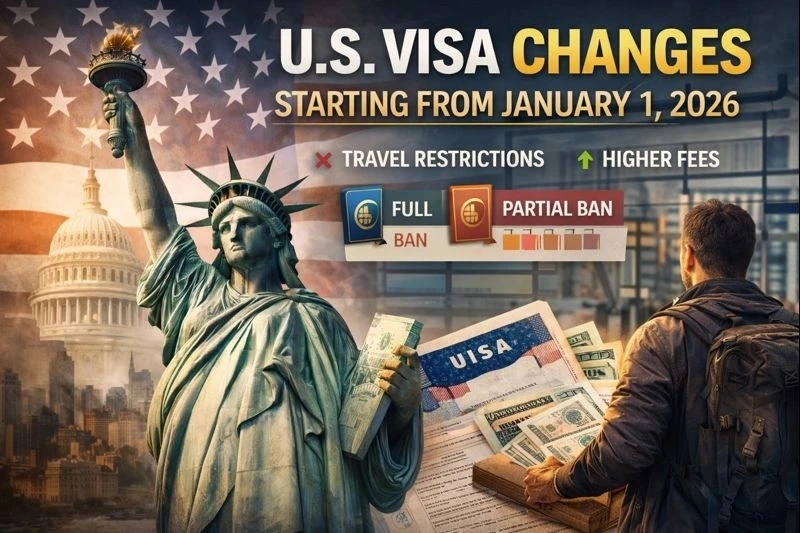
1. Travel restrictions affecting citizens of 39 countries
Some countries face a complete suspension of most visa categories, while others face partial restrictions.
2. Increase in immigration-related application fees
Several immigration services now cost more than before, affecting applicants across many categories.
These changes apply worldwide and impact people planning to travel, study, work or settle in the U.S.
Understanding the Travel Restrictions
The travel restrictions are not a single blanket ban. Instead, countries are divided into two groups, each treated differently.
Countries Under Full Visa Suspension
Nationals of certain countries face a full suspension of most U.S. visas if they meet specific conditions.
This means:
- Immigrant visas are suspended
- Most non-immigrant visas such as tourist, student, and exchange visas are not issued
The full suspension applies only if the person:
- Is outside the United States on January 1, 2026
- Does not already hold a valid U.S. visa on that date
Countries under full suspension include:
Afghanistan
Burma (Myanmar)
Chad
Republic of the Congo
Equatorial Guinea
Eritrea
Haiti
Iran
Laos
Libya
Mali
Niger
Sierra Leone
Somalia
South Sudan
Sudan
Syria
Yemen
In addition, individuals traveling using travel documents issued by the Palestinian Authority fall under the same restriction.
Countries Under Partial Visa Restrictions
Some countries are not fully blocked, but visa access is limited.
For these countries:
- Immigrant visas are generally suspended
- Certain non-immigrant visas face restrictions or reduced availability
Commonly affected categories include:
- Tourist and business visas
- Student visas
- Exchange visitor visas
Countries under partial restriction include:
Angola
Antigua and Barbuda
Benin
Burundi
Côte d’Ivoire
Cuba
Dominica
Gabon
The Gambia
Malawi
Mauritania
Nigeria
Senegal
Tanzania
Togo
Tonga
Venezuela
Zambia
Zimbabwe
Applicants from these countries may still qualify for some visa types, but approval standards are stricter and options are narrower.
Who Is NOT Affected by the Travel Restrictions
It is important to understand that the restrictions do not apply to everyone.
You are generally not affected if you:
- Already hold a valid U.S. visa issued before January 1, 2026
- Are a lawful permanent resident of the U.S. (green card holder)
- Hold dual citizenship and travel using a passport from a country not under restriction
- Are traveling under specific diplomatic or official government categories
Existing visas are not automatically cancelled, but travelers should expect stricter scrutiny at entry points.
What This Means for Students Planning to Study in the U.S.
Students from restricted countries face the biggest impact.
- New student visa applications from fully restricted countries are not accepted
- Students from partially restricted countries may face longer processing times and tighter eligibility checks
- Students already studying in the U.S. can usually continue their education if their status remains valid
Those planning future education should review options carefully before applying.
Impact on Work Visas and Professionals
Work visas are not entirely shut down, but scrutiny has increased.
- Applicants from restricted countries may see reduced visa validity periods
- Renewals and new applications are examined more closely
- Travel outside the U.S. during renewal periods may carry additional risk
Professionals already working in the U.S. are advised to plan international travel cautiously.
Family-Based Immigration and Reunification
Family-sponsored immigration is also affected:
- Immigrant visas for relatives from restricted countries are largely suspended if applicants are outside the U.S.
- Family members already in the U.S. under valid status may still adjust their status depending on individual circumstances
This has emotional and logistical consequences for families waiting to reunite.
Immigration Fees Are Increasing
Alongside travel restrictions, the U.S. has increased several immigration-related fees.
These increases affect services such as:
- Employment authorization documents
- Asylum-related filings
- Temporary protected status applications
- Certain adjustment and benefit requests
Not all fees have increased, and exact costs depend on the form and category. However, applicants should expect higher overall expenses when filing immigration paperwork after January 1, 2026.
Why Fee Increases Matter
For many applicants, immigration is not a single application but a process involving multiple steps.
Fee increases can mean:
- Higher upfront costs
- Increased financial pressure on students and families
- Additional planning for employers sponsoring workers
Applicants should budget carefully and verify fees before submitting any application.
What Indian Applicants Should Know
India is not included in the restricted country list.
However, Indian applicants may still experience:
- Longer appointment wait times
- Increased document verification
- Higher application costs
Students, professionals and families should apply early and prepare documentation thoroughly.
How to Prepare If You’re Planning U.S. Travel
If you or someone in your family plans to apply for a U.S. visa:
- Apply as early as possible
- Ensure all documents are accurate and complete
- Avoid unnecessary international travel during sensitive application periods
- Stay updated on official announcements
Careful planning reduces uncertainty and stress.
A Bigger Picture: What This Means Globally
These changes reflect a broader shift in how countries manage borders, security, and migration.
For travelers, it means:
- Immigration rules can change quickly
- Staying informed is essential
- Long-term planning matters more than ever
For governments, it signals stricter compliance expectations and closer scrutiny of international travel systems.
Final Thoughts
The U.S. visa changes effective January 1, 2026, mark one of the most impactful immigration updates in recent years. While not everyone is affected, those who are must navigate a more complex and selective system.
Understanding the rules clearly, planning early and staying informed can make the difference between a smooth process and unexpected delays.
If the United States is part of your future plans, knowledge is your strongest tool.
For the Latest Trending News, Please visit Popnewsblend.com

Hi, I’m Prashant Jain — a curious soul, storyteller, and content creator at heart.I’ve always been drawn to the world of entertainment, travel, sports, health & lifestyle — not just as a writer, but as someone who genuinely lives these experiences. Whether I’m binge-watching the latest OTT series, exploring offbeat spiritual destinations in India, or diving deep into wellness routines and cricket match insights, I love sharing what I discover with like-minded readers.
PopNewsBlend is my way of blending personal journeys with meaningful stories — ones that inform, inspire, and keep you ahead of the curve. Everything I write comes from real observations, hands-on experiences, and a deep passion for understanding the world around us.
Discover more from Popnewsblend
Subscribe to get the latest posts sent to your email.
Related posts:
 Elon Musk Officially Launches “America Party”: What It Means for the U.S., Global Politics, and the Future of Power
 Dreaming of a U.S. Green Card? Here’s the New Citizenship Rule Every Indian Must Know
 Apollo Tyres Takes Over as Indian Cricket Team’s Jersey Sponsor: A Deep Dive
 Fatima Bosch from Mexico Crowned Miss Universe 2025: Complete Highlights, Winner Breakdown, Runners-Up and India’s Final Position


This site was… how do I say it? Relevant!! Finally I have found something which helped me. Cheers!