
★★★★ 3.5 / 5
Critic’s Score
Suriya · Trisha Krishnan · RJ BalajiTamil Action-Fantasy Drama Runtime: ~2 hrs 30 mins
There is a particular kind of exhaustion that comes from waiting for a film that keeps slipping away. Karuppu was supposed to be Suriya’s Diwali 2025 gift to his fans. Then it became a Pongal 2026 release. Then Republic Day. Then April. And then, finally, on May 14, 2026, nineteen months after the project was first officially announced under the working title Suriya 45, the film walked into theatres across Tamil Nadu and the world. Fans who had been refreshing booking sites at midnight greeted it like a long-overdue monsoon. The question, of course, is whether the rain was worth the drought.
The short answer: mostly, yes. The longer answer requires us to sit with what RJ Balaji has attempted here, and what he has delivered, because Karuppu is not one kind of film. It is several films stitched together by a bold mythology and carried on Suriya’s shoulders with visible conviction. When it works, it genuinely works. When it stumbles, it stumbles in ways you cannot ignore if you are being honest about it.
Let me be very clear upfront. I am not a fan account. I have been watching Tamil cinema for over two decades. I have seen Suriya at his peak in films like Pithamagan, Vaaranam Aayiram, and Jai Bhim. I carry those memories with me when I walk into anything he does. Karuppu earns its place in the conversation without quite earning the top shelf. And there is something genuinely refreshing about a mass entertainer that is willing to reach for something this specific in its mythology and this deliberate in its social intent.
Karuppu : The Film at a Glance
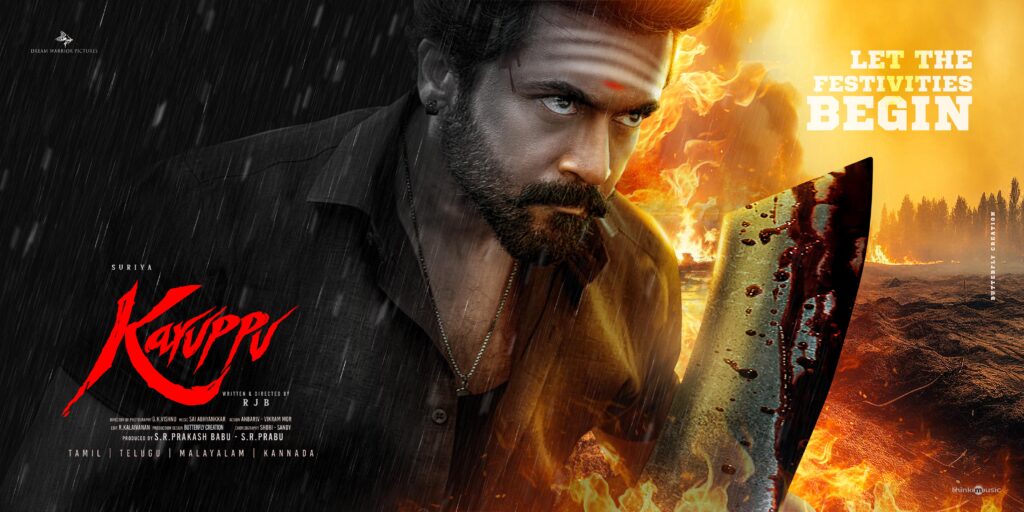
Director : RJ Balaji
Producer : Dream Warrior Pictures
Music : Sai Abhyankkar
Cinematography : GK Vishnu
Editing : R. Kalaivanan
Action : Anbariv & Vikram Mor
Release Date : May 14, 2026
Runtime : ~150 Minutes
Certificate : UA 13+
Karuppu : Cast and Performances: Who Brings What to the Table
The casting in Karuppu is one of its quiet strengths. RJ Balaji did not just assemble names. He assembled types and energy signatures that complement what the story demands at each stage. Here is how each major player lands.
Suriya Sivakumar as Saravanan / Karuppuswamy (Dual Role)
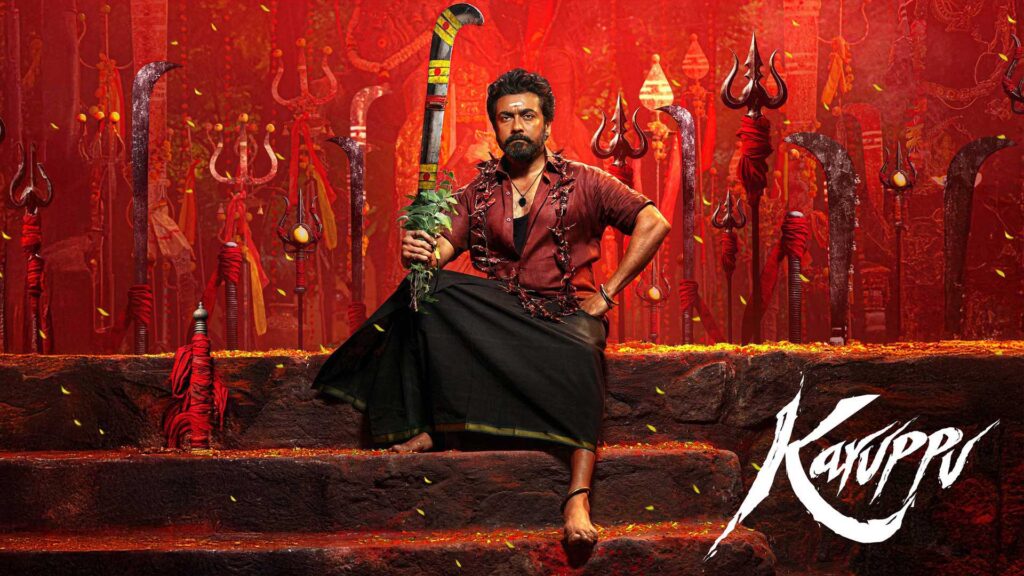
Suriya plays a lawyer named Saravanan who becomes a vessel for the ancient folk deity Karuppuswamy. The dual role demands physical contrast and emotional range. He delivers on both counts. His Saravanan is warm, principled, occasionally funny. His Karuppuswamy is controlled fury, all dark attire and aruval and a quietness that is more terrifying than any shout. The transformation scenes are where the film’s CGI budget earns its keep, and Suriya earns his 45th lead film with a performance that never feels mechanical.
Trisha Krishnan as Preethi — Lawyer, Co-Lead
Karuppu marks the fourth time Suriya and Trisha have shared the screen together — after Mounam Pesiyadhe (2002), Aayutha Ezhuthu (2004), and Aaru (2005). That is a twenty-one year gap since their last pairing, and the reunion carries real weight on screen. Her character Preethi is a lawyer in her own right, treated as a co-lead rather than an accessory. Trisha handles both the emotional and the procedural courtroom scenes with the quiet authority of someone who has been underused for years and knows exactly what to do when given the space.
RJ Balaji vs Baby Kannan — Antagonist
Here is the part where I will say something that might surprise people: RJ Balaji as the villain is one of the film’s unexpected pleasures. He is not threatening in a conventional action-movie way. He is menacing in the way that a well-dressed man who controls the paperwork is menacing. He understands that the best villains in courtroom dramas are not the ones who swing punches, but the ones who smile while the system does their dirty work. His Baby Kannan is slippery, well-tailored, and genuinely unpleasant.
Indrans vs Supporting — Elder Figure
Indrans does what Indrans always does, which is walk into a scene and quietly make it feel true. His role is not large but it is load-bearing in the emotional first half. There is one scene involving a temple, a conversation, and a single glance that will stay with you longer than most of the action sequences.
Yogi Babu vs Comic Relief / Support
Yogi Babu earns his laughs here without disrupting the film’s tone, which is a harder balance than it sounds. He is placed strategically in the first half during moments of audience breathing room. His comic sequences are shorter and more purposeful than in many recent films where he tends to be overextended. Credit to Balaji for knowing when to cut.
Natty Subramaniam vs Pivotal Supporting Role
Natty has spoken publicly about the rehearsals that went into his role, and it shows on screen. His character sits at an interesting moral intersection in the story. Without revealing the specifics, he is one of those supporting characters who makes you feel the weight of social compromise in ways the plot alone cannot carry. A quiet standout.
Prakash Raj as Sathyan Raj — Supporting Role
Prakash Raj is confirmed in the cast by IMDb, playing a character named Sathyan Raj. The specifics of his role and its weight in the narrative are best discovered in the theatre, but his presence in a Tamil action-drama of this scale carries the implicit promise of a performance that will not be throwaway. He is one of the most reliable character actors in South Indian cinema, and his inclusion adds further credibility to an already strong ensemble.
The wider ensemble includes Swasika, Sshivada, Supreeth Reddy, Kaali Venkat, Mansoor Ali Khan, Aadukalam Naren, and Anagha Maaya Ravi, giving the film a full and layered world beyond its principals.
Karuppu The Plot: Courtrooms, Folk Deities, and a Village Fighting Back
At its core, Karuppu is about what happens when the system that is supposed to protect people fails them entirely, and something older and more primal has to step in. Saravanan is a lawyer in a corrupt society where justice moves at the pace of whoever pays the most. He is fighting to protect a village temple, a sacred space that powerful interests want demolished to make way for something profitable. Trisha’s Preethi is fighting alongside him, and together they represent the formal legal battle.
But Karuppu, as RJ Balaji himself explained during promotions, is not really about whether the court wins. It is about what Balaji calls the arrival of a superhero when the world goes through an extremely difficult phase. That superhero is Karuppuswamy, the ancient folk deity of Tamil rural communities, who possesses Saravanan and turns the battle from a courtroom into something far more elemental. The transformation from lawyer to deity vessel is the film’s central dramatic gear shift, and it happens at exactly the point where you begin to feel the procedural first half has said everything it needs to say.
The choice of Karuppuswamy as the mythological anchor is significant and, frankly, underrated in most of the coverage I have read. This is not Vishnu or Murugan, the deities of grand temple festivals and wide cultural recognition. Karuppuswamy is a folk deity, historically associated with the marginalized and the rural, a guardian of boundaries both physical and social. Anchoring a superhero film in this specific iconography says something about who the film considers its audience, and what it believes justice looks like when formal systems collapse. Whether Balaji fully capitalizes on that thematic richness is a question I will return to in a moment.
“When the world is going through an extremely difficult phase, what if a superhero arrives to put an end to that suffering? We have portrayed that in a massy and action-packed way.”— RJ Balaji, Director of Karuppu, speaking to Republic World ahead of release
What to Expect When You Walk In
The first half of Karuppu is slower and more emotionally grounded than the promotional material might suggest. If you walk in expecting a wall-to-wall action film from the opening shot, you will be slightly disoriented for about the first forty minutes. The film takes its time with the village, the temple, the community, and the legal setup. This patience pays dividends later, because when the stakes of the second half land, you actually care about the people involved rather than simply watching spectacular sequences happen to strangers.
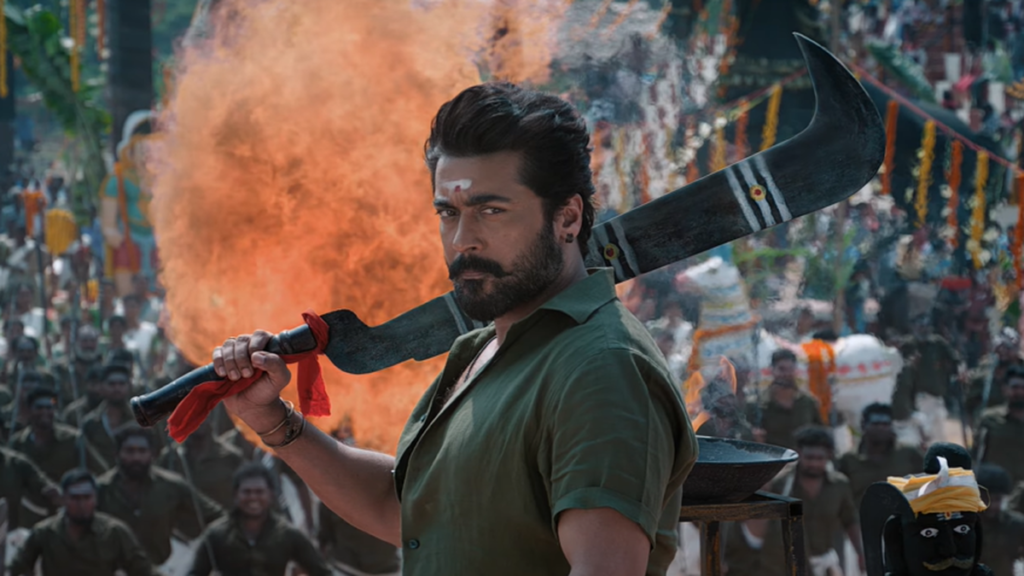
Pre-release buzz from industry sources and early social media reactions has noted that the second half delivers the theatrical moments. One viral post described it as a film that provides a high every ten minutes once the second half kicks in. That is not an exaggeration. The action choreography by Anbariv and Vikram Mor, who have credits on KGF and Vikram respectively, produces sequences that are large-scale without being incoherent. GK Vishnu’s cinematography, familiar to audiences from Jawan and Mersal, gives the deity sequences a visual grammar that is different from the courtroom scenes. The colour palette shifts, the frame becomes more mythological in composition, and the CGI, while not always perfect, earns its purpose.
What Works in Karuppu
- Suriya’s dual performance is controlled, layered, and physically committed.
- Trisha Krishnan is treated as a genuine co-lead with legal agency and screen time to match.
- The choice of Karuppuswamy mythology gives the film cultural specificity that generic superhero templates lack.
- The second half delivers mass entertainer moments at a consistent pace.
- RJ Balaji as the antagonist is an unexpected casting decision that genuinely pays off.
- Sai Abhyankkar’s debut score shows a composer who understands both folk instruments and cinematic scale.
- GK Vishnu’s cinematography earns its billing. The deity sequences look different in the right ways.
You May Also Like :
What Could Have Been Better: An Honest Assessment
I want to be fair to the film and fair to the audience, so let me be direct about where Karuppu does not fully meet its own ambitions.
The screenplay, co-written by RJ Balaji along with four other writers, shows the seams of collaboration in places. There are moments in the second half where the social drama momentum that builds so carefully in the first half gets subordinated to commercial action requirements. The film that begins by caring about the village and its people sometimes forgets those people during the big set pieces. The antagonist’s motivations, while entertaining in RJ Balaji’s performance, are underwritten at the script level. Baby Kannan does bad things because the film needs him to, not always because the screenplay explains why a man like him would pursue what he pursues with the particular methods he uses.
The CGI, while significantly better than the teaser suggested, has rough edges in specific moments. Tamil audiences are sophisticated enough viewers to notice when a visual effect looks constructed rather than integrated, and there are three or four sequences where the deity transformation has not been rendered to the standard the rest of the film aspires to. This is not fatal, but it is noticeable.
There is also the question of the social message. Karuppu wants to say something about folk traditions, marginalized communities, and the way formal systems fail people without formal power. It has the right ingredients. But in the second half, the message gets absorbed into the mass entertainer machinery rather than emerging from it. Jai Bhim, Suriya’s finest recent film, succeeded because the system-critique and the emotional drama were inseparable. In Karuppu, they sometimes feel like parallel tracks rather than a single unified argument. That is not a fatal criticism. It is a measure of how high the bar is when Suriya is involved.
One more thing worth mentioning for honest completeness: the release itself had a chaotic morning. First-day nine AM shows were cancelled across Tamil Nadu and internationally due to what the producers called unavoidable reasons, with financial hurdles being cited in media reports. This is not something the film can be reviewed for, but it is part of the lived experience of being a Karuppu audience member on May 14, 2026, and any account that omits it is not giving you the full picture.
Ratings and Reactions from Around the Industry
Here is what the wider conversation looks like as the film reaches audiences. I have compiled reactions from across the spectrum, not cherrypicking to support a predetermined conclusion.
IMDb (User Score) Audience aggregate — score pending sufficient votes at time of publishing : Awaited
Kuldeep Gadhvi (Actor-Reviewer) Censor screening reaction on X : 4/5
A2 Studio (Industry Tracker) Pre-release intelligence report : Hit verdict
One viral negative reaction pre-release : 1.5/5
Social Media Consensus (Twitter/X) Aggregate fan and casual viewer sentiment : Positive trending
This Review (Critic’s Score) Independent assessment, full viewing : 3.5/5
Note: Early reactions to mass entertainers that play to theatrical audiences tend to vary sharply depending on expectations. Suriya fans going in expecting a pure mass experience may be slightly underwhelmed by the first half. Those going in expecting a film with something to say will likely feel the film earns its running time.
To get the regular updates on Latest Kollywood Movies Release And Reviews, Follow Popnewsblend.com or Instagram @Popnewsblend
My Personal Take: A Critic Who Grew Up on Suriya Films
I watched Pithamagan in a theatre in 2003. I sat through the first screening of Vaaranam Aayiram and cried at a scene that still holds up today. I understand what Suriya means to Tamil cinema, and I refuse to let that understanding become either a reason to inflate or deflate what Karuppu actually is.
What Karuppu actually is, in my honest estimation, is a film that bites off more than it can chew and still manages to make the bite worth taking. RJ Balaji is a director who cares. That care shows in the casting, in the mythology selection, in the way the first half builds a world before blowing it apart. The problem is that caring is not the same as complete creative control, and Karuppu occasionally feels like a negotiation between the film Balaji wanted to make and the film a commercial Tamil release in 2026 requires.
Suriya at 50 is not trying to be Suriya at 35. There is a gravity in his performances now that the younger version did not have, and Karuppu uses that gravity productively. The scene where Saravanan first becomes aware of the deity’s presence is not played with shock or theatrics. It is played with a quiet recognition, as if some part of him always knew this was coming. That is a choice that only an actor with his experience and confidence makes.
Trisha deserves more reviews that notice what she actually does in this film. She is not in a supporting role. She is in a co-lead role and she justifies every minute of it. The reunion of Suriya and Trisha is not nostalgia deployed for marketing purposes. It is two mature performers returning for their fourth film together — twenty-one years after Aaru — who bring everything they have learned into scenes that feel earned rather than manufactured.
Would I watch it again? Yes. Would I take my family? Yes, though children below thirteen might find the second half intense in ways the UA 13+ certificate correctly flags. Is it Suriya’s best film of the decade? Not quite. Is it worth the nineteen-month wait since announcement? For the most part, yes. The mythology is specific enough to be meaningful. The performances are strong enough to carry the weaker screenplay moments. And there is at least one sequence in the second half that reminded me why Tamil cinema, at its best, can make a theatre feel like a community event rather than a passive consumption experience.
Final Verdict
Karuppu is a flawed but genuinely ambitious Tamil action-drama that earns more than it wastes. Suriya’s dual performance as a lawyer and a folk deity’s vessel is his most layered work in several years. Trisha Krishnan’s return as a co-lead is overdue and well-executed. RJ Balaji as both director and antagonist surprises in both roles. The first half is patient and emotionally grounded. The second half is large-scale and theatrically generous. The screenplay has rough edges, and the CGI is not uniformly strong. But Karuppu picks a specific cultural mythology and commits to it with enough conviction that even its imperfections feel earned rather than careless. Go watch it. Go watch it in the biggest screen you can find.
★★★½ 3.5 / 5
Frequently Asked Questions About Karuppu (2026)
These are the questions I have been receiving consistently about this film, and I will answer each one as plainly as I can.
What is Karuppu about? What is the story of the film?
Karuppu follows Saravanan, a lawyer played by Suriya, who is fighting to protect a rural village temple from being demolished by corrupt and powerful forces. When the legal system fails, Saravanan becomes possessed by the ancient Tamil folk deity Karuppuswamy and transforms into a supernatural force fighting for justice on behalf of marginalized communities. Trisha Krishnan plays Preethi, a lawyer who fights alongside him. The film blends courtroom drama, social commentary, folk mythology, and superhero-scale action sequences.
Is Karuppu worth watching? Is it a hit or flop?
Karuppu is worth watching, especially on a large screen. The film has its structural weaknesses in the screenplay’s second-half transitions, and the CGI has uneven moments. However, Suriya’s dual performance, Trisha’s co-lead work, a strong supporting cast, and a genuinely meaningful choice of mythology make it a worthwhile theatrical experience. Early industry tracking suggests it is heading toward a hit verdict, with over 110 crore in pre-release non-theatrical business already locked in.
Does Suriya play a double role in Karuppu?
Yes. Suriya plays dual roles in Karuppu. His first role is Saravanan, a principled lawyer, and his second is Karuppuswamy, the ancient folk deity who possesses Saravanan. The two roles are connected through the possession arc rather than being two unrelated characters, which gives the dual performance more dramatic unity than a typical double-role Tamil film.
Who is Karuppuswamy? Why is this deity important to the film?
Karuppuswamy, often written as Karuppannasamy, is a significant folk deity in Tamil Nadu, particularly venerated by rural and Dalit communities. Unlike many deities in mainstream Tamil cinema, Karuppuswamy is specifically associated with the protection of boundaries, communities, and the marginalized. The film’s choice to anchor its superhero premise in this specific deity rather than a mainstream temple god is culturally and politically deliberate. It signals who the film considers its community and what kind of justice it is invoking.
Why was Karuppu delayed so many times before releasing on May 14, 2026?
The film was originally announced in October 2024 as Suriya 45 and initially targeted a Diwali 2025 release. The primary reason for multiple delays was the volume and complexity of CGI required for the deity transformation and action sequences. Post-production simply took longer than the initial schedule allowed. Additional factors included competing releases on Pongal and the Tamil Nadu Legislative Assembly elections creating uncertainty about the release environment. The film eventually found its window at May 14, 2026, approximately nineteen months after the official October 2024 announcement.
What happened with the cancelled morning shows on release day?
On May 14, 2026, just hours before the film’s scheduled release, the 9 AM first-day-first-show screenings were cancelled across Tamil Nadu and internationally. Producer SR Prabhu posted a statement on X at 1:17 AM citing unavoidable reasons without specifying details. Media reports linked the disruption to alleged last-minute financial hurdles in the film’s release process. Director RJ Balaji responded publicly expressing faith that the film would release on the day as planned, and later screenings proceeded. It was a chaotic and disappointing start for fans who had tickets for the morning shows.
Is Trisha Krishnan in a big role in Karuppu?
Yes, and significantly more than promotional material might suggest. Trisha plays Preethi, a lawyer treated as a co-lead throughout the film. Karuppu is actually their fourth film together — following Mounam Pesiyadhe (2002), Aayutha Ezhuthu (2004), and Aaru (2005) — marking a twenty-one year gap since their last pairing. Her legal scenes in the first half carry genuine weight, and her character’s journey runs parallel to Suriya’s rather than orbiting it.
Who composed the music for Karuppu? Is the soundtrack good?
The music for Karuppu was composed by Sai Abhyankkar, marking his debut as a film composer. He replaced AR Rahman, who was initially associated with the project. The soundtrack has received solid reception, with the first single God Mode generating strong positive response on streaming platforms and social media. Within the film, Abhyankkar’s score demonstrates an understanding of both folk instrumentation appropriate to the Karuppuswamy mythology and the broader sonic requirements of a commercial Tamil mass entertainer.
Is Karuppu suitable for family viewing? What is the age certificate?
Karuppu received a UA 13+ certificate from the Central Board of Film Certification after minor modifications in response to censor board suggestions. The film is suitable for general family viewing, though the action intensity in the second half and the supernatural transformation sequences may be overwhelming for younger children. Families with children under thirteen should exercise judgment, but the film contains no content that makes it unsuitable for adolescents and above.
When will Karuppu release on OTT streaming platforms?
No OTT streaming details have been officially confirmed as of the theatrical release date. The film’s pre-release business reportedly includes digital streaming rights as part of its 110+ crore non-theatrical package, but the specific platform and release timeline have not been publicly announced. Tamil theatrical releases of this scale typically have an OTT window of four to eight weeks after theatrical. Watch the official Dream Warrior Pictures channels for announcements.
Is Karuppu Suriya’s 45th film? Why is that significant?
Yes. Karuppu marks Suriya’s 45th film as a lead actor, which is why it was originally announced under the working title Suriya 45. This is a significant career milestone in Tamil cinema, where lead actors are counted carefully by the industry and by fan communities. Suriya began his career in 1997 and completing 45 lead films across nearly three decades represents one of the more sustained lead careers in Kollywood.
This review reflects the critic’s personal assessment based on a full theatrical viewing of Karuppu on May 14, 2026. Ratings from other platforms cited are based on available information at time of publication and may be updated as more audience data becomes available.
Karuppu Movie Review 2026 · An independent Tamil cinema criticism piece · Published May 14, 2026
Keywords: Karuppu review, Suriya 45 review, Karuppu Tamil movie, RJ Balaji director, Trisha Krishnan Suriya reunion, Karuppuswamy movie, Tamil action fantasy 2026, Karuppu box office, Karuppu OTT release, Karuppu cast performance, Karuppu rating

Hi, I’m Prashant Jain — a film enthusiast and critic who lives and breathes cinema. From big-screen releases to the latest drops on OTT, I watch extensively and review honestly, without hype or bias.
I believe a good review should go beyond just “good” or “bad.” It should help you understand what works, what doesn’t, and whether a film is truly worth your time. My reviews focus on storytelling, performances, direction, and overall impact — all through the lens of a genuine viewer.
I regularly cover new movie releases and trending web series across OTT, bringing clear, no-nonsense insights for audiences who want real opinions, not paid praise.
Through PopNewsBlend, I aim to cut through the noise and give you reviews you can trust — whether you’re deciding what to watch next or just love discussing cinema as much as I do.
Discover more from Popnewsblend
Subscribe to get the latest posts sent to your email.
Related posts:
 The Ultimate Guide to the Best Bollywood Comedy Movies Ever Made
 Tanvi: The Great – A Landmark in Indian Cinema
 Thug Life Movie (2025)Review: Kamal Haasan & Mani Ratnam’s Ambitious Reunion Delivers Style Over Substance
 Ek Din Movie Review (2026): Junaid Khan & Sai Pallavi Deliver a Soulful Love Story That Stays With You


Pingback: Kartavya Netflix Review 2026: Saif Ali Khan Delivers His Best Performance in Years
Pingback: Aakhri Sawal Review (2026): Sanjay Dutt Delivers a Powerful Political Drama