
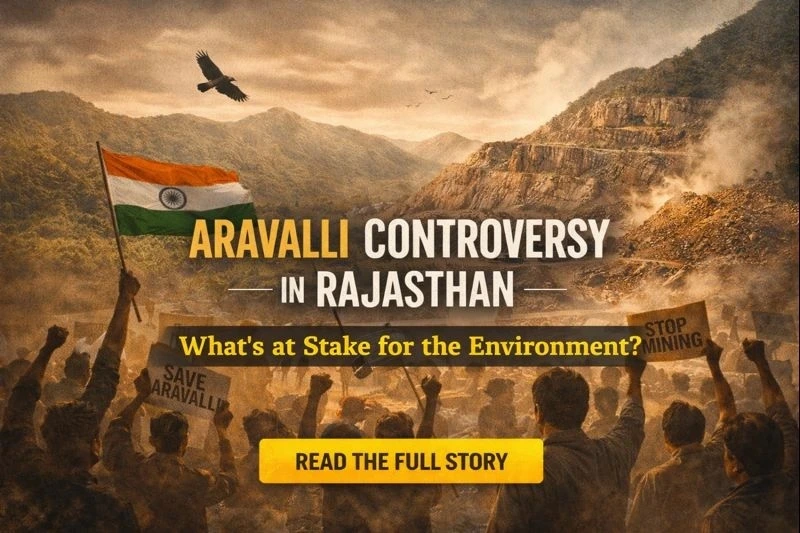
The Aravalli mountain range — one of the world’s oldest geological formations and an ecological lifeline for North India — has suddenly become the center of one of the most significant environmental controversies of 2025. Across Rajasthan, the protests against a new definition and potential weakening of protections for the Aravallis have intensified, uniting environmentalists, political groups, tribal communities, students, lawyers and local citizens in a movement many are calling “Save Aravalli”.
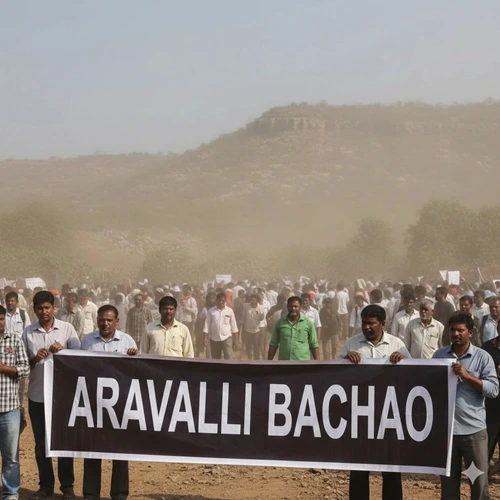
What Exactly Is Happening in Rajasthan?
In November 2025, the Supreme Court of India accepted a new definition of the Aravalli hills that has drastically narrowed what qualifies as part of the mountain range. According to this definition, only landforms that rise at least 100 metres above their surroundings and are close enough to other similar hills will be classified as Aravalli.
This may sound technical, but the real consequence is enormous:
- A vast majority of the Aravalli terrain, particularly lower hills, slopes and ridges, no longer qualify as protected range under this definition.
- Environmental groups estimate that up to 90% of what was previously considered Aravalli may lose its protective status, making it vulnerable to development or mining.
As a result, street protests have erupted not only in Rajasthan’s cities like Udaipur and Jaipur but also in neighbouring states. Lawyers, students, tribal groups, environmentalists and political party workers have taken to the streets, demanding protection of the entire range and a rollback of the controversial definition.
Why Are People Protesting?
The crux of the protests is fear, uncertainty and ecological concern.
Environmental Concerns at the Heart
Protesters and experts argue that the new definition:
- Weakens legal protection for most of the Aravalli hills
- Makes lower hills and slopes legally open to mining or construction
- Opens the door to environmental degradation
Environmentalists warn that this change undermines decades of conservation efforts and threatens the region’s ecology — including air quality, groundwater levels and soil stability. People are also concerned that mining interests could exploit the situation at the cost of the natural environment.
Societal and Cultural Opposition
The Aravalli range is more than geography — it symbolizes heritage, cultural identity, livelihood and the lifeblood of rural communities. Tribal groups, who have lived in harmony with the Aravallis for generations, say the definition change undermines their ancestral lands and traditional ways of life.
Political Tensions
Political leaders in Rajasthan, including prominent opposition figures, have seized on the issue, arguing that environmental protection should come before commercial or industrial interests. This has intensified protests, turning them into both ecological and political demonstrations.
What Exactly Is the Government Planning or Its Policy?
The policy change revolves around the legal definition of the Aravalli Hills, which determines what areas are protected from activities like mining and construction.
New Definition
The Supreme Court, based on recommendations by a committee under the Ministry of Environment, Forest and Climate Change, set the criteria that:
- Only hills 100 metres or higher above local relief will be considered Aravalli.
- An Aravalli range must consist of two or more such hills within 500 metres of each other.
The government argues that:
- This classification brings clarity and objectivity to defining protected zones.
- The new framework would still protect 90% of the Aravalli area using valley, slope and proximity criteria.
- Core areas like tiger reserves, wetlands, eco-sensitive zones and critical biodiversity areas remain protected.
Clarifications from the Government
Officials have rejected claims of opening the Aravallis to unrestricted mining. According to the Ministry:
- The 100-metre criterion applies to the topography and not merely the peak.
- Protected areas include all landforms that are part of the mountain system as long as they are connected by proximity and ecological functions.
Despite these reassurances, activists and local communities remain sceptical, citing potential loopholes and long-term ecological risks.
What Is the Aravalli Mountain Range and Its Importance to Rajasthan?
The Aravalli Range is considered one of the oldest mountain systems in the world, older even than the Himalayas. Stretching across parts of Rajasthan, Haryana, Delhi and Gujarat, it performs vital ecological functions that sustain life and environment in a fragile region.
Ecological and Environmental Roles
The Aravallis:
- Act as a natural shield against desertification, preventing the Thar Desert from expanding eastwards into fertile plains.
- Help in groundwater recharge, as rainwater percolates through its rocky formations into aquifers below.
- Maintain air quality and temperature balance, reducing dust storms and heat waves in North India.
- Provide crucial habitat for wildlife and support biodiversity through forests, grasslands and wildlife corridors.
Economic and Cultural Value
Millions depend on the mountain ecosystem for:
- Agriculture
- Grazing grounds
- Tourism
- Traditional medicinal plants
For centuries, many tribal and rural communities have lived in or around the Aravalli hills, making them both ecological and cultural heritage.
What Could Happen If the Aravalli Range Is Damaged or Destroyed?
Experts and activists warn that weakening protections for the Aravallis could have long-term and irreversible consequences.
Desertification and Climate Impact
Without these hills acting as a natural barrier, the Thar Desert could advance, increasing sandstorms, dust pollution and making large areas arid. This might harm agriculture and degrade land quality across western and northwestern India.
Water Scarcity
Aravallis play a significant role in groundwater recharge. If mining or construction disrupts large parts of this landscape, water tables could drop further, exacerbating water shortages in rural and urban areas.
Loss of Biodiversity
Large-scale ecological disruption can lead to:
- Habitat loss for wildlife
- Reduced forest cover
- Increased soil erosion
- Decline in flora and fauna species
Such outcomes would not only affect Rajasthan but also neighbouring states linked ecologically.
Long-Term Environmental Instability
Experts believe that removing natural protections can push fragile ecological systems past a tipping point, making environmental recovery significantly harder. Critics argue that defining hills only by height ignores the functional ecology of landscapes — meaning smaller hills still contribute to climate resilience and water cycles.
Current Situation on the Ground in Rajasthan
As of December 2025, protests have grown across Rajasthan and neighbouring regions:
- Mass demonstrations have been reported in Udaipur, Jaipur, Alwar and other districts.
- Lawyers, activists and local communities have marched on government offices demanding stronger protections.
- Opposition political leaders have raised the issue in assemblies and media, promising legal and political pushback.
- Tribal groups have pledged to defend the Aravalli hills, uniting traditional ecological knowledge with modern environmental advocacy.
Conclusion: A Defining Moment for Rajasthan’s Ecology
The Aravalli controversy is not just a legal debate — it is emerging as a watershed moment for environmental protection, sustainable policy and ecological justice in India.
At stake are not merely hills, but:
- Groundwater security
- Air quality
- Agricultural stability
- Biodiversity and climate resilience
- Cultural heritage and livelihood of rural communities
This debate highlights the complex balance between development and conservation. While the government maintains that protections remain strong, citizens and environmentalists are united in demanding safeguards for the entire Aravalli range, not just the tallest hills.
The coming months will determine whether India chooses long-term ecological balance or short-term economic gains. It is a story unfolding not just in the courts and government chambers, but on the streets and in the hearts of millions who see the Aravalli not just as hills, but as a lifeline.
Protests and digital campaigns like “Save Aravalli” continue to trend.
Frequently Asked Questions (FAQ) on the Aravalli Issue
Q1: What is the Aravalli mountain range?
The Aravalli range is one of the world’s oldest mountain systems, stretching across Rajasthan, Haryana, Delhi and Gujarat, known for its ecological, cultural and economic importance.
Q2: Why are people protesting in Rajasthan?
Protests were triggered by a new definition accepted by the Supreme Court that narrows the legal classification of Aravalli hills, potentially removing protection from most of the range and exposing it to mining or development.
Q3: What exactly changed in the definition?
Only landforms rising 100 metres or more above their surroundings will now be classified as part of the Aravalli hill system. Areas below this threshold could lose legal protection.
Q4: Does this mean mining is now allowed everywhere?
According to the government, mining will remain restricted in protected and eco-sensitive zones. However, environmentalists fear that large portions of the range could become vulnerable due to reduced protection.
Q5: Why is the Aravalli range so important for Rajasthan?
The Aravallis prevent desertification, help in groundwater recharge, support biodiversity, maintain air quality and are essential for the ecological balance of the region.
Q6: What could happen if the Aravalli hills are damaged?
Major risks include loss of water resources, increased desertification, soil erosion, worsened air quality, biodiversity loss and long-term ecological instability.
Q7: Are all political parties involved in the debate?
Yes, environmental and political debates have merged, with opposition leaders criticising the policy change and activists intensifying protests across Rajasthan.
For the Latest Trending News in India, Please Follow Popnewsblend.com

Hi, I’m Prashant Jain — a curious soul, storyteller, and content creator at heart.I’ve always been drawn to the world of entertainment, travel, sports, health & lifestyle — not just as a writer, but as someone who genuinely lives these experiences. Whether I’m binge-watching the latest OTT series, exploring offbeat spiritual destinations in India, or diving deep into wellness routines and cricket match insights, I love sharing what I discover with like-minded readers.
PopNewsBlend is my way of blending personal journeys with meaningful stories — ones that inform, inspire, and keep you ahead of the curve. Everything I write comes from real observations, hands-on experiences, and a deep passion for understanding the world around us.
Discover more from Popnewsblend
Subscribe to get the latest posts sent to your email.
Related posts:
 Elon Musk Officially Launches “America Party”: What It Means for the U.S., Global Politics, and the Future of Power
 Dreaming of a U.S. Green Card? Here’s the New Citizenship Rule Every Indian Must Know
 Apollo Tyres Takes Over as Indian Cricket Team’s Jersey Sponsor: A Deep Dive
 Fatima Bosch from Mexico Crowned Miss Universe 2025: Complete Highlights, Winner Breakdown, Runners-Up and India’s Final Position


यह लेख बताता है कि लोग सड़कों पर क्यों उतरे हैं, क्या दांव पर लगा है, और अरावली की रक्षा हमारे पानी, हवा और आने वाली पीढ़ियों के लिए क्यों ज़रूरी है। 💧🌍