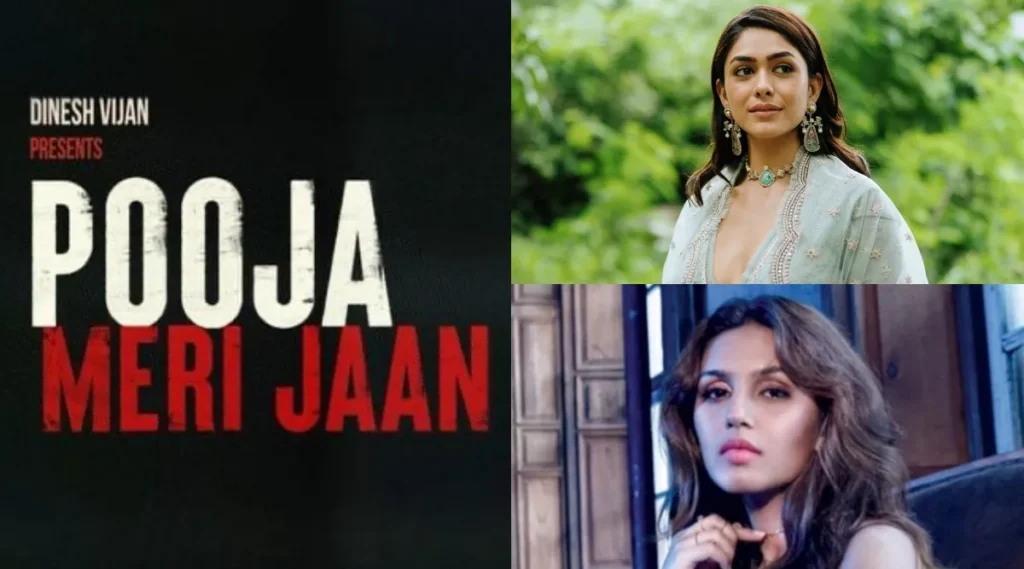
There are some movies that entertain you, some that surprise you, and some that leave you thinking about a question long after the credits roll. Pooja Meri Jaan belongs somewhere in the third category. The new Hindi crime thriller and courtroom drama starring Mrunal Thakur, Huma Qureshi, Vikram Singh Chauhan and Vijay Raaz takes a seemingly simple situation — a woman rejecting a man’s romantic advances — and turns it into a much larger conversation about consent, obsession, emotional responsibility, social judgment and the dangerous consequences of blaming someone without understanding the complete story.
Directed by Navjot Gulati and produced by Dinesh Vijan, Pooja Meri Jaan premiered on ZEE5 on October 2, 2026. The film has a runtime of around 1 hour 57 minutes and carries an A certificate. While the movie is packaged as a crime thriller and courtroom drama, its real subject is much more complicated. It asks what happens when a person’s refusal to enter a relationship is interpreted as cruelty, and whether another person’s emotional reaction can ever become the responsibility of the person who said no.
That makes Pooja Meri Jaan a particularly relevant film for today’s audience. It isn’t simply interested in solving a crime. It wants viewers to question the assumptions that are often made around relationships, rejection and blame.
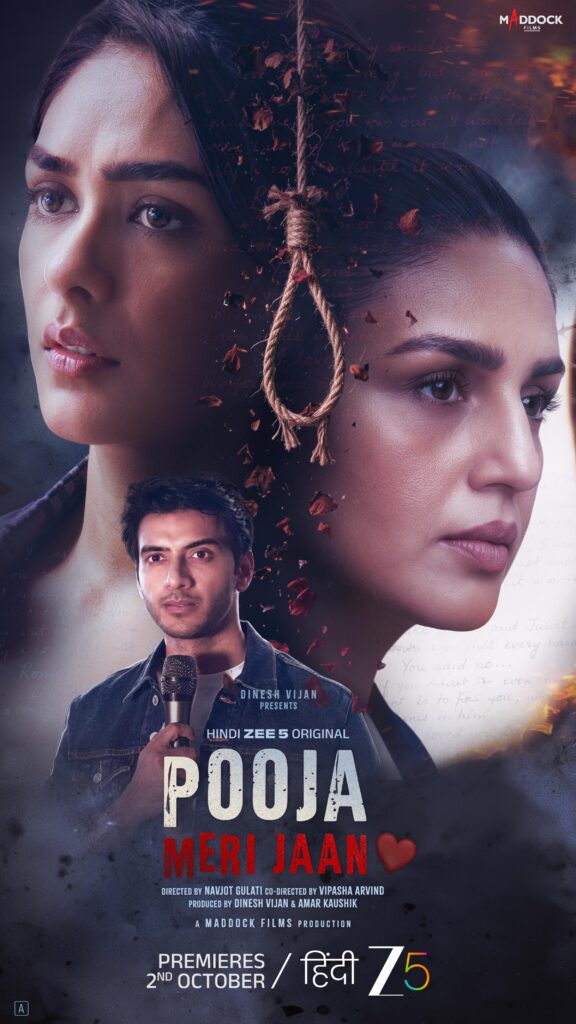
Pooja Meri Jaan Release Date, OTT Platform and Other Details
Pooja Meri Jaan released on ZEE5 on October 2, 2026. Unlike several major Bollywood films that arrive in theatres first, this movie has been positioned as an OTT release, allowing audiences to watch it from home.
The movie has been directed by Navjot Gulati, who has previously been associated with films dealing with contemporary relationships and modern social dynamics. The production comes from Maddock Films, with Dinesh Vijan as producer.
Here are the important details readers searching for the film should know:
- Movie: Pooja Meri Jaan
- Release date: October 2, 2026
- OTT platform: ZEE5
- Language: Hindi
- Genre: Crime thriller, courtroom drama and social drama
- Director: Navjot Gulati
- Producer: Dinesh Vijan
- Lead cast: Mrunal Thakur, Huma Qureshi, Vikram Singh Chauhan and Vijay Raaz
- Runtime: Approximately 1 hour 57 minutes
- Certification: A
- Music: Vishal Mishra
- Cinematography: Jishnu Bhattacharjee
- Editing: Sanyukta Kaza
ZEE5’s official listing confirms the film’s release and principal cast, while industry listings identify it as a crime-oriented drama with courtroom elements.
What Is Pooja Meri Jaan About?
At the centre of Pooja Meri Jaan is Pooja Dogra, a Delhi-based theatre actor played by Mrunal Thakur. Pooja is associated with a theatre group and is involved in a production of Romeo and Juliet. Her life takes a dramatic turn when she becomes the object of romantic interest for her co-actor Aniket Srivastava, played by Vikram Singh Chauhan.
Aniket develops strong feelings for Pooja, but there is one fundamental problem: Pooja doesn’t reciprocate them. She rejects his advances and attempts to create distance between them. What initially appears to be an ordinary situation involving unrequited love gradually becomes much darker.
Aniket struggles to accept Pooja’s rejection. His emotional attachment becomes increasingly complicated, and after his death by suicide, the situation takes an unexpected legal and social turn. A message left behind appears to connect his death with Pooja, and suddenly the woman who rejected him finds herself at the centre of accusations.
Instead of simply grieving or trying to understand what happened, people begin asking whether Pooja is responsible.
That question becomes the foundation of the entire movie.
You May Also Like To Read About:
Pooja Meri Jaan Story: When Saying “No” Becomes Evidence Against You
The most interesting aspect of the story is that Pooja isn’t accused of committing a conventional crime. Her alleged wrongdoing is essentially tied to her relationship with Aniket and the way she responded to his feelings.
After his death, however, the narrative around her begins to change. His family believes that Pooja played a role in what happened. The police become involved, and the situation eventually reaches the courtroom.
This is where the movie expands beyond a relationship drama.
Pooja’s character, her behaviour, her friendships and her past are all examined. Things that would normally be considered private suddenly become part of a public argument about whether she should be blamed.
Her legal battle therefore becomes only one part of the problem. She is also fighting a battle against public perception.
The film explores a disturbing modern reality: once an accusation becomes public, proving that the accusation is wrong can be much harder than making the accusation in the first place.
Social media, gossip, emotional reactions and incomplete information begin shaping public opinion before the legal process can establish the facts.
The Central Question of Pooja Meri Jaan
The most important question in the film isn’t really whether Pooja loved Aniket.
It is whether one person’s rejection can make them responsible for another person’s subsequent decision.
That distinction is at the heart of the screenplay.
The film asks audiences to think about the difference between heartbreak and entitlement. Someone can genuinely experience emotional pain after rejection, but does that automatically create an obligation for the other person to reciprocate their feelings?
And if that rejection is followed by tragedy, should responsibility automatically be transferred to the person who said no?
Pooja Meri Jaan doesn’t treat these questions as simple black-and-white issues. Instead, it places them inside a courtroom and allows different characters to argue competing perspectives.
That approach gives the movie much more substance than a conventional romantic thriller.
Mrunal Thakur as Pooja
Mrunal Thakur is the emotional centre of the film, and much of Pooja Meri Jaan’s success depends on whether audiences believe her character’s transformation from an ordinary theatre actor into a woman suddenly forced to defend herself against accusations.
Mrunal handles that progression effectively.
Pooja isn’t presented as an unrealistically perfect victim. She gets angry, becomes frustrated and occasionally reacts emotionally. She isn’t constantly calm or articulate, which makes her feel more human.
Her strongest moments come when she is simply trying to understand how her personal life has suddenly become a public case.
India Today praised the film’s central premise and highlighted Mrunal’s performance while discussing the movie’s themes of love, rejection and male entitlement.
What makes her performance work is that she doesn’t play Pooja as someone who has all the answers. She plays her as someone trying to survive a situation she never expected to be in.
Huma Qureshi as Sana Mehfooz
Huma Qureshi plays Sana Mehfooz, a lawyer and friend who becomes an important part of Pooja’s legal battle.
Sana’s role gives Huma the opportunity to bring authority and intensity to the courtroom sequences. She isn’t simply there to deliver dramatic legal speeches. Her character has to understand the emotional circumstances surrounding the case while also breaking down the arguments being made against Pooja.
The relationship between Sana and Pooja also provides the film with an important emotional foundation. Sana is not just defending a client; she is defending someone she knows personally.
Huma brings a certain confidence to those scenes, particularly when the film shifts from emotional drama into legal confrontation.
Vikram Singh Chauhan as Aniket
Vikram Singh Chauhan plays Aniket Srivastava, the man whose feelings for Pooja become the catalyst for the entire story.
The role is challenging because Aniket cannot simply be portrayed as a stereotypical villain. His emotions are initially presented as genuine, and that makes the later developments more complicated.
The film wants viewers to think about an important distinction: having genuine feelings for somebody doesn’t automatically give you a right to that person’s affection.
Aniket’s character represents the uncomfortable territory between love, emotional dependence and entitlement.
That is also why his character continues to influence the story even after his death.
Vijay Raaz Brings Another Perspective
Vijay Raaz plays Jatin Trivedi, a lawyer and self-described men’s-rights activist who becomes involved in the case.
This is one of the film’s more interesting casting choices because Jatin isn’t written merely as a ridiculous antagonist. He represents a competing interpretation of what happened.
His arguments may frustrate viewers who sympathise with Pooja, but that is precisely why the character is useful.
If every opposing argument were obviously foolish, the courtroom conflict would have very little dramatic value.
Vijay Raaz gives the character enough conviction to make the audience actually consider what he is saying before deciding whether they agree with it.
Why Pooja Meri Jaan Is More Than a Courtroom Thriller
Calling Pooja Meri Jaan simply a courtroom drama doesn’t quite capture its ambitions.
The courtroom is really a metaphor for the way Pooja is judged everywhere.
She is judged by the police, by Aniket’s family, by strangers, by social media and eventually by the audience.
The film repeatedly asks how much information people need before deciding that someone is guilty.
This becomes particularly relevant in the age of social media, where allegations can spread within minutes.
A photograph can be taken out of context. A message can be interpreted differently. A voice recording can become “proof” in the public imagination. A relationship can be turned into a motive.
Pooja Meri Jaan uses these elements to explore how quickly public opinion can become a substitute for evidence.

Consent Is the Real Subject of the Movie
While the film is packaged as a thriller, its strongest thematic idea is consent.
The movie repeatedly returns to the idea that rejection is not an invitation to negotiate indefinitely.
A person can say no to a relationship.
A person can change their mind.
A person can refuse someone’s affection without having to provide a justification that satisfies the other person.
That sounds obvious, but the film’s story demonstrates how complicated that principle can become when emotions, tragedy and public opinion enter the picture.
Cinema Express praised the film for exploring male entitlement and the social pressure surrounding women’s choices.
The movie therefore becomes less about one particular relationship and more about a larger cultural question: Why does society sometimes find it easier to blame the person who rejected someone than to accept that rejection itself is a complete answer?
Pooja Meri Jaan and the Court of Public Opinion
One of the film’s most contemporary elements is its depiction of social-media judgment.
The legal case develops alongside a public narrative, and that distinction is important.
The law requires evidence.
Public opinion often doesn’t.
Once people emotionally identify with one side of a story, they can interpret every subsequent development through that existing belief.
Pooja therefore has two battles to fight: one inside the courtroom and another outside it.
This aspect makes the movie particularly relevant to modern audiences because social-media trials have become an increasingly familiar part of public life.
The film doesn’t suggest that every accusation is false or that every accused person is innocent. Instead, it raises a more fundamental question:
Should a person’s guilt be decided by evidence or by the loudest version of the story?
Pooja Meri Jaan: What Critics Are Saying
The early critical response to Pooja Meri Jaan has been generally positive, although critics have also pointed out weaknesses in the execution.
Bollywood Hungama rated the film 3/5, praising its topical premise, performances and dialogue while noting that some courtroom portions don’t always work equally well.
NDTV also gave the film 3/5, describing it as a one-time watch and appreciating its exploration of gender bias and the emotional consequences of rejection.
Times of India found the premise intriguing and highlighted the questions surrounding rejection, responsibility and blame.
Cinema Express viewed the film as a thought-provoking examination of male entitlement and social judgment, particularly praising its central subject.
Rediff considered the film well-intentioned, while also noting that some portions become somewhat heavy-handed.
India Today praised the relevance of the story and Mrunal Thakur’s performance but suggested that the filmmaking doesn’t always match the strength of its subject.
Taken together, the early reviews suggest a film with a strong and timely premise, good performances and meaningful social commentary, but one that occasionally struggles to translate those ideas into consistently powerful courtroom storytelling.
What Works in Pooja Meri Jaan?
Several aspects of the movie stand out positively.
- The premise is highly relevant. The film takes an everyday relationship issue and examines its darker consequences.
- Mrunal Thakur delivers a convincing central performance. Her character’s emotional journey provides the film with its strongest dramatic element.
- Huma Qureshi adds weight to the courtroom sections. Her legal character provides structure to the second half.
- Vijay Raaz brings complexity to the opposing side. His character isn’t merely a caricature.
- The film raises meaningful questions about consent and rejection. It encourages viewers to think beyond the immediate crime-thriller narrative.
- The relatively short runtime works in its favour. At around two hours, the movie doesn’t become an unnecessarily long courtroom saga.
Where Pooja Meri Jaan Could Have Been Better
The film’s biggest weakness is that its subject is sometimes stronger than its execution.
The central idea is powerful enough to sustain an entire film, but certain courtroom sequences feel designed primarily to communicate a message rather than emerge naturally from the characters.
There are moments when the screenplay seems to tell audiences what they should think instead of allowing them to arrive at the conclusion themselves.
That reduces some of the ambiguity that could have made the film even more compelling.
The courtroom drama also doesn’t always reach the intensity of the strongest films in the genre. There are effective exchanges, but some scenes feel more like statements of the film’s social position than genuine legal confrontations.
This is particularly noticeable because the film’s premise is sophisticated enough to support a more nuanced screenplay.
Pooja Meri Jaan Direction and Screenplay
Director Navjot Gulati deserves credit for choosing a subject that could easily have been turned into a simplistic morality tale.
Instead, the film tries to create competing perspectives.
The screenplay, credited to Kanishka, Niren Bhatt and Navjot Gulati, uses different characters to construct different versions of the same events.
This is one of the smarter aspects of the storytelling.
The facts may remain the same, but the interpretation changes depending on who is telling the story.
That idea fits perfectly with the film’s larger theme because Pooja’s entire problem is that people are constructing a version of her story without necessarily understanding the complete truth.
Music, Cinematography and Technical Aspects
The film’s music has been composed by Vishal Mishra, while the background score is by John Stewart Eduri. According to Bollywood Hungama, the songs do not leave as strong an impression as the background score, which contributes more effectively to the thriller atmosphere.
The cinematography by Jishnu Bhattacharjee keeps the film grounded and realistic rather than giving it an overly glossy Bollywood appearance.
The editing by Sanyukta Kaza helps maintain the pace, which is particularly important for a film that moves between relationship drama, investigation and courtroom proceedings.
Is Pooja Meri Jaan Based on a True Story?
There is no indication from the official material that Pooja Meri Jaan is based on one specific real-life incident.
The film is presented as a fictional story.
However, its themes are very much rooted in real-world conversations surrounding relationships, consent, rejection, stalking, emotional dependency, victim blaming and social-media judgment.
That distinction is important: the story is fictional, but the social questions it raises are very real.
Pooja Meri Jaan Ending: Does the Climax Work?
The film’s ending attempts to bring together its legal and emotional arguments without turning the conclusion into a conventional Bollywood courtroom victory lap.
The important thing isn’t simply whether Pooja wins or loses her legal battle.
The bigger question is whether the people around her are finally willing to distinguish between tragedy and responsibility.
The climax may divide audiences because the movie’s social message is more important to the filmmakers than delivering a completely unpredictable thriller ending.
For viewers who prefer character-driven courtroom dramas, that approach should work reasonably well. Those looking for a twist-heavy crime thriller may find the conclusion less satisfying.
I would recommend watching the film before reading a detailed spoiler-based ending explanation because much of its impact comes from watching the characters’ assumptions change throughout the story.
My Personal Review of Pooja Meri Jaan
What I found most interesting about Pooja Meri Jaan is that it refuses to make rejection a simple romantic obstacle.
Bollywood has spent decades portraying persistence as romance. The hero continues trying, the heroine initially refuses and eventually changes her mind, and the audience is encouraged to see persistence as proof of love.
Pooja Meri Jaan asks what happens when that formula doesn’t end with the heroine changing her mind.
What happens when she continues saying no?
And what happens when something tragic follows?
Those are uncomfortable questions, and the movie deserves credit for putting them at the centre of a mainstream Hindi thriller.
The execution isn’t flawless. Some courtroom scenes are too direct, and the screenplay occasionally explains its message instead of trusting the audience.
But the performances give the film enough emotional weight to remain engaging.
Mrunal Thakur is the standout for me. Huma Qureshi provides a strong supporting performance, while Vijay Raaz adds the kind of ambiguity that prevents the courtroom conflict from becoming completely predictable.
The film isn’t a perfect courtroom thriller, but it is a worthwhile social drama wrapped inside a crime story.
My Rating: 3.5/5 ⭐
- Story: 4/5
- Screenplay: 3.5/5
- Direction: 3.5/5
- Performances: 4/5
- Courtroom drama: 3.5/5
- Social relevance: 4.5/5
- Music: 2.5/5
- Overall: 3.5/5
Is Pooja Meri Jaan Worth Watching?
If you’re looking for a light romantic movie, Pooja Meri Jaan is probably not what you’re expecting.
If you enjoy socially relevant crime dramas, courtroom stories and films that explore complicated relationship dynamics, however, it is worth adding to your ZEE5 watchlist.
The biggest reason to watch isn’t the mystery alone.
It is the conversation the film creates around rejection and responsibility.
The movie doesn’t suggest that every situation involving heartbreak has an easy answer. Instead, it asks audiences to separate emotional pain from the idea of ownership.
And that makes Pooja Meri Jaan considerably more interesting than a standard romantic thriller.
Pooja Meri Jaan vs a Typical Bollywood Romance
A conventional Bollywood love story often revolves around whether two people will eventually fall in love.
Pooja Meri Jaan begins from the opposite position: what happens when only one person wants the relationship?
Traditional romantic storytelling can sometimes present persistence as proof of genuine love. This movie asks whether persistence can become pressure when the other person has already made their position clear.
That difference is central to the film.
It transforms what could have been a familiar unrequited-love story into a discussion about consent, boundaries and emotional responsibility.
Final Verdict: Pooja Meri Jaan Review
Pooja Meri Jaan is an ambitious and relevant Hindi courtroom thriller that is stronger in its subject and performances than in the execution of every courtroom sequence.
Mrunal Thakur carries the emotional weight of the film effectively, while Huma Qureshi gives the legal narrative the confidence it needs. Vijay Raaz is particularly effective because his character provides an opposing perspective rather than functioning as a straightforward villain.
Navjot Gulati’s film doesn’t have the polished unpredictability of the best courtroom thrillers, but it does something equally important: it makes the audience reconsider an assumption that is often taken for granted.
A person’s “No” should not automatically become a crime simply because someone else cannot accept it.
That is ultimately what Pooja Meri Jaan wants its audience to think about.
It may not be a flawless film, but it is certainly a film with something to say.
Pooja Meri Jaan — 3.5/5 ⭐
Worth watching for Mrunal Thakur’s performance, its socially relevant premise and the uncomfortable questions it leaves behind.
Pooja Meri Jaan FAQs
What is Pooja Meri Jaan about?
Pooja Meri Jaan follows Pooja Dogra, a Delhi theatre actor whose life changes after she rejects the romantic advances of Aniket. After Aniket dies by suicide, Pooja becomes the subject of accusations and eventually has to defend herself in court. The film explores rejection, consent, emotional responsibility, social judgment and victim blaming.
When was Pooja Meri Jaan released?
Pooja Meri Jaan premiered on October 2, 2026.
Where can I watch Pooja Meri Jaan?
The movie is streaming on ZEE5.
Who is in the Pooja Meri Jaan cast?
The principal cast includes Mrunal Thakur, Huma Qureshi, Vikram Singh Chauhan and Vijay Raaz.
Who plays Pooja in Pooja Meri Jaan?
Mrunal Thakur plays Pooja Dogra, the central character in the film.
Who plays Aniket in Pooja Meri Jaan?
Vikram Singh Chauhan plays Aniket Srivastava, the man whose romantic feelings for Pooja become central to the story.
Who plays the lawyer in Pooja Meri Jaan?
Huma Qureshi plays Sana Mehfooz, the lawyer who represents Pooja. Vijay Raaz also plays lawyer Jatin Trivedi, who becomes involved from the opposing side.
Who directed Pooja Meri Jaan?
The movie was directed by Navjot Gulati.
Is Pooja Meri Jaan a courtroom drama?
Yes. It combines elements of a crime thriller, courtroom drama and social drama, with the legal case forming a major part of the second half.
Is Pooja Meri Jaan based on a true story?
No specific real-life incident has been identified by the makers as the direct basis for the story. It is a fictional narrative dealing with real-world issues such as rejection, consent, obsession and victim blaming.
Is Pooja Meri Jaan a romantic movie?
The story begins with romantic interest, but it is not a conventional romantic film. It develops into a crime and courtroom drama examining what happens when romantic feelings are not reciprocated.
What is the main message of Pooja Meri Jaan?
The movie explores the importance of accepting rejection and respecting consent. It also questions whether one person should be blamed for another person’s emotional response to rejection.
Is Pooja Meri Jaan worth watching?
For audiences interested in Hindi courtroom dramas, socially relevant thrillers, relationship dramas and films about consent, the movie is worth watching. The performances and premise are stronger than some of the screenplay’s courtroom execution.
What is Pooja Meri Jaan’s rating?
My rating for Pooja Meri Jaan is 3.5 out of 5 stars. Critics have generally responded positively to the film’s premise and performances, although several reviews have identified weaknesses in the execution.

Hi, I’m Prashant Jain — a film enthusiast and critic who lives and breathes cinema. From big-screen releases to the latest drops on OTT, I watch extensively and review honestly, without hype or bias.
I believe a good review should go beyond just “good” or “bad.” It should help you understand what works, what doesn’t, and whether a film is truly worth your time. My reviews focus on storytelling, performances, direction, and overall impact — all through the lens of a genuine viewer.
I regularly cover new movie releases and trending web series across OTT, bringing clear, no-nonsense insights for audiences who want real opinions, not paid praise.
Through PopNewsBlend, I aim to cut through the noise and give you reviews you can trust — whether you’re deciding what to watch next or just love discussing cinema as much as I do.
Discover more from Popnewsblend
Subscribe to get the latest posts sent to your email.
Related posts:
 Squid Game Season 3: Netflix’s Global Sensation Ends With a Bang
 Anil Kapoor’s 24 Series on Jio Hotstar (April 24): Why This Iconic Thriller Is a Must-Watch Again
 Berlin and the Lady with an Ermine – Netflix Original Series — Deep Dive Review & Analysis
 System on Amazon Prime Video Review 2026: Sonakshi Sinha and Jyotika Deliver a Courtroom Drama That Hits Harder Than You Expect