There is a moment in Daayra when you realise that Meghna Gulzar is not really interested in giving you an easy answer.
You have just watched something terrible happen.
A young woman is brutally murdered.
Four men accused of the crime are killed in a police encounter.
The public celebrates.
Sweets are distributed.
The police officers involved are suddenly treated like heroes.
And for a few moments, you understand why.
If someone has committed an unimaginably horrific crime, isn’t eliminating them a form of justice?
Then the film asks the uncomfortable question.
What if the police encounter was not justice at all?
What if the people who are supposed to enforce the law decided that the law was too slow?
And what happens when the same society that demands justice also celebrates the killing of suspects before a court has established their guilt?
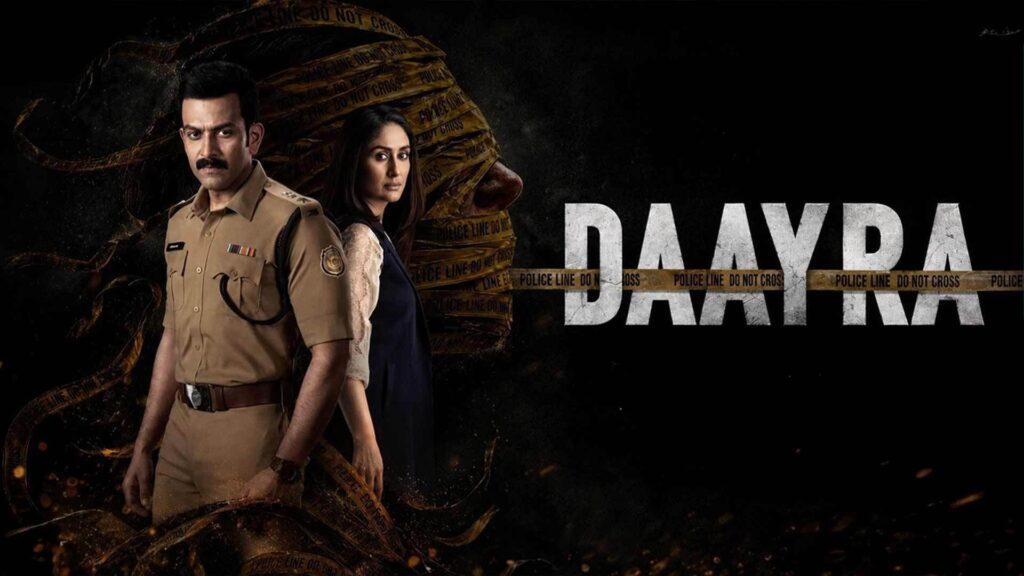
That is the uncomfortable territory explored by Daayra, Meghna Gulzar’s investigative crime thriller starring Kareena Kapoor Khan and Prithviraj Sukumaran.
Released in theatres on September 18, 2026, the film is built around two police officers with very different ideas about what justice should look like. Kareena plays DCP Ajooni Kohli, an Internal Vigilance officer tasked with investigating the encounter, while Prithviraj plays DCP Raman Kumar, the police officer whose team carried it out.
And after watching the film, one thing is clear.
Daayra is much more interested in the question of justice than in the crime itself.
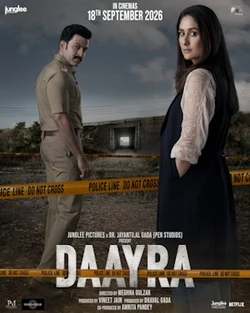
Daayra Movie Plot
The film begins with the disappearance of a young woman named Ragini.
Her family approaches the police, but the case does not receive the urgency they expect.
Then her burnt body is discovered.
The case quickly becomes a media storm.
Under pressure to find the perpetrators, DCP Raman Kumar and his team arrest four men accused of the crime.
But before the accused can be produced in court, they are killed in a police encounter.
The official version is straightforward.
The suspects attempted to escape.
They allegedly opened fire.
The police retaliated.
The accused died.
For a public furious over the original crime, the encounter feels like instant justice.
But not everyone believes the official version.
Enter DCP Ajooni Kohli.
She is assigned to investigate what actually happened.
And this is where Daayra shifts from a conventional crime thriller into something more interesting.
The central question is no longer simply:
Who committed the crime?
It becomes:
Who gets to decide what justice looks like?
Daayra Cast
Kareena Kapoor Khan as DCP Ajooni Kohli
Kareena is playing a police officer here, but this is not the usual Bollywood cop performance.
Ajooni is controlled.
She listens.
She observes.
She does not arrive at every conclusion immediately.
That restraint is important because the character could easily have been written as the stereotypical fearless female officer who walks into every room and dominates everyone.
Instead, Kareena keeps much of the performance contained.
There are moments when you can see Ajooni processing information without immediately revealing what she thinks.
That works.
However, there are also times when you feel the screenplay has not given Kareena enough dramatic material to fully exploit what she brings to the role.
And that is one of Daayra’s recurring problems.
The actor sometimes appears more interesting than the material.
Prithviraj Sukumaran as DCP Raman Kumar
Prithviraj is the more immediately convincing presence.
Raman is not presented as a cartoon villain.
That would have made the film much easier.
Instead, he genuinely believes that his actions are justified.
He sees himself as a police officer who is doing what the system is unable or unwilling to do.
And that makes the character considerably more disturbing.
Because Raman’s argument is not completely absurd.
There are moments when you almost understand where he is coming from.
That is precisely where Prithviraj’s performance works.
He does not constantly try to look intimidating.
He simply behaves like a man who believes that he is right.
And that confidence carries considerable weight.
The Indian Express also singled out Prithviraj’s contained performance as one of the film’s stronger elements.
You May Also Like To Read About:
- Om Ka Hari Review
- Lust Stories 3 Review
- Mirzapur: The Movie Review
- Khosla Ka Ghosla 2 Review
- Toxic Movie Review
Daayra Review: The Real Battle Is Not Between Two Cops
At first glance, Daayra looks like a Kareena Kapoor versus Prithviraj Sukumaran movie.
It isn’t.
The real battle is between two ideas.
Law versus instant justice.
Procedure versus public anger.
Evidence versus belief.
Accountability versus closure.
Ajooni believes that a police officer cannot decide guilt and punishment at the same time.
Raman appears to believe that there are situations where waiting for the legal system is itself a form of injustice.
That argument is what gives Daayra its backbone.
The movie doesn’t ask you to forget the brutality of the original crime.
Instead, it asks whether outrage over one crime can justify another violation of due process.
That is a much harder question.
And thankfully, the film does not treat it like a simple good-cop/bad-cop story.
What Makes Daayra Different From a Typical Crime Thriller?
The obvious answer is that the investigation is not primarily about finding the murderer.
You already know what happened to the accused.
The mystery is about the encounter itself.
Was it genuine?
Was it staged?
Were the accused actually trying to escape?
Did the police follow procedure?
And if they didn’t, does the horror of the original crime somehow change how we judge the encounter?
That structure allows Meghna Gulzar to move away from the traditional whodunit.
The film becomes a moral investigation.
And that is where Daayra is at its most effective.
Meghna Gulzar’s Direction
Meghna Gulzar has repeatedly shown an interest in stories where the truth is less comfortable than the first version presented to us.
With Daayra, she again puts the audience in an uncomfortable position.
The film does not simply tell you what to think.
It lets different characters make their arguments.
That is particularly effective during the scenes involving the police investigation.
There is also a deliberate seriousness to the filmmaking.
Daayra doesn’t try to turn a sensitive subject into a mass-action spectacle.
The violence has consequences.
The investigation feels procedural.
And the film spends time with the uncomfortable aftermath rather than simply celebrating revenge.
NDTV described the film as a police drama that blends thriller and procedural elements while focusing on the conflict between its two DCPs.
Follow us on Instagram to get regular latest Bollywood release and ratings updates.
Where Daayra Works Best
1. The Central Question
The strongest thing about the film is its question about justice.
Most crime thrillers ask who did it.
Daayra asks whether the people responsible for delivering justice can themselves cross the line.
That stays with you after the film ends.
2. Prithviraj’s Performance
Prithviraj brings an authority to Raman that makes the character believable.
He does not need to shout in every scene.
His confidence does most of the work.
3. Kareena’s Controlled Performance
Ajooni is not written as an action hero.
She is an investigator.
Kareena understands that difference.
Her performance is strongest when she is simply observing people and putting pieces together.
4. The Investigation
The procedural portions are where Daayra becomes genuinely engaging.
The film makes you wait for information rather than throwing revelations at you every ten minutes.
5. The Moral Ambiguity
The film does not make the central debate completely comfortable.
And that is a good thing.
You may find yourself understanding Raman’s frustration while still questioning his actions.
That tension is the movie’s most interesting achievement.
Where Daayra Could Have Been Better
This is where my experience of the film became more mixed.
The premise is excellent.
The performances are strong.
The subject matter is powerful.
But the screenplay doesn’t always maintain the same intensity.
The film takes its time establishing the investigation, and some portions feel slower than they need to be.
The first half is more procedural, while the second half attempts to push the moral confrontation harder.
That shift doesn’t always feel completely smooth.
Several critics have pointed to similar issues. The Hindustan Times found the film initially slow but praised its morally complex investigation, while Bollywood Hungama felt the film’s second half and climax did not fully live up to its premise.
And I can understand both reactions.
There is a very good film inside Daayra.
But there are moments when you can almost see the screenplay struggling to get there.
The Biggest Problem With Daayra
For me, the biggest weakness is that the central confrontation could have been sharper.
You have two intelligent police officers.
Both have strong positions.
Both have reasons for what they believe.
That should produce explosive conversations.
But some of those confrontations don’t quite reach the emotional or intellectual intensity the setup promises.
The film raises big questions.
Sometimes, however, the characters don’t get equally powerful arguments to answer them.
That imbalance becomes more noticeable toward the end.
The Times of India made a similar observation, noting that while Daayra raises important questions, its central confrontation could have benefited from sharper and more evenly matched arguments.
Kareena Kapoor and Prithviraj: Who Makes the Bigger Impact?
If I had to separate the two performances purely on what the film gives them, Prithviraj has the more immediately memorable role.
Raman is written with more ambiguity.
You can dislike his methods while still understanding his frustration.
Kareena’s Ajooni is the moral counterpoint.
She represents procedure and accountability.
But because the character is more controlled, her performance takes longer to register.
That isn’t necessarily a weakness in Kareena’s acting.
It is more a question of writing.
She has the less flamboyant role.
The Film’s Most Important Idea
Daayra keeps returning to one uncomfortable idea:
When people lose faith in the system, they start looking for justice outside it.
That can happen when cases take too long.
It can happen when victims feel ignored.
It can happen when people believe powerful individuals can escape consequences.
But once society begins accepting punishment without due process, another question emerges.
Who decides who deserves punishment?
And what happens when that person is wrong?
The film does not provide an easy solution.
It shouldn’t.
Is Daayra Based on a True Story?
Daayra is described as a work of fiction inspired by a narrative of events available to the public, rather than a straightforward recreation of one specific real-life case. The film uses its fictional characters and setting to explore questions surrounding crime, policing, encounters and justice.
That distinction is important.
The film may remind viewers of real incidents involving police encounters and public debates over vigilante justice, but it should not automatically be treated as a direct retelling of one particular case.
Daayra vs Meghna Gulzar’s Previous Films
Comparisons with Meghna Gulzar’s earlier work are inevitable.
Films such as Talvar, Raazi and Sam Bahadur demonstrated her interest in stories where character, institutions and circumstances matter as much as conventional plot mechanics.
Daayra sits closer to Talvar in spirit because it is interested in the investigation itself and the uncomfortable questions surrounding truth and accountability.
But Daayra is not as tightly constructed as Talvar.
That earlier film had a particularly strong sense of investigative uncertainty.
Daayra has a compelling moral premise, but its screenplay occasionally becomes more predictable than its subject deserves.
Daayra Climax: Does It Deliver?
Without giving away the ending, I would say this:
The climax gives you the confrontation the film has been building toward, but I wanted it to hit harder.
The ideas are there.
The emotional stakes are there.
The performances are there.
But the payoff feels somewhat less explosive than the setup suggests.
That is not to say the ending doesn’t work.
It is more that the film spends so much time building the moral argument that you expect the final stretch to completely knock the argument apart or deepen it.
Instead, it lands somewhere in between.
Is Daayra Worth Watching?
Yes, particularly if you enjoy serious Hindi crime thrillers that are more interested in questions than explosions.
If you are looking for a fast-paced police action movie, Daayra may feel slow.
If you enjoy investigative dramas, morally complicated characters and stories about the justice system, there is considerably more to appreciate.
The film is also worth watching for Prithviraj and Kareena.
But I would go into it expecting a crime drama and moral investigation, not a conventional Bollywood thriller.
My Personal View
What stayed with me after Daayra was not the crime.
It was the reaction to the crime.
The cheering.
The celebrations.
The feeling that justice had finally arrived.
And then the uncomfortable realisation that perhaps what people were celebrating was not justice at all, but revenge.
That is a powerful place for a movie to take you.
I also liked that Raman isn’t written as an easy villain.
If he were simply corrupt, the entire debate would become meaningless.
The interesting part is that he believes the system is failing and that he is doing what needs to be done.
The problem is that once an individual decides that the law is no longer enough, the definition of justice becomes dangerously personal.
That is the film’s strongest thought.
My frustration was that the screenplay doesn’t always explore that thought as deeply as it could.
There are stretches where the movie feels absolutely gripping.
Then there are stretches where the momentum drops.
The performances keep it alive.
The subject keeps you interested.
But the writing doesn’t always keep pace with the ambition.
Daayra Rating
My Rating: 3.5/5
Story: 3.5/5
Acting: 4/5
Direction: 3.5/5
Screenplay: 3/5
Thriller Element: 3.5/5
Emotional Impact: 3.5/5
Overall: 3.5/5
The rating reflects the film as a whole rather than simply its premise.
The premise is strong.
The performances are strong.
The questions are important.
The execution is uneven.
Daayra Final Verdict
Daayra is not really asking whether the four accused men deserved to die.
It is asking something much more uncomfortable.
Who gave anyone the right to decide?
That distinction is what makes the film worth discussing.
Kareena Kapoor gives Ajooni a controlled presence, while Prithviraj Sukumaran gives Raman enough conviction to make his character’s argument uncomfortable rather than cartoonish.
Meghna Gulzar creates a serious, morally complicated crime drama that wants you to question the difference between justice and revenge.
It doesn’t always execute that idea perfectly.
Some portions are slow.
The central confrontation could have been stronger.
And the climax doesn’t quite deliver the punch the setup promises.
But when Daayra works, it works because it refuses to give you the easy satisfaction of saying that one side is completely right.
And perhaps that is the real circle, or daayra, the film wants us to think about.
The moment we step outside the law in the name of justice, where exactly do we draw the line?
That question is much harder to answer than it first appears.
Daayra Frequently Asked Questions
What is Daayra movie about?
Daayra is an investigative crime thriller about a young woman’s murder, a police encounter involving four accused men, and the subsequent investigation into whether the encounter was genuine or staged. DCP Ajooni Kohli is tasked with investigating DCP Raman Kumar and his team.
Who directed Daayra?
Daayra is directed by Meghna Gulzar.
Who is in the Daayra cast?
The principal cast includes Kareena Kapoor Khan as DCP Ajooni Kohli and Prithviraj Sukumaran as DCP Raman Kumar, along with Pragati Mishra, Kshitee Jog, Jitendra Joshi and other supporting actors.
When was Daayra released?
Daayra was released in Indian cinemas on September 18, 2026.
What is the genre of Daayra?
Daayra is a Hindi crime thriller, investigative drama and mystery film.
Is Daayra based on a true story?
Daayra is presented as fiction based on a narrative of events available to the public. It should not be treated as a direct recreation of one specific real-life case.
Is Daayra based on a real police encounter?
The film draws on the broader real-world context of police encounters and debates about justice and vigilantism, but the story and characters are fictionalised.
What is the main theme of Daayra?
The central theme is the conflict between law and instant justice. The film asks whether police officers can bypass legal procedure when they believe the justice system has failed.
Is Daayra a remake?
Daayra is presented as an original Meghna Gulzar-directed crime thriller rather than a remake of an earlier Hindi film.
Is Daayra worth watching?
Daayra is likely to appeal most to viewers who enjoy investigative crime dramas and morally complicated stories. Its strong performances and central premise are balanced by slower portions and an uneven screenplay.
Who is better in Daayra, Kareena Kapoor or Prithviraj Sukumaran?
Both actors play deliberately different characters. Kareena’s Ajooni is controlled and investigative, while Prithviraj’s Raman is more forceful and morally ambiguous. Prithviraj’s performance has been particularly noted by critics, while Kareena’s restrained portrayal gives the investigation its counterpoint.
What is the runtime of Daayra?
Daayra has a runtime of approximately 2 hours and 23 minutes.
What is Daayra rated?
Daayra has received an A certificate in India and is intended for adult audiences.
Does Daayra have an OTT release date?
The film released theatrically on September 18, 2026. A confirmed OTT streaming date should be checked with the official streaming platform or distributor before publishing an update.
What is the rating of Daayra?
My personal rating for Daayra is 3.5 out of 5.
Is Daayra better than Talvar?
Both films deal with crime, investigation and questions surrounding justice, but they are different stories. Talvar is more tightly focused on the investigation of a specific murder case, while Daayra places greater emphasis on the moral conflict surrounding policing, encounters and justice.
Final Word
Daayra left me with a question rather than a feeling of complete satisfaction.
And I think that is partly the point.
It isn’t a perfect thriller.
It isn’t consistently gripping.
But it gets you thinking about something that is considerably more uncomfortable than a murder mystery.
What happens when the people responsible for enforcing the law decide that the law itself is getting in the way of justice?
There is no easy answer.
And after watching Daayra, you may find yourself arguing with the film long after the credits have rolled.
That, more than the twists or the investigation, is what makes this movie worth talking about.

Hi, I’m Prashant Jain — a film enthusiast and critic who lives and breathes cinema. From big-screen releases to the latest drops on OTT, I watch extensively and review honestly, without hype or bias.
I believe a good review should go beyond just “good” or “bad.” It should help you understand what works, what doesn’t, and whether a film is truly worth your time. My reviews focus on storytelling, performances, direction, and overall impact — all through the lens of a genuine viewer.
I regularly cover new movie releases and trending web series across OTT, bringing clear, no-nonsense insights for audiences who want real opinions, not paid praise.
Through PopNewsBlend, I aim to cut through the noise and give you reviews you can trust — whether you’re deciding what to watch next or just love discussing cinema as much as I do.
Discover more from Popnewsblend
Subscribe to get the latest posts sent to your email.
Related posts:
 The Ultimate Guide to the Best Bollywood Comedy Movies Ever Made
 Ek Din Movie Review (2026): Junaid Khan & Sai Pallavi Deliver a Soulful Love Story That Stays With You
 System on Amazon Prime Video Review 2026: Sonakshi Sinha and Jyotika Deliver a Courtroom Drama That Hits Harder Than You Expect
 Top Upcoming Movies Releasing in July 2026: Complete Release Calendar, Cast, Story Details and Everything We Know So Far