There are calendars that simply mark days, and then there is the Hindu calendar, which marks meaning. Every festival on it arrives carrying a story, a season, a reason to gather the people you love around a plate of food or a lit diya, and a quiet reminder that faith in India has never really been separate from everyday life. It lives in the smell of incense drifting out of a kitchen window, in the sound of dhol before a procession even turns the corner, in the four days your entire family somehow finds time to be in the same city at once.
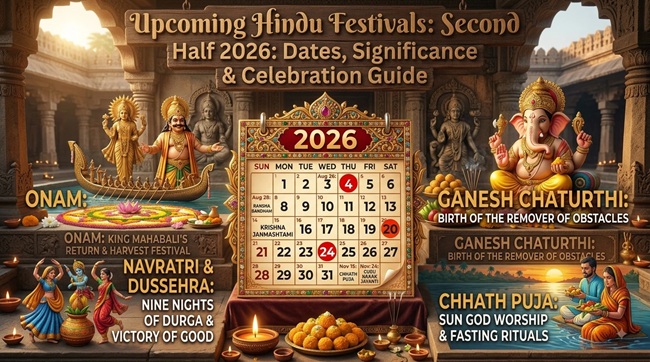
As we move deeper into 2026, the second half of the year is where the calendar truly comes alive. What follows is a complete, date-wise guide to every major Hindu festival still ahead of us this year, along with what each one means, how it is traditionally celebrated, and why it continues to matter as much today as it did generations ago.
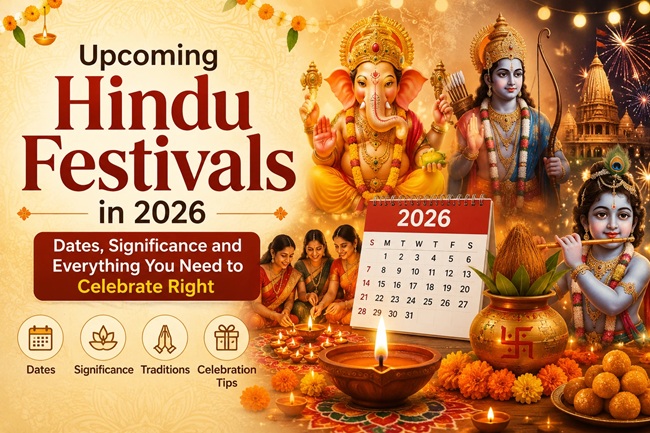
Upcoming Hindu Festivals in 2026
Onam, August 26, 2026
Technically a harvest festival rather than a Hindu religious observance in the strictest sense, Onam is nonetheless deeply woven into Kerala’s spiritual fabric and is celebrated by Malayalis of every faith. The festival marks the legendary homecoming of King Mahabali, a ruler so beloved and just that Lord Vishnu, in his Vamana avatar, is said to have granted him an annual return to the land he once ruled, simply so his people could welcome him home again.
The full celebration spans ten days, beginning with Atham and building toward Thiruvonam, the main day, which falls on August 26 in 2026. Homes are decorated with intricate flower carpets called pookalam, elaborate vegetarian feasts known as Onam Sadhya are served on banana leaves, and Kerala’s backwaters come alive with the thunderous energy of Vallamkali, the traditional snake boat races. If there is one festival on this list that captures pure, unfiltered joy, it is this one.
Raksha Bandhan, August 28, 2026
Just two days after Onam, the festival calendar turns tender with Raksha Bandhan, a celebration built entirely around the bond between siblings. On this day, sisters tie a sacred thread, the rakhi, around their brothers’ wrists as a symbol of protection and love, and brothers respond with gifts and a promise to stand by their sisters through whatever life brings.
The ritual traces back to several legends, the most well known being the story of Draupadi tying a strip of cloth around Lord Krishna’s wrist after he was injured, a gesture he later returned by protecting her in her own moment of need. Though rooted in Hindu tradition, Raksha Bandhan today is celebrated widely across religions and regions, a rare festival that has genuinely transcended its origins to become something closer to a universal celebration of sibling love.
Krishna Janmashtami, September 4, 2026
Janmashtami marks the birth of Lord Krishna, one of Hinduism’s most beloved and playful deities, born at midnight to end an era of tyranny and restore dharma to the world. Devotees observe a day-long fast, breaking it only after midnight, the believed hour of Krishna’s birth, with prayers, bhajans, and elaborate decorations of Krishna’s cradle in temples and homes alike.
The festival is perhaps best known for its most exuberant tradition, Dahi Handi, where young men form human pyramids to break a pot of curd suspended high above the street, recreating Krishna’s own mischievous childhood habit of stealing butter from his neighbours. It is a festival that manages to hold deep devotion and pure, joyful chaos in the same breath, which feels entirely fitting for the deity it celebrates.
Ganesh Chaturthi, September 14 to 23, 2026
Few festivals transform a city’s skyline quite like Ganesh Chaturthi. Beginning on September 14, 2026, this ten-day celebration marks the birth of Lord Ganesha, the remover of obstacles and the deity invoked before any new beginning. Clay idols of Ganesha, ranging from modest home-sized figures to towering public installations, are ceremonially installed, worshipped daily, and finally immersed in rivers, lakes, or the sea on the tenth day, in a ritual known as Visarjan.
While the festival is celebrated across India, its scale in Maharashtra, and particularly in Mumbai, is genuinely unmatched, with massive public pandals drawing millions of devotees over the ten days. In recent years, the conversation around eco-friendly, biodegradable idols has grown louder, as communities try to balance devotion with the environmental toll of traditional plaster of Paris immersions, a shift worth watching as this year’s celebrations unfold.
Sharad Navratri and Dussehra, October 11 to 20, 2026
Navratri, meaning nine nights, is dedicated to the nine forms of Goddess Durga, each honoured on a different day of the festival with distinct colours, rituals, and stories. Sharad Navratri, the most widely celebrated of the year’s four Navratris, begins on October 11, 2026, and builds toward Dussehra, or Vijayadashami, on October 20.
How this festival looks depends heavily on where you are standing. In Gujarat, it means nights of Garba and Dandiya Raas, entire communities dancing in circular formations until well past midnight. In West Bengal, the same nine nights culminate in Durga Puja, with elaborately crafted pandals and idols of the goddess slaying the buffalo demon Mahishasura. Across North India, Dussehra itself marks Lord Rama’s victory over Ravana, commemorated with the burning of towering Ravana effigies. One festival, told through at least three entirely different regional lenses, each equally devoted.
Karva Chauth, October 29, 2026
Nine days after Dussehra, Karva Chauth arrives as one of the most emotionally significant festivals for married women across North and West India. Observed on October 29, 2026, the day involves a strict, sunrise-to-moonrise fast undertaken by wives for the health and longevity of their husbands, broken only after sighting the moon through a traditional sieve, followed by looking at their husband’s face and offering him water.
The festival draws on the legend of Queen Veeravati and the devotion of Savitri, who is said to have won her husband’s life back from Yama, the god of death, through sheer determination and faith. Beyond the fast itself, the day has also become a broader celebration of marital bonds, with mehendi, festive attire, and family gatherings woven into the modern observance.
Dhanteras and Diwali, November 6 to 8, 2026
The festival most of India waits for all year begins quietly with Dhanteras on November 6, 2026, a day traditionally associated with purchasing gold, silver, or new utensils, believed to invite prosperity into the home. Two days later, on November 8, comes Diwali itself, the festival of lights, marking Lord Rama’s return to Ayodhya after fourteen years of exile and his victory over Ravana.
Homes are lit with rows of diyas, rangoli patterns bloom across doorsteps, families gather for Lakshmi Puja to invite the goddess of wealth into their homes, and the sky, for one night, belongs to fireworks. Diwali is one of the rare festivals that manages to be both deeply devotional and unapologetically festive at the very same time, a celebration of light overcoming darkness that somehow still feels personal to every single household that observes it.
Govardhan Puja and Bhai Dooj, November 10 to 11, 2026
The celebrations continue almost without pause. Govardhan Puja, observed on November 10, 2026, commemorates Lord Krishna lifting the Govardhan hill to shelter the people of Vrindavan from Indra’s wrath, a story often read as a lesson in protecting community over blind ritual. The very next day, November 11, brings Bhai Dooj, a sibling festival similar in spirit to Raksha Bandhan, where sisters pray for their brothers’ long life and brothers, in turn, promise to protect and support them.
Together, these two days round off the Diwali festivities on a note of gratitude, both toward nature and toward family, before the year moves into its final major stretch of celebrations.
Chhath Puja, November 15, 2026
Few festivals demand the physical devotion that Chhath Puja does. Observed primarily in Bihar, Jharkhand, and parts of Uttar Pradesh, but celebrated with equal passion by communities across the country and the world, Chhath Puja on November 15, 2026, is dedicated to Surya, the sun god, and Chhathi Maiya.
Devotees undertake a rigorous four-day fast that includes standing in rivers or ponds at both sunset and sunrise to offer prayers directly to the sun, a ritual demanding both physical endurance and unwavering faith. It is one of the few major Hindu festivals with no idol worship at all, its devotion expressed purely through nature, water, and the rising and setting sun, which gives it a rawness that feels genuinely distinct from anything else on this list.
Guru Nanak Jayanti, November 24, 2026
While primarily a Sikh festival, Guru Nanak Jayanti, falling on Kartik Purnima, November 24 in 2026, is widely observed and respected across Hindu communities as well, a reflection of how deeply intertwined Sikh and Hindu traditions have historically been in North India. The day marks the birth anniversary of Guru Nanak Dev Ji, the founder of Sikhism, and is celebrated with Prabhat Pheris, early morning devotional processions, continuous recitations of scripture known as Akhand Path, and community meals, or langar, offered freely to all visitors regardless of faith or background.
Why These Dates Move Every Year
If you have ever wondered why Diwali fell in October one year and November the next, the answer lies in how the Hindu calendar itself is built. Unlike the Gregorian calendar, which is purely solar, the Hindu Panchang is lunisolar, tracking both the movement of the moon through tithis and the sun’s position through the year. Most major festivals are anchored to a specific lunar tithi, which means their corresponding Gregorian date shifts annually, sometimes by as much as a few weeks. A smaller number of festivals, like Makar Sankranti, are tied to the sun’s solar transition instead, which is why that particular festival reliably falls around the same date, January 14, every single year. Worth remembering the next time someone in the family insists a festival is “late” this year.
Frequently Asked Questions
Which Hindu festival is coming up next after August 16, 2026? Onam, falling on August 26, 2026, is the next major festival on the calendar, followed closely by Raksha Bandhan on August 28.
What is the most important Hindu festival of 2026? Diwali, observed on November 8, 2026, is widely regarded as the most significant and widely celebrated Hindu festival of the year, drawing participation from Hindu communities across virtually every region of India and among the global diaspora.
Why do Hindu festival dates change every year? Hindu festivals follow the Panchang, a lunisolar calendar based on both moon phases and sun positions, which is why most festival dates shift each year relative to the fixed Gregorian calendar, while a small number of solar festivals remain on a consistent date.
How many days does Ganesh Chaturthi last in 2026? Ganesh Chaturthi 2026 begins on September 14 and continues for ten days, concluding with Ganpati Visarjan around September 23.
Is Onam considered a Hindu festival? Onam originated as a Hindu harvest festival tied to the legend of King Mahabali and Lord Vishnu’s Vamana avatar, though today it is celebrated as a broader cultural festival by people of all faiths across Kerala.
What is the difference between Dussehra and Diwali? Dussehra, observed on October 20, 2026, marks Lord Rama’s victory over Ravana and the triumph of good over evil, while Diwali, observed roughly nineteen days later on November 8, commemorates Rama’s return home to Ayodhya and is centred on Lakshmi Puja and the lighting of diyas.
Which Hindu festivals in 2026 involve fasting? Several major festivals on this list involve fasting, including Janmashtami, Karva Chauth, and Chhath Puja, each with its own specific duration, rules, and spiritual significance behind the practice.
Disclaimer
This article is intended for general informational and cultural purposes only. Festival dates in the Hindu calendar are determined by regional Panchang calculations and can vary slightly depending on location, sect, and local tradition. Readers are encouraged to verify exact dates, muhurat timings, and regional variations with a local Panchang, temple, or family priest before finalising travel, puja, or celebration plans. This article does not intend to disrespect or misrepresent any religious belief, community, or tradition referenced.
Hi, I’m Prashant Jain — a film enthusiast and critic who lives and breathes cinema. From big-screen releases to the latest drops on OTT, I watch extensively and review honestly, without hype or bias.
I believe a good review should go beyond just “good” or “bad.” It should help you understand what works, what doesn’t, and whether a film is truly worth your time. My reviews focus on storytelling, performances, direction, and overall impact — all through the lens of a genuine viewer.
I regularly cover new movie releases and trending web series across OTT, bringing clear, no-nonsense insights for audiences who want real opinions, not paid praise.
Through PopNewsBlend, I aim to cut through the noise and give you reviews you can trust — whether you’re deciding what to watch next or just love discussing cinema as much as I do.
Discover more from Popnewsblend
Subscribe to get the latest posts sent to your email.
Related posts:
 International Yoga Day 2025: A Global Celebration of Mind-Body Harmony
 Is Diwali Only a Hindu Festival? Exploring the Universal Spirit of the Festival of Lights
 Vishu Festival 2026: Meaning, Significance, Rituals, Celebrations & Traditions Explained
 Char Dham Yatra 2026: A Divine Journey Begins on Akshaya Tritiya – A Shiv Bhakt’s Calling