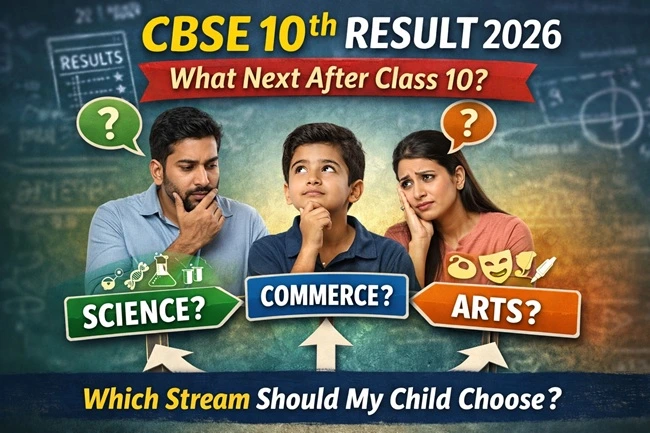
Marks Are Out… But Now What?
The CBSE 10th results are finally out.
Some homes are celebrating. Some are quiet. Some are filled with mixed emotions — relief, confusion, pressure, expectations.
And almost every parent and student is now asking the same question:
“What next?”
Science, Commerce, or Arts?
It may look like just a stream selection, but let’s be honest — this decision feels much bigger. It feels like it will decide everything that comes after.
Career. College. Life direction.
That pressure is real.
But here’s something most people don’t say out loud:
Choosing a stream is important — but choosing it the right way is far more important.
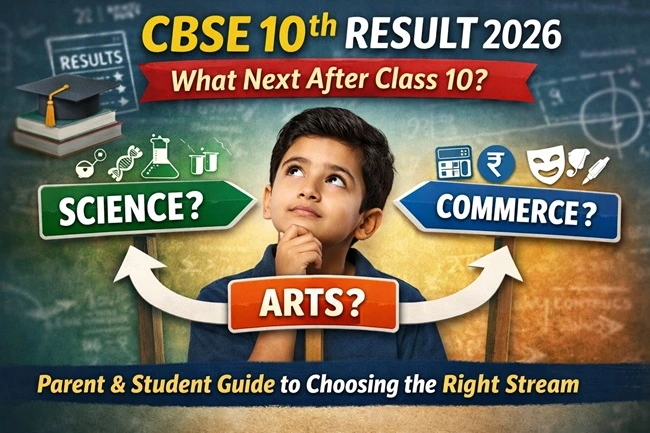
First, Let’s Break a Big Myth
Before we talk about how to choose, let’s clear something that creates unnecessary stress in most families.
Your stream does not lock your entire life.
Yes, it influences your path. But it doesn’t trap you forever.
We’ve all seen examples:
- Science students moving into business or design
- Commerce students becoming lawyers or entrepreneurs
- Arts students building successful careers in media, psychology, or even tech
The world has changed.
Careers are no longer straight lines — they are flexible, evolving journeys.
So take a breath.
This decision matters, but it’s not irreversible.
The Biggest Mistake Parents and Students Make
Let’s be honest here.
Most stream decisions in India are made based on:
- Marks (“You got 90%, you should take Science”)
- Social pressure (“Sharma ji ka beta took Science”)
- Fear (“Arts has no scope”)
- Status (“Science is the best stream”)
But here’s the truth:
Marks show performance, not passion.
Comparison kills clarity.
Fear leads to wrong decisions.
If a child is forced into a stream they don’t connect with, the result is often:
- Loss of interest
- Academic stress
- Low confidence
- Constant struggle
And that’s something no parent wants.
Step 1: Understand the Child — Not Just the Marks
This is where everything begins.
Before choosing any stream, ask:
- What subjects does the child genuinely enjoy?
- What kind of activities excite them?
- Do they like solving problems, creating things, or communicating ideas?
- Are they more analytical, creative, or people-oriented?
Have an honest conversation.
Not a lecture. Not a decision announcement.
A conversation.
Sometimes, kids don’t say what they really feel because they’re afraid of disappointing their parents.
Create a space where they can speak freely.
Step 2: Know What Each Stream Actually Offers
Let’s simplify it without overcomplicating things.
Science Stream
Best suited for students who:
- Enjoy Maths, Physics, Biology
- Like problem-solving and logical thinking
- Are interested in careers like engineering, medicine, research, technology
But remember — Science is not just about becoming a doctor or engineer anymore.
It opens doors to:
- Data science
- AI and machine learning
- Environmental science
- Aviation
- Biotechnology
Commerce Stream
Ideal for students who:
- Enjoy numbers, business, economics
- Are interested in finance, entrepreneurship, management
Career paths include:
- Chartered Accountant (CA)
- Company Secretary (CS)
- Business management
- Banking and finance
- Startups and entrepreneurship
Arts / Humanities Stream
This stream has changed the most in recent years.
Perfect for students who:
- Enjoy subjects like psychology, history, political science, sociology
- Are creative, expressive, or curious about human behavior and society
Career opportunities:
- Psychology
- Law
- Media and journalism
- Design
- Civil services
- Content creation and digital careers
One important truth: Arts is no longer a “backup option.” It’s a powerful choice when aligned with the right interests.
Step 3: Look at the Future — But Don’t Chase Trends Blindly
Parents often ask:
“What will be in demand in the future?”
It’s a valid question. But here’s how to approach it wisely.
Careers that are growing fast:
- Technology (AI, data, cybersecurity)
- Healthcare and mental health
- Digital marketing and content
- Finance and business
- Creative industries
But here’s the catch:
The future belongs to skills, not just degrees.
No matter what stream your child chooses, they will need:
- Communication skills
- Problem-solving ability
- Adaptability
- Digital awareness
So instead of chasing “what’s trending,” focus on:
“Where can my child grow and sustain interest?”
Because consistency beats trends.
Step 4: Take Professional Guidance (If Needed)
Sometimes, it’s hard to decide within the family.
That’s okay.
You can consider:
- Career counseling
- Aptitude tests
- Mentorship sessions
These tools don’t decide the future — but they give clarity.
And clarity reduces stress.
Step 5: Parents — Your Role Is Crucial Here
This is not just your child’s decision.
It’s a shared journey.
But your role is not to control.
Your role is to guide.
What parents should do:
- Listen without judgment
- Encourage exploration
- Provide information, not pressure
- Support the child’s interest
What parents should avoid:
- Comparing with others
- Forcing a stream
- Using fear as motivation
- Ignoring the child’s voice
Because at the end of the day:
The child has to study it for 2+ years — not the parent.
A Simple Way to Decide (Practical Approach)
If you’re still confused, try this:
Ask your child to imagine:
- Studying Science for the next 2 years
- Studying Commerce for the next 2 years
- Studying Arts for the next 2 years
Which one feels:
- Interesting?
- Manageable?
- Exciting (even a little)?
That instinct matters.
Let’s Talk Honestly: It’s Okay to Be Unsure
Not every 15-year-old knows what they want to become.
And that’s completely okay.
This stage is not about having all the answers.
It’s about choosing a direction that feels right — for now.
Life will offer chances to pivot, learn, and grow.
Conclusion: Choose Peace Over Pressure
This moment feels big.
But don’t let it become overwhelming.
Choose a stream that:
- Matches interest
- Feels sustainable
- Keeps the child mentally healthy
Because success doesn’t come from the “most popular stream.”
It comes from:
- Consistency
- Interest
- Effort
- Support
And most importantly — a happy, confident child.
Let’s Make This Interactive
Parents and students reading this:
Take a moment and reflect.
- What is your biggest confusion right now?
- What is your child inclined towards?
- Are you choosing based on interest or pressure?
Start the conversation at home today.
Because the right decision begins with the right discussion.
To get the Regular Updates, Follow us on Instagram @Popnewsblend
Frequently Asked Questions (FAQs)
1. Which stream is best after 10th?
There is no “best” stream universally. The best stream is the one that matches the student’s interest, strengths, and long-term comfort with the subjects.
2. Can a student change stream later?
Yes, in many cases students can switch streams after Class 11 or even later during graduation, depending on the path they choose.
3. Is Science better than Commerce or Arts?
No stream is “better.” Science is often seen as more prestigious, but Commerce and Arts offer equally strong and successful career opportunities.
4. What if my child is confused and unable to decide?
That’s common. You can:
- Talk openly
- Explore subjects
- Take career counseling or aptitude tests
Give them time instead of forcing a quick decision.
5. Should marks decide the stream?
Marks can be an indicator of performance but should not be the only deciding factor. Interest and ability to sustain effort matter more.
6. What are the future career options in Arts?
Arts offers careers in psychology, law, media, civil services, design, teaching, social work, and many modern digital fields.
7. How can parents support their child during this phase?
By listening, encouraging, avoiding comparison, and creating a pressure-free environment where the child feels safe to express their thoughts.
8. What if parents and child disagree on the stream?
Have open discussions, understand each other’s concerns, and if needed, involve a neutral career counselor to guide the decision.
9. Is it risky to choose a non-traditional career path?
Every career has risks. What matters is dedication, skill-building, and adaptability. Non-traditional careers today often have huge growth potential.
10. How important is stream selection for long-term success?
It plays a role, but it’s not everything. Skills, mindset, and continuous learning are far more important in the long run.
For more Such Parenting Tips, Please Follow Popnewsblend.com

Hi, I’m Prashant Jain — a film enthusiast and critic who lives and breathes cinema. From big-screen releases to the latest drops on OTT, I watch extensively and review honestly, without hype or bias.
I believe a good review should go beyond just “good” or “bad.” It should help you understand what works, what doesn’t, and whether a film is truly worth your time. My reviews focus on storytelling, performances, direction, and overall impact — all through the lens of a genuine viewer.
I regularly cover new movie releases and trending web series across OTT, bringing clear, no-nonsense insights for audiences who want real opinions, not paid praise.
Through PopNewsBlend, I aim to cut through the noise and give you reviews you can trust — whether you’re deciding what to watch next or just love discussing cinema as much as I do.
Discover more from Popnewsblend
Subscribe to get the latest posts sent to your email.
Related posts:
 How to Reduce Screen Time for Kids Without Stress: A Friendly Parent’s Guide
 Mental Health of Kids: Are We Failing Them by Not Talking About It Early?
 How To Protect Kids From Bullying : A Parent’s Guide to Understanding, Preventing, and Responding the Right Way
 Helping Your Child Overcome Fear: A Parent’s Guide to Raising a Confident, Emotionally Secure Kid