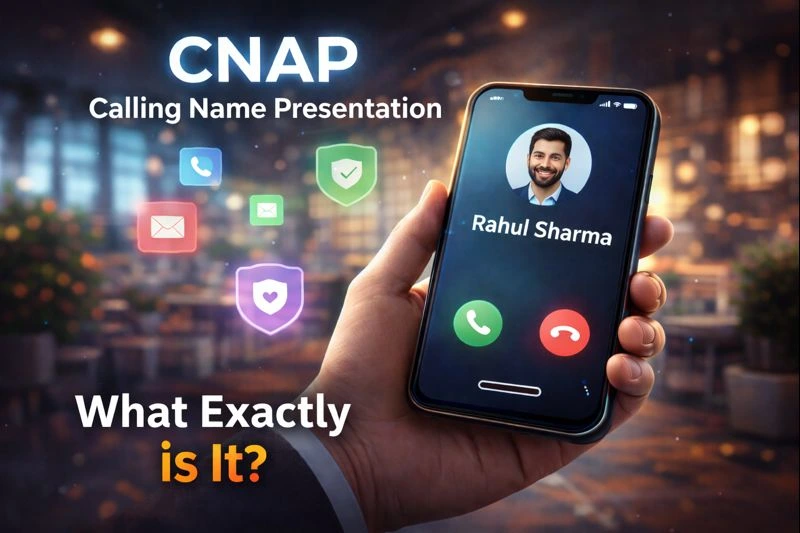
In an age where unknown calls and spam robocalls dominate our phone activity, telecom regulators and service providers are introducing a game-changer: Calling Name Presentation, widely known as CNAP. Whether you’re a daily mobile user tired of answering mystery calls or a business owner wanting your brand to show up reliably when you dial out — CNAP promises to transform the way we perceive incoming calls on our phones.
What Is Calling Name Presentation (CNAP)?
Imagine receiving a phone call from an unknown number. Instead of seeing just an 8- or 10-digit number, your screen now shows a proper name — exactly who’s calling. That’s the essence of Calling Name Presentation (CNAP).
CNAP is a telecommunications network feature that enables incoming calls to display the registered caller’s name along with their number directly on your device’s screen — even if the number isn’t saved in your contacts.
Unlike traditional caller ID (which only shows the number), CNAP shows:
✔ A caller’s registered legal name
✔ Verified from telecom records
✔ Automatically fetched from network data
✔ Shown without needing any third-party app
Think of CNAP as a verified and official caller ID service baked directly into telecom networks.
The Traditional Caller ID vs. Calling Name Presentation (CNAP) – What’s the Difference?
Traditional Caller ID
- Shows only the phone number.
- Doesn’t reveal who the number belongs to.
- Leaves room for uncertainty — especially with spam calls.
Calling Name Presentation (CNAP)
- Displays the caller’s name along with the number.
- Uses official telecom/KYC records rather than crowd-sourced data.
- Works network-level, without relying on apps or internet.
In other words, CNAP turns a blind phone number into a recognizable name that helps you decide — answer or ignore.
Why Is Calling Name Presentation (CNAP) Being Introduced?
In recent years, mobile users have become overwhelmed with:
1. Robocalls
2.Spam marketing calls
3.Phishing & fraud calls
4.Calls from unknown numbers
When you can’t see who’s calling, people tend to ignore all unknown calls — including genuine ones from doctors, job recruiters or delivery agents. CNAP aims to change that experience.
TRAI’s Backing
India’s telecom regulator, Telecom Regulatory Authority of India (TRAI), has recommended the introduction of CNAP as a supplementary service to enhance transparency and empower users to make better decisions when receiving calls.
This move isn’t limited to India — many global telecom standard bodies, like the European Telecommunications Standards Institute (ETSI), define CNAP as a service that enables the “called party” to see the calling party’s name information.
How Does Calling Name Presentation (CNAP) Work?
CNAP works behind the scenes in the telecom network — you don’t need apps, internet or settings adjustments.
Here’s how it functions:
- SIM Registration Name: When you activate a SIM, you provide your identity details through official documents.
- Telecom Records Store Name: That registered name is stored securely in the telecom provider’s database.
- Caller Dials a Number: Whenever someone calls you.
- Network Fetches Name: The telecom network pulls the caller’s registered name from the database.
- Your Phone Shows the Name: You see the caller’s name on your screen, not just numbers.
No app, no internet — just network intelligence working for you.
Is Calling Name Presentation (CNAP) Available in India Now?
Yes! Calling Name Presentation (CNAP) is being rolled out in phases across India, with government and telecom authorities pushing for wider implementation.
Here’s the rollout timeline:
- Pilot launch: October 2025
- Network expansion across regions
- Nationwide availability expected by March 31, 2026
Once fully implemented on 4G and 5G networks, users across the country will begin seeing caller names automatically.
Keep in mind that some older phones or 2G/3G devices might not support CNAP immediately, so universal availability may take some time.
Top Benefits of Calling Name Presentation
1. Easier Identification of Unknown Calls
No more guessing who’s on the other side. You can decide to pick up important calls but ignore spam — smartly.
2. Enhanced User Convenience
Instead of memorizing numbers or saving every unknown contact, you instantly get the caller’s registered identity.
3. Reduced Spam & Fraud Impact
Real names make it harder for scammers to disguise themselves. If every number shows a verified identity, fraudulent calls become less effective.
4. Better Business Communication
Companies can display official brand names during outbound calls, boosting professionalism and trust among customers.
5. Dependence on Apps Reduces
You won’t need third-party caller ID apps that rely on crowd-sourced data and personal contacts, enhancing privacy and accuracy.
6. Faster Decision Making
Users can quickly judge whether to answer or ignore based on the actual caller identity.
Privacy Concerns and Debates
Like any major telecom feature, CNAP comes with its share of privacy concerns and industry debates.
Operator Concerns
Several telecom service bodies have argued that CNAP should not be mandatory because:
- Not all devices support CNAP.
- Data sharing with handset/OS makers might risk privacy.
- Some users prefer anonymity.
Possible Privacy Issues
Critics caution that if your official name gets displayed every time you call someone, it could:
- Lead to unwanted exposure
- Increase social media stalking
- Raise concerns around data storage and legal boundaries
- Share identity info without explicit consent
To address these, telecom regulators and operators are exploring opt-in/opt-out models and strict privacy safeguards.
CNAP vs. Truecaller and Other Caller ID Apps
You may be familiar with apps like Truecaller that show caller names on your phone. But how is CNAP different?
| Feature | CNAP | Truecaller |
|---|---|---|
| Works without Internet | ✅ | ❌ |
| Uses Verified Telecom Records | ✅ | ❌ (Crowd-sourced) |
| Requires App | ❌ | ✅ |
| Data Stored via Telecom | 🔒 | 🧠 |
| Spam List & Reporting | ❌ | ✅ |
Key differences:
- CNAP is network-level and doesn’t depend on user contacts or internet access.
- Truecaller relies on crowd data, which can sometimes be inaccurate.
- CNAP displays registered legal name, not user-labelled names stored on phones.
So while Truecaller still offers spam tagging and custom names, CNAP offers authenticity and verification from official sources.
Who Benefits Most from CNAP?
1. Everyday Mobile Users
If you get unknown calls frequently, CNAP lets you decide faster who’s calling.
2. Businesses and Customer Service
Official brand names on calls improve recognition and trust among customers.
3. Elderly or Less Tech-Savvy Users
People who struggle with managing contacts or apps will find CNAP extremely user-friendly.
4. Fraud Control & Security Awareness
While not a foolproof anti-scam tool, CNAP helps users more consciously respond to calls.
Potential Challenges Ahead
Despite its advantages, CNAP isn’t perfect:
- Older phones might not support it yet
- Telecom operators need to sync cross-network data
- Legal and privacy frameworks must evolve
- Users may still see spam if fraudsters register fake names
These challenges require careful regulation, secure data handling and user awareness.
Final Thoughts: Is CNAP the Future of Caller ID?
In a world where calls are increasingly treated with suspicion, CNAP could be a defining moment in how we interact with telephone communication.
By bringing verified name identification into the network itself — without an app — CNAP promises to make phone calls:
- More transparent
- Safer
- More user-friendly
Yet it also opens conversations about data privacy, opt-in consent and how telecom networks collect and share identity information.
As CNAP continues rolling out across India and other markets, understanding this feature will help you make the most of its benefits — while staying informed about privacy implications.
For the latest Trending News, Please Follow Popnewsblend.com

Hi, I’m Prashant Jain — a curious soul, storyteller, and content creator at heart.I’ve always been drawn to the world of entertainment, travel, sports, health & lifestyle — not just as a writer, but as someone who genuinely lives these experiences. Whether I’m binge-watching the latest OTT series, exploring offbeat spiritual destinations in India, or diving deep into wellness routines and cricket match insights, I love sharing what I discover with like-minded readers.
PopNewsBlend is my way of blending personal journeys with meaningful stories — ones that inform, inspire, and keep you ahead of the curve. Everything I write comes from real observations, hands-on experiences, and a deep passion for understanding the world around us.
Discover more from Popnewsblend
Subscribe to get the latest posts sent to your email.
Related posts:
 Elon Musk Officially Launches “America Party”: What It Means for the U.S., Global Politics, and the Future of Power
 Dreaming of a U.S. Green Card? Here’s the New Citizenship Rule Every Indian Must Know
 Apollo Tyres Takes Over as Indian Cricket Team’s Jersey Sponsor: A Deep Dive
 Fatima Bosch from Mexico Crowned Miss Universe 2025: Complete Highlights, Winner Breakdown, Runners-Up and India’s Final Position