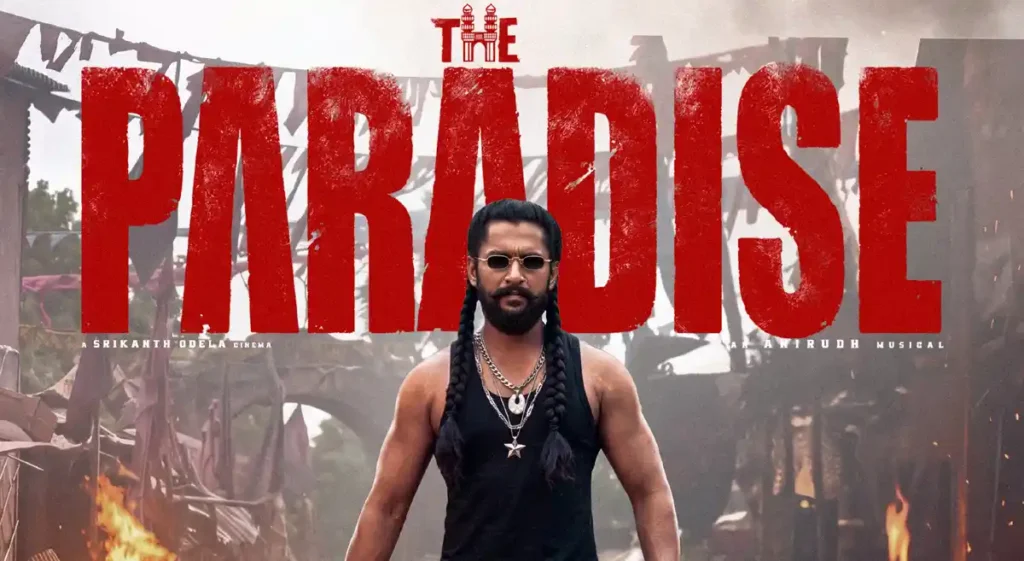
The Paradise Movie Review: Nani and director Srikanth Odela reunite after Dasara, and this time they have clearly gone bigger. Much bigger. Set in 1980s Secunderabad, The Paradise takes us into the world of the Savaari community, a marginalised group living without a recognised identity and under the control of a powerful feudal figure. At the centre of this world is Jadal, played by Nani, whose return gradually turns into a larger fight for dignity, identity and freedom.
On paper, there is plenty to get excited about. Nani has undergone a striking physical transformation, Srikanth Odela gets a much larger canvas after Dasara, Anirudh Ravichander handles the music, and the supporting cast includes Mohan Babu, Kayadu Lohar, Raghav Juyal and Sonali Kulkarni. The film also arrives with the kind of scale that clearly announces itself as a major theatrical release.
But The Paradise is an interesting case. It is a film where the craft is often considerably better than the writing. There are stretches that look fantastic and action sequences that genuinely deliver, while other portions leave you wondering why such an ambitious world has been given such a familiar story.
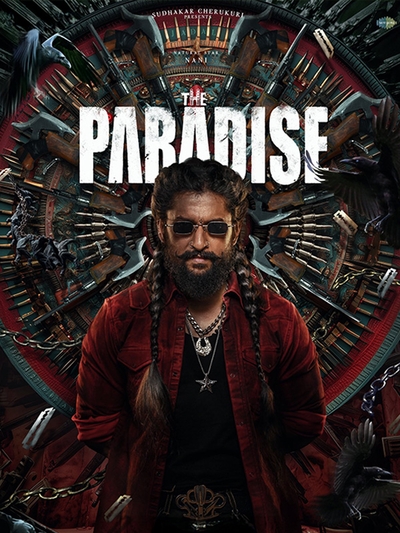
The Paradise Movie Details
- Movie: The Paradise
- Release date: September 24, 2026
- Language: Telugu
- Genre: Period action drama
- Director: Srikanth Odela
- Producer: Sudhakar Cherukuri
- Lead actor: Nani
- Cast: Nani, Mohan Babu, Kayadu Lohar, Raghav Juyal, Sonali Kulkarni, Sampoornesh Babu and others
- Music: Anirudh Ravichander
- Cinematography: Ch Sai
- Editing: Navin Nooli
- Runtime: 2 hours 54 minutes
- Certification: A
- Release: Worldwide theatrical release
The film’s official release date is September 24, 2026, and current listings put its runtime at approximately 2 hours and 54 minutes.
What Is The Paradise About?
The story is set in 1980s Secunderabad and revolves around the Savaari community, which exists on the fringes of society without the identity and rights enjoyed by the rest of the population. Their lives are dominated by Shikanja Malik, a ruthless and powerful figure played by Mohan Babu.
Jadal, played by Nani, returns to this world after spending time in prison. His return isn’t simply about coming home. It gradually brings him into a much larger conflict involving his community, Malik’s control and the question of whether the Savaari can finally claim an identity of their own.
That basic premise is actually one of the film’s strongest ideas. The problem is that the story eventually moves into territory that Indian commercial cinema has explored many times before: an oppressed community, a powerful oppressor, a reluctant protagonist, rebellion, violence and revenge.
The Indian Express made a similar observation in its review, arguing that the film relies heavily on a familiar template despite its much larger scale and ambition.
Nani Is Easily the Film’s Biggest Strength
There is no question that Nani has committed himself to Jadal.
The transformation isn’t limited to his appearance. The beard, hair and leaner physicality are immediately noticeable, but the more effective change is in the way he carries himself. Jadal doesn’t move or speak like the more familiar Nani characters. His posture is heavier, his expressions are restrained and his physical presence is deliberately rough.
That matters because the character spends a lot of time communicating through silence rather than dialogue.
Nani also handles the action convincingly. The physical demands of the role are obvious, particularly during the fight sequences, and the actor gives the impression that Jadal has been shaped by the brutal environment around him rather than simply dropped into it for the sake of an action scene.
The Indian Express described Nani’s physical transformation and committed performance as one of the film’s major positives, while The Times of India also highlighted his altered gait, posture and screen presence.
The frustrating part is that the screenplay doesn’t always give Nani material worthy of the performance he is giving.
You May Also Like To Read About:
- Vibe Movie Review: Kunal Kemmu’s Spy Comedy Is Funny, Chaotic and Worth Watching?
- Daayra Review: Kareena Kapoor and Prithviraj Face Off in a Gripping Battle Between Justice and the Law
- Om Ka Hari Review
- Lust Stories 3 Review: Four Stories of Desire, Marriage and Intimacy, But Does Netflix’s Bold Anthology Still Have the Spark?
- Mirzapur: The Movie Review — Is Kaleen Bhaiya Finally Back in Form
Mohan Babu Deserved More
Mohan Babu plays Shikanja Malik, the man controlling the Savaari community.
He has exactly the kind of screen presence this role requires. When he appears, there is an immediate sense of authority. Unfortunately, the screenplay doesn’t make enough use of him.
For a story built around Jadal’s rebellion against an oppressive power structure, the central conflict should ideally develop through a strong relationship between protagonist and antagonist. Instead, Malik disappears for considerable stretches, which weakens the dramatic spine of the movie.
The Indian Express and 123Telugu both pointed out that Mohan Babu’s role is surprisingly limited considering the importance of the antagonist to the story.
That is a missed opportunity because a stronger Jadal–Malik conflict could have added considerably more tension to the second half.
Kayadu Lohar and Sonali Kulkarni
Kayadu Lohar plays Subbu and provides some of the quieter moments in the film. Her scenes with Nani bring a welcome human element to a movie that otherwise spends a great deal of time surrounded by violence and confrontation.
The problem is that the character isn’t developed enough.
The same issue affects Sonali Kulkarni. She brings emotional weight to the role of Jadal’s mother, particularly in the earlier portions, but the character gradually loses importance as the story becomes increasingly focused on action.
This is one of the recurring problems with The Paradise: the supporting characters often feel like they are there to serve Jadal’s story rather than having sufficiently developed stories of their own.
Raghav Juyal Takes a Dark Turn
Raghav Juyal is an interesting casting choice because audiences have traditionally associated him with dance and comedy.
Here, he gets a much darker role.
He brings menace and unpredictability, and there are moments where that contrast works very well. However, the character isn’t developed enough to make a lasting impression beyond the immediate impact of his screen presence.
The film clearly knows that Juyal can surprise the audience. It simply doesn’t give him enough material to take that surprise very far.
The World-Building Is Excellent
If there is one department where The Paradise consistently feels like a major theatrical production, it is the visual world.
The Savaari settlement has texture. The production design creates a convincing period environment, and the film doesn’t make the world look artificially polished. The locations, costumes and sets contribute to the sense that these characters genuinely belong to this particular time and place.
Avinash Kolla’s production design is one of the film’s strongest technical achievements, while cinematographer Ch Sai gives the film a suitably earthy and weathered visual style.
This is particularly important because the story deals with a community living under difficult circumstances. The setting feels lived-in rather than simply constructed for a movie.
There are several frames that look genuinely impressive on a big screen.
Unfortunately, the better the film looks, the more obvious the screenplay problems become.
The Action Works — Especially in the First Half
The action sequences are probably the safest reason to choose The Paradise as a theatrical watch.
The fights are physical, bloody and deliberately uncomfortable rather than looking like perfectly choreographed superhero combat. The violence feels connected to the world and to the characters.
The first half benefits particularly from this approach.
There is a disturbing opening sequence, several effective action stretches and a strong build towards the interval. 123Telugu specifically highlighted the action blocks, the opening sequence, the café fight and the interval stretch as positives.
The problem is that the film eventually begins to rely on violence too heavily.
When every escalation has to be bigger, bloodier and louder than the previous one, the impact inevitably starts to diminish.
Anirudh Ravichander’s Music
Anirudh’s songs are among the more enjoyable parts of the soundtrack. “Aaya Sher” and “Yeshanagula” provide some much-needed energy and have already received attention in the early response to the film.
The background score is more complicated.
There are scenes where the music adds exactly the kind of scale the film needs. But there are also moments when the score seems to be working harder than the scene itself.
Some reviews have also raised concerns about the sound mixing, with dialogue becoming difficult to hear during certain louder action sequences.
The Biggest Problem: The Screenplay
This is where The Paradise loses much of its potential.
The film has an interesting setting and an important central conflict, but the actual story structure isn’t particularly fresh. The basic journey from oppression to rebellion is familiar, and the film doesn’t consistently find new ways of presenting it.
That doesn’t mean a familiar story cannot work.
It absolutely can.
But when the story is familiar, the characters or screenplay need to provide something distinctive. The Paradise doesn’t always manage that.
The first half gives the impression that the film is carefully building towards something substantial. The second half, however, increasingly relies on violence and familiar mass-cinema beats instead of developing the emotional consequences of what has happened.
The Times of India described the first half as the stronger section and criticised the latter portion for becoming an overextended succession of violent confrontations.
That is probably the most accurate way of describing the film’s biggest structural problem.
The Second Half Is Where Things Start to Slip
The nearly three-hour runtime isn’t necessarily the problem.
The issue is how that time is used.
Once the central conflict is established, the screenplay needs to keep developing the characters. Instead, several scenes repeat the same emotional idea in increasingly violent ways.
The editing doesn’t always help. Transitions can feel abrupt, and some scenes move on before the emotional moment has properly landed. Both The Indian Express and 123Telugu have criticised the editing and pacing, particularly in the second half.
The result is a strange viewing experience: the film looks increasingly expensive while feeling increasingly repetitive.
Don’t miss the Latest Movie Release and Ratings, Follow us on Instagram and Facebook.
What Works in The Paradise?
- Nani’s physical transformation and performance
- Strong production design
- Convincing 1980s atmosphere
- Raw and impactful action sequences
- Strong first-half momentum
- Anirudh’s songs
- Ch Sai’s cinematography
- Several impressive theatrical moments
What Doesn’t Work?
- Familiar screenplay
- Weak character development outside Jadal
- Underused Mohan Babu
- Limited scope for Kayadu Lohar and Sonali Kulkarni
- Raghav Juyal’s character isn’t developed enough
- Uneven editing and sound mixing
- Second half loses momentum
- Violence begins replacing emotional development
- Runtime feels longer once the story starts repeating itself
The Paradise Ratings and Reviews
The early critical response is clearly mixed rather than universally positive.
| Publication | Rating |
|---|---|
| The Times of India | 2.5/5 |
| The Indian Express | 2/5 |
| 123Telugu | 2.75/5 |
| Deccan Chronicle | 1.5/5 |
The numbers differ, but there is a noticeable pattern in the written reviews: Nani’s performance, the action and the technical craft receive praise, while the screenplay, character writing and second half attract the strongest criticism.
Audience reactions are still developing because the film has only just reached theatres, so it would be premature to treat today’s audience rating as a settled verdict.
Is The Paradise Worth Watching?
If you’re a Nani fan, there is plenty here to appreciate. His performance is committed, the transformation is convincing and the film gives him a very different kind of character to play.
If you enjoy large-scale Telugu action cinema, the theatrical experience has genuine appeal. The production design, cinematography and action sequences are clearly designed for a big screen.
But if you’re expecting another Dasara-level surprise from the Nani–Srikanth Odela combination, expectations may need to be tempered.
The problem isn’t that The Paradise lacks ambition.
It has plenty of ambition.
The problem is that the writing doesn’t consistently match the ambition.
The Paradise vs Dasara
The comparison with Dasara is unavoidable because both films bring Nani and Srikanth Odela together.
Dasara worked partly because it felt unexpected. Odela was a new director, Nani was presented in a relatively unfamiliar mass avatar, and the coal-mining setting gave the story a distinctive identity.
With The Paradise, the stakes are considerably higher. The budget is bigger, the production is larger and the expectations are much greater.
But that also creates the film’s biggest challenge.
What felt raw and surprising in Dasara sometimes feels familiar here.
The Paradise has more scale, but scale alone doesn’t create emotional depth.
Final Verdict
The Paradise is a film caught between what it wants to be and what its screenplay allows it to become.
There is a genuinely impressive movie hiding inside these nearly three hours. Nani gives Jadal physicality and restraint, the production design creates an absorbing world, the action delivers several memorable moments and Srikanth Odela demonstrates that he has a strong visual instinct.
But the screenplay doesn’t maintain the same confidence.
The first half builds curiosity and tension, only for the second half to lean increasingly on violence, familiar commercial beats and repetition. Characters who could have added emotional depth are underwritten, and the central Jadal–Malik conflict doesn’t receive the sustained development it deserves.
That makes The Paradise frustrating rather than outright disappointing. You can see the effort everywhere. You can see the money on the screen. You can see Nani’s commitment. You can see the director’s ambition.
What you don’t always see is an equally strong story holding all of it together.
The Paradise Rating: 2.5/5
Verdict: A technically impressive and fiercely performed action drama that delivers on atmosphere and spectacle but struggles to sustain its story beyond the first half.
Should You Watch It?
Watch it in theatres if: you are a Nani fan, enjoy raw action dramas or want to experience the film’s production design and action on a big screen.
Keep expectations measured if: you are looking for a tightly written story, deeply developed supporting characters or something radically different from the familiar oppressed-community-versus-tyrant template.
The Paradise Movie FAQ
Who is the lead actor in The Paradise?
Nani plays Jadal, the central character around whom the story’s conflict develops.
Who directed The Paradise?
The film is directed by Srikanth Odela, who previously worked with Nani on Dasara.
Who is in the cast of The Paradise?
The principal cast includes Nani, Mohan Babu, Kayadu Lohar, Raghav Juyal, Sonali Kulkarni and Sampoornesh Babu.
What is The Paradise about?
The film is set in 1980s Secunderabad and follows Jadal and the Savaari community as they struggle against a powerful system that denies them identity, dignity and freedom.
Is The Paradise a sequel to Dasara?
No. It is a separate story. The connection is the collaboration between Nani and director Srikanth Odela.
How long is The Paradise?
The film has a reported runtime of approximately 2 hours and 54 minutes.
Who composed The Paradise music?
Anirudh Ravichander composed the music for the film.
Is The Paradise suitable for children?
The film has an A certification and contains considerable violence and mature themes. Parents should take the certification and the child’s sensitivity to violent content into account.
What is the current critic rating of The Paradise?
Early reviews vary. The Times of India has rated it 2.5/5, The Indian Express 2/5, 123Telugu 2.75/5 and Deccan Chronicle 1.5/5. These are opening-day critical ratings and can differ as more reviews appear.
Is The Paradise worth watching?
It depends on what you expect from it. Nani’s performance, the action and the visual world are the film’s strongest attractions. The screenplay and uneven second half are its major weaknesses.
The Bottom Line
The Paradise looks like a much bigger film than Dasara, but bigger doesn’t necessarily mean better. Nani gives the movie everything he has, and there are enough striking moments to make the theatrical experience worthwhile for action and Nani fans. But the screenplay ultimately prevents the film from reaching the level its impressive technical craft suggests it could have achieved.
Hi, I’m Prashant Jain — a film enthusiast and critic who lives and breathes cinema. From big-screen releases to the latest drops on OTT, I watch extensively and review honestly, without hype or bias.
I believe a good review should go beyond just “good” or “bad.” It should help you understand what works, what doesn’t, and whether a film is truly worth your time. My reviews focus on storytelling, performances, direction, and overall impact — all through the lens of a genuine viewer.
I regularly cover new movie releases and trending web series across OTT, bringing clear, no-nonsense insights for audiences who want real opinions, not paid praise.
Through PopNewsBlend, I aim to cut through the noise and give you reviews you can trust — whether you’re deciding what to watch next or just love discussing cinema as much as I do.
Discover more from Popnewsblend
Subscribe to get the latest posts sent to your email.
Related posts:
 The Ultimate Guide to the Best Bollywood Comedy Movies Ever Made
 Ek Din Movie Review (2026): Junaid Khan & Sai Pallavi Deliver a Soulful Love Story That Stays With You
 System on Amazon Prime Video Review 2026: Sonakshi Sinha and Jyotika Deliver a Courtroom Drama That Hits Harder Than You Expect
 Top Upcoming Movies Releasing in July 2026: Complete Release Calendar, Cast, Story Details and Everything We Know So Far