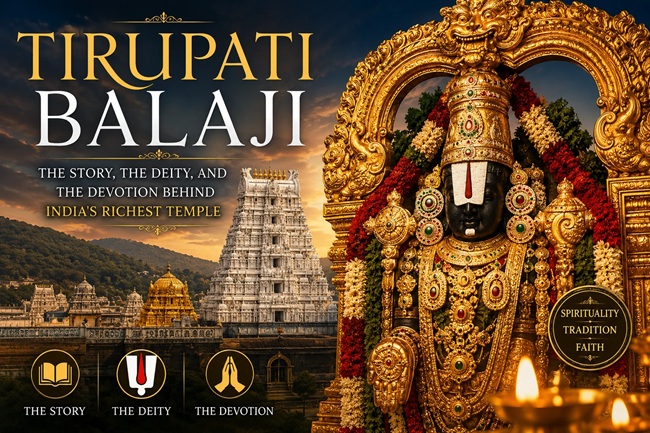
Perched on the seventh peak of the Tirumala hills in Andhra Pradesh, the Sri Venkateswara Temple — popularly known as Tirupati Balaji — is one of the most visited pilgrimage sites on Earth. Millions of devotees travel here every year, many after saving for months, some walking barefoot for days, all carrying the same quiet hope: a glimpse, or darshan, of the deity believed to answer prayers no other god could.
This post traces the mythology behind the temple, explains who is worshipped there, and unpacks one of its most striking traditions — the offering of hair.
Who Is Worshipped at Tirupati Balaji Temple?
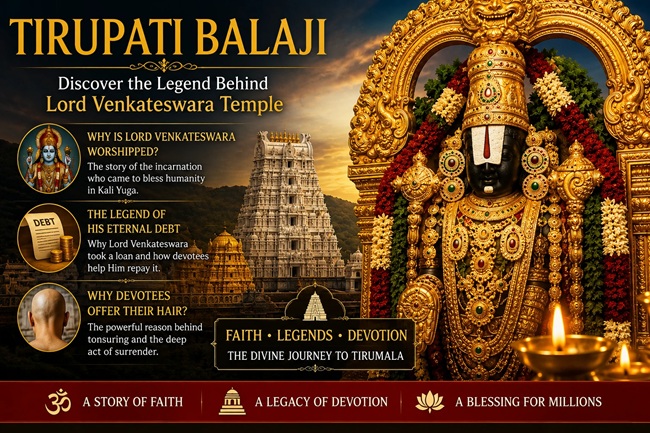
The presiding deity is Lord Venkateswara, also called Balaji, Srinivasa, or Venkatachalapathy — all names for a form of Lord Vishnu, the preserver god in the Hindu trinity. The idol enshrined in the sanctum is a self-manifested (swayambhu) black stone deity, standing roughly eight feet tall, adorned daily in gold, diamonds, and fragrant flowers.
Devotees believe this isn’t merely a representation of Vishnu but Vishnu himself, physically present and awake in the modern age — which is part of why the temple commands such intense devotion even today.
The Legend Behind the Tirupati Balaji Temple
The story behind Tirupati draws from the Puranas, particularly threads found in the Venkatachala Mahatmyam. While versions differ slightly across regional tellings, the core narrative goes like this:
A Cosmic Dispute
Once, the sage Bhrigu was sent by a gathering of sages to determine which of the three principal gods — Brahma, Shiva, or Vishnu — was the greatest, worthy of receiving the fruits of a great sacrifice. When Bhrigu visited Vishnu’s abode, Vishnu was resting, seemingly unaware of the sage’s arrival. Insulted by what he took as disrespect, Bhrigu kicked Vishnu on the chest.
Rather than react in anger, Vishnu gently caught Bhrigu’s foot and, apologizing for having caused him any pain, pressed it — inadvertently crushing the small eye said to reside on the sole of a sage’s foot (a mark of pride, in some tellings). Humbled by Vishnu’s patience and humility, Bhrigu declared him the supreme god.
But Vishnu’s consort, Goddess Lakshmi, was outraged that Bhrigu had struck her husband on the chest — the very place where she resides. Feeling disrespected, she left Vaikuntha (Vishnu’s celestial abode) and descended to earth, taking the form of Padmavati, born to a king in the region that is now Andhra Pradesh.
Vishnu Follows Her to Earth
Distraught at Lakshmi’s departure, Vishnu followed her down to earth and settled on the Venkata hills (present-day Tirumala) in the form of Venkateswara. There, he lived in poverty as an ascetic, in a state of self-imposed penance, waiting to win her back.
He eventually fell in love with Padmavati and, in order to marry her, needed money for the wedding — a detail devotees find deeply human and relatable. Unable to arrange the funds himself, Vishnu is said to have borrowed a massive sum from Kubera, the god of wealth, to conduct the marriage in a manner befitting royalty.
The Eternal Debt
This is the detail that shapes temple practice even today: Venkateswara is believed to still be repaying that loan to Kubera — with interest — and will continue to do so until the end of this cosmic age (Kali Yuga). This is why devotees offer money, gold, and valuables at the temple’s hundi (donation box): they believe they are helping Lord Venkateswara clear his debt, and that the act generates immense merit in return. It’s also considered a major reason the temple has become the richest temple in the world, receiving enormous daily donations.
Why Is Tirupati Balaji Temple So Popular Among Devotees?
A few reasons come together to explain the intensity of devotion here:
- The belief in a “living,” awake deity. Many devotees feel Venkateswara is not a symbolic idol but a real, conscious presence — some point to the idol’s heartbeat-like warmth and the fact that it is bathed in real perspiration-like moisture as evidence.
- Kali Yuga’s accessible god. Hindu tradition holds that in this current age, rituals of the past are hard to perform, but simply visiting Tirumala and praying to Venkateswara is believed to grant results equivalent to far more elaborate penances of earlier ages.
- Wish-fulfillment. Devotees commonly visit to ask for prosperity, marriage, childbirth, health, or success — and return afterward specifically to give thanks, often with a vow (mokku) fulfilled.
- The sheer scale of collective faith. Tirumala sees some of the largest crowds of any religious site globally, and this scale itself reinforces belief — the presence of millions of devoted pilgrims each year deepens the sense that something extraordinary resides there.
The Hair-Offering Tradition: Why Do Devotees Shave Their Heads at Tirupati Balaji Temple?
One of the temple’s most visible customs is tonsuring — devotees shaving their hair, sometimes their first hair since birth, and offering it to the deity. The temple’s Kalyanakatta (tonsure halls) process tens of thousands of pilgrims a day.
There are a few interwoven explanations for this practice:
- Repaying a cosmic debt of one’s own. Just as Venkateswara borrowed from Kubera, legend holds that when the deity needed hair for Padmavati’s wedding rituals, the goddess Neela Devi (a form of Bhoodevi) offered her own hair unhesitatingly. Pleased by her selfless generosity, Venkateswara blessed her by declaring that anyone who offers their hair at his shrine would be granting her a share in blessings, while receiving prosperity themselves.
- A symbol of surrendering the ego. Hair is closely tied to vanity and self-image. Shaving it off at the temple is viewed as an act of humility — devotees offering up something personal and prized as a mark of total surrender to the divine.
- Fulfilling a vow. Many pilgrims tonsure their heads specifically because they had prayed for something — a job, a child, recovery from illness — and promised to offer their hair if the wish was granted. It’s one of the most common ways devotees say “thank you.”
The hair collected is not discarded — the temple trust auctions it globally to wig and cosmetic manufacturers, and proceeds from these auctions form a significant, and lesser-known, part of the temple’s income.
Tirupati Balaji Temple : Other Notable Rituals and Facts
- The Laddu Prasadam: Tirupati’s laddus are so famous they hold a Geographical Indication (GI) tag, and devotees consider receiving one as receiving the deity’s blessing directly.
- Vishesh Darshan and Seva: Devotees can opt for various types of viewing and ritual participation, from free general darshan (which can take many hours of queueing) to paid faster routes, reflecting the temple’s effort to manage its overwhelming daily footfall.
- Padmavathi Temple in Tiruchanoor: Tradition holds that a visit to Tirupati is incomplete without also visiting the nearby shrine of Goddess Padmavati — since she is regarded as Venkateswara’s consort, and skipping her shrine is considered inauspicious.
- Daily rituals: The temple follows an elaborate schedule of rituals starting before dawn (Suprabhatam, the ritual of “waking” the deity) and continuing through the day with multiple sevas (services) and aartis.
Closing Thoughts
What makes Tirupati Balaji extraordinary isn’t just its scale or its wealth — it’s the deeply human mythology at its core. A god who fell in love, went into debt for a wedding, and is still repaying it; a goddess who gave her hair without hesitation; devotees who travel across the country to offer a small piece of themselves in return for hope. It’s this blend of the divine and the deeply relatable that has kept the hills of Tirumala alive with footsteps for centuries — and shows no sign of slowing down.
Note: Details of the Venkateswara legend vary across regional and textual traditions; the version above reflects the most commonly told narrative among devotees today.

Hi, I’m Prashant Jain — a film enthusiast and critic who lives and breathes cinema. From big-screen releases to the latest drops on OTT, I watch extensively and review honestly, without hype or bias.
I believe a good review should go beyond just “good” or “bad.” It should help you understand what works, what doesn’t, and whether a film is truly worth your time. My reviews focus on storytelling, performances, direction, and overall impact — all through the lens of a genuine viewer.
I regularly cover new movie releases and trending web series across OTT, bringing clear, no-nonsense insights for audiences who want real opinions, not paid praise.
Through PopNewsBlend, I aim to cut through the noise and give you reviews you can trust — whether you’re deciding what to watch next or just love discussing cinema as much as I do.
Discover more from Popnewsblend
Subscribe to get the latest posts sent to your email.
Related posts:
 International Yoga Day 2025: A Global Celebration of Mind-Body Harmony
 Is Diwali Only a Hindu Festival? Exploring the Universal Spirit of the Festival of Lights
 Vishu Festival 2026: Meaning, Significance, Rituals, Celebrations & Traditions Explained
 Char Dham Yatra 2026: A Divine Journey Begins on Akshaya Tritiya – A Shiv Bhakt’s Calling