
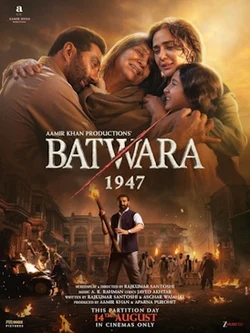
There are films that ask for two hours of your attention, and then there are films that ask for a piece of your heart and don’t give it back easily. Batwara 1947 belongs firmly to the second category, and walking out of the theatre on its opening day, I found myself doing something I rarely do after a big star vehicle release. I sat in my seat for a full minute after the lights came on, just letting it settle.
Directed by Rajkumar Santoshi and released in cinemas on August 14, 2026, timed deliberately to coincide with the anniversary of India’s Partition, Batwara 1947 is not the film its trailers or its lead actor’s recent filmography might have led you to expect. This is not another loud, flag waving war drama riding on box office momentum. It is a quieter, sadder, and ultimately more affecting film about what people do to each other, and for each other, when history forces a line through their homes.
Here is my complete, honest take on the film, covering the story, the cast, the performances, and everything that worked and didn’t for me.
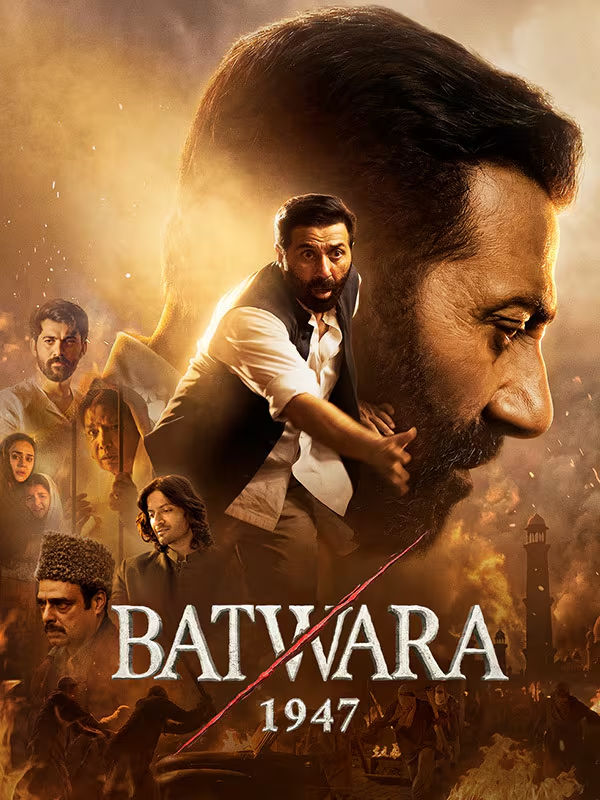
Batwara 1947: A Quick Introduction To The Film
Batwara 1947 comes from Aamir Khan Productions, produced by Aamir Khan along with Aparna Purohit, and it marks a long overdue reunion between Rajkumar Santoshi and Sunny Deol, the actor director pair behind Ghayal, Damini, and Ghatak. The film began its life under the working title Lahore 1947 before being officially renamed earlier this year.
The story is adapted from Asghar Wajahat’s widely respected Hindi play Jis Lahore Nai Vekhya, O Jamya E Nai, a work that has been performed on stage for decades and is considered one of the more nuanced literary responses to Partition. Santoshi wrote the screenplay himself, working alongside Wajahat on the dialogues, and the theatrical roots of the material are visible throughout the film in the best possible way, through tightly written confrontations and long, unbroken emotional scenes rather than spectacle for its own sake.
The film runs for two hours and twenty five minutes, is rated A by the censor board, and released in Hindi across a wide theatrical footprint, going head to head at the box office with Emraan Hashmi and Disha Patani’s Awarapan 2 on the same Independence Day weekend.
Batwara 1947: Star Cast
Sunny Deol leads the film as Sikandar Mirza, a Meerut based man whose life is upended by Partition. Preity Zinta returns to the big screen after an eight year hiatus playing Hamida, Sikandar’s wife, in what is being widely discussed as one of the most anticipated comebacks of the year. Shabana Azmi plays Mai, an elderly Hindu woman whose story becomes the emotional spine of the film. Karan Deol, sharing the screen with his father for the first time, plays their son. Ali Fazal appears as Habib Anwar, and Abhimanyu Singh plays Yakub Khan, the film’s antagonist. Khushi Hajare, Kanikka Kapur, and Ira Sandhir round out the supporting cast in smaller but meaningful roles. The film is shot by veteran cinematographer Santosh Sivan, edited by Shyam Salgaonkar, and scored by A R Rahman, with lyrics written by Javed Akhtar.
Batwara 1947: The Plot
Set on the eve of India’s independence, Batwara 1947 opens with Sikandar Mirza celebrating freedom from British rule in Meerut, unaware of the storm about to arrive at his own doorstep. As Partition unfolds and communal violence spreads, Sikandar’s Muslim family makes the difficult decision to migrate to Lahore, joining the millions of people forced to cross a border that had not even existed a few months earlier.
When they arrive in Lahore, the family is allotted a haveli that had belonged to a Hindu family who fled during the chaos. What they do not expect is to find that the house is not actually empty. An elderly Hindu woman named Mai has stayed behind, refusing to abandon the home she has spent her entire life in, regardless of the danger surrounding her.
What begins as tension, suspicion, and outright conflict between Sikandar’s family and Mai slowly transforms into something far more complicated and far more tender. As the film progresses, resentment gives way to understanding, and understanding gives way to something close to family. Around this central relationship, the film also follows Hamida’s own quiet reckoning with displacement, and a parallel thread involving Habib Anwar and the menacing Yakub Khan, whose presence in the story brings the violence and paranoia of the era into sharp, uncomfortable focus.
At its heart, this is not really a story about a border being drawn. It is a story about a house, and about who gets to call a house a home, and what happens when two people with every reason to hate each other choose not to.
Batwara 1947: Acting And Performances
If there is one department where Batwara 1947 does not put a foot wrong, it is the performances.
Sunny Deol delivers what is genuinely one of the more layered performances of his career. Longtime fans will get the anger and the thunderous dialogue delivery he built his stardom on, but what surprised me was how much vulnerability he brings to the quieter scenes, particularly in the film’s second half, where fear and helplessness sit right alongside his trademark intensity. It is the kind of role that could have easily leaned entirely on his action hero image, and the fact that it does not is a credit to both Santoshi’s writing and Deol’s willingness to go somewhere less comfortable.
Shabana Azmi, playing Mai, is the film’s true emotional anchor. She brings a dignity and warmth to the role that makes her the character audiences connect with almost immediately, and her scenes opposite Deol are consistently the strongest stretches of the film. Their evolving dynamic, moving from hostility to genuine familial affection, carries the entire narrative on its shoulders, and both actors rise to meet that responsibility.
Preity Zinta‘s comeback is handled with real care. She is not sidelined as a decorative presence, and she brings a lived in warmth and vulnerability to Hamida that makes her return to the screen feel earned rather than nostalgic.
Karan Deol, making his first on screen appearance alongside his father, is earnest and clearly puts in effort, though his performance is noticeably rawer next to the seasoned actors surrounding him, and a few scenes would have benefited from more restraint and polish.
Ali Fazal does solid work but is working with a character that feels underwritten relative to his talent, while Abhimanyu Singh is convincingly menacing as the film’s antagonist, giving the story the sense of looming danger it needs.
Batwara 1947: What Is Promising About This Film
The single most promising thing about Batwara 1947 is its refusal to take the easy route. A film about Partition starring Sunny Deol could very reasonably have been expected to lean into jingoism or a simple us versus them framing. Instead, Santoshi and his writing team use the setup to make an argument for shared humanity across the very divide the film is named after, and that choice gives the film a weight and relevance that goes beyond nostalgia or star power.
The Sikandar and Mai relationship is genuinely moving, written with patience rather than rushed sentimentality, and it gives both lead actors room to do some of the best work of their recent careers. The production design and cinematography recreate the period with real conviction, particularly in a large scale migration train sequence that took weeks to film and clearly shows on screen in terms of scale and detail. A R Rahman’s score, paired with Javed Akhtar’s lyrics, adds emotional texture without ever overwhelming the visuals. And the film carries a message that feels genuinely pertinent rather than performative, about how hatred divides people but shared humanity has the power to outlast it.
You May Also Like To Read :
Batwara 1947: What Is Missing
For all its emotional highs, Batwara 1947 is not without its problems. The first half moves at a measured, at times slow pace, spending a considerable amount of time on setup before the central relationship between Sikandar and Mai truly begins to breathe. Some of the character work outside the central trio feels uneven, with Ali Fazal’s character in particular feeling like it needed another pass in the writing room to give it the depth the actor is clearly capable of delivering.
Karan Deol’s inexperience shows in certain scenes, especially opposite far more seasoned co-stars, and while his sincerity comes through, the film occasionally exposes the gap between his current abilities and the emotional demands of the material. There are also moments in the back half where the narrative leans on familiar tropes of the genre, mob violence, a dramatic police station confrontation, that feel effective in the moment but slightly predictable if you have watched other Partition era dramas before.
Batwara 1947 : What Could Have Been Better
A tighter first half would have made a real difference here. The film has an emotional payoff strong enough to justify its two hour twenty five minute runtime, but getting there takes longer than it needs to, and a leaner edit in the opening act would likely have made the eventual emotional crescendo land even harder. Giving Ali Fazal’s character a clearer arc, rather than treating him as a supporting piece around the central relationship, would have strengthened the film’s broader ensemble. And while Karan Deol shows promise, a couple of his more dramatically demanding scenes could have used either more rehearsal time or subtler writing to work around his relative inexperience rather than asking him to carry heavier emotional beats head on.
Personal View And Rating
I went into Batwara 1947 bracing myself for another loud, flag waving spectacle riding on Sunny Deol’s recent box office momentum, and I left having watched something far more thoughtful than that. This is a film about a house and the people fighting over what it means, and by the end, it becomes a film about what it actually means to call somewhere home. Shabana Azmi and Sunny Deol together give the film its soul, and Preity Zinta’s return reminds you exactly why her absence from the big screen was felt so strongly.
It is not a flawless film. The pacing issues in the first half are real, and a couple of performances and character arcs needed sharper writing. But the emotional conviction on display, backed by genuinely powerful central performances, carries it through its rough patches convincingly.
My personal rating for Batwara 1947 is three and a half stars out of five. It is a film that stumbles on its way there but earns its emotional payoff by the time the credits roll, and it is absolutely worth a big screen watch, particularly for anyone who grew up hearing Partition stories from grandparents and never quite saw that scale of feeling translated onto film before.
Frequently Asked Questions
What is Batwara 1947 about? Batwara 1947 is a period drama set during the Partition of India, following a Muslim family that migrates from India to Lahore and is given a haveli already occupied by an elderly Hindu woman who refuses to leave, sparking a relationship that evolves from conflict into an unlikely bond.
Who are the lead actors in Batwara 1947? The film stars Sunny Deol, Preity Zinta, Shabana Azmi, Karan Deol, Ali Fazal, and Abhimanyu Singh in lead and supporting roles.
Who directed Batwara 1947? The film is directed by Rajkumar Santoshi, marking his reunion with Sunny Deol after their earlier collaborations on Ghayal, Damini, and Ghatak.
When was Batwara 1947 released? The film released theatrically worldwide on August 14, 2026, coinciding with the anniversary of Partition and the Independence Day weekend in India.
Is Batwara 1947 based on a true story? The film is not based on a single true story but is adapted from Asghar Wajahat’s acclaimed play Jis Lahore Nai Vekhya, O Jamya E Nai, which draws on the broader historical and emotional realities of the Partition era.
Is Batwara 1947 suitable for family viewing? The film carries an A certificate from the censor board due to scenes involving communal violence and mature themes, so it is intended for adult audiences rather than family viewing with young children.
How long is the runtime of Batwara 1947? The film has a runtime of two hours and twenty five minutes.
Is Batwara 1947 available on any OTT platform? At the time of this review, Batwara 1947 is a theatrical only release and is not available on any streaming platform. Any OTT release would typically follow several weeks after the theatrical run, depending on distribution decisions by the makers.
How does Batwara 1947 compare to Sunny Deol’s other recent films? Unlike his recent action heavy box office successes, Batwara 1947 leans far more into emotional drama than action, giving Sunny Deol a more restrained and vulnerable role compared to his recent output.
Is this Preity Zinta’s comeback film? Yes, Batwara 1947 marks Preity Zinta’s return to Hindi cinema after an eight year gap from acting.
Disclaimer
This review reflects the personal opinion of the writer based on a theatrical viewing of Batwara 1947 and publicly available information about the film’s cast, crew, and production at the time of writing. Ratings and opinions expressed here are subjective and may differ from other critics or individual viewers. Details such as box office performance, further reviews, and streaming availability may change after publication, and readers are encouraged to verify the latest information from official sources before making viewing decisions. This article does not intend to defame, misrepresent, or cause disrespect to any individual, community, or historical event referenced in the film or this review.

Hi, I’m Prashant Jain — a film enthusiast and critic who lives and breathes cinema. From big-screen releases to the latest drops on OTT, I watch extensively and review honestly, without hype or bias.
I believe a good review should go beyond just “good” or “bad.” It should help you understand what works, what doesn’t, and whether a film is truly worth your time. My reviews focus on storytelling, performances, direction, and overall impact — all through the lens of a genuine viewer.
I regularly cover new movie releases and trending web series across OTT, bringing clear, no-nonsense insights for audiences who want real opinions, not paid praise.
Through PopNewsBlend, I aim to cut through the noise and give you reviews you can trust — whether you’re deciding what to watch next or just love discussing cinema as much as I do.
Discover more from Popnewsblend
Subscribe to get the latest posts sent to your email.
Related posts:
 The Ultimate Guide to the Best Bollywood Comedy Movies Ever Made
 Ek Din Movie Review (2026): Junaid Khan & Sai Pallavi Deliver a Soulful Love Story That Stays With You
 System on Amazon Prime Video Review 2026: Sonakshi Sinha and Jyotika Deliver a Courtroom Drama That Hits Harder Than You Expect
 Top Upcoming Movies Releasing in July 2026: Complete Release Calendar, Cast, Story Details and Everything We Know So Far
Pingback: August 2026 Bollywood Releases: Complete Calendar — Every Movie, Cast & Release Date You Need to Know
Pingback: Awarapan 2 Movie Review: Emraan Hashmi Returns To The Role That Broke Him, And This Time He Comes Back Whole
Pingback: Toxic Movie Review: Is Yash's Rs 800 Crore Comeback Worth The Wait? (2026)