
If you walk into a paan shop in Bengaluru, Mysuru, or Mangaluru this month and ask for gutka, you’re going to get turned away — or at least, that’s the intention behind the Karnataka government’s latest move.
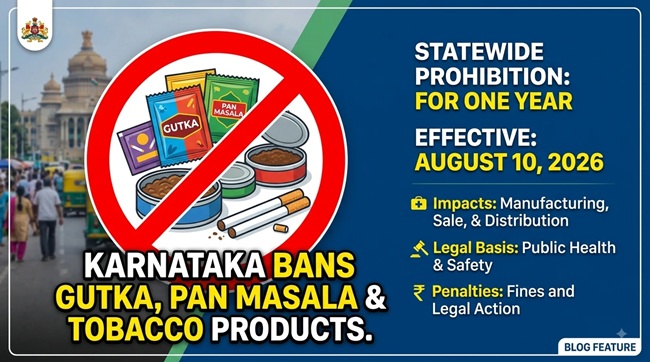
On August 10, 2026, the state’s Food Safety and Drugs Administration Department issued a fresh, sweeping notification banning the manufacture, storage, transportation, distribution, and sale of gutka, pan masala, and any other product containing tobacco or nicotine, anywhere in Karnataka, for a full year. It’s not a one-off headline — it’s the newest chapter in a battle the state has been fighting, on and off, for well over a decade.
But this time, the order comes with a twist that closes a loophole the industry has exploited for years. Let’s break down exactly what’s happened, why, and what it actually means on the ground.
What Exactly Has Karnataka Banned?
The notification prohibits the manufacture, storage, transport, distribution, and sale of:
- Gutka (a mix of crushed areca nut, tobacco, slaked lime, and other additives)
- Pan masala containing tobacco or nicotine
- Any other food product where tobacco or nicotine is used as an ingredient in the final product, regardless of branding or naming
Here’s the important part: the ban explicitly covers products that are sold as separate sachets meant to be mixed by the consumer — for instance, a pack of plain pan masala sold alongside a small tobacco sachet, marketed as two separate “legal” products but designed to be combined into a single tobacco-laced product at the point of use. This twin-pack tactic has been the industry’s go-to workaround for years, and the new order specifically targets it, whether the products are sold packaged or unpackaged.
The Legal Basis: Why Karnataka Can Do This
This isn’t a new law — it’s an executive order issued under existing legislation. Specifically, the ban has been notified under:
- Section 30(2)(a) of the Food Safety and Standards Act, 2006 (FSSA), which empowers the state’s Food Safety Commissioner to restrict or prohibit the sale of any article of food in the interest of public health
- Regulation 2.3.4 of the Food Safety and Standards (Prohibition and Restrictions on Sales) Regulations, 2011, which specifically flags tobacco and nicotine as substances that cannot legally be used as ingredients in food products
This legal route matters because gutka and pan masala are technically classified as “food products” under Indian law — which is precisely why they fall under food safety regulation rather than being banned outright under a separate tobacco-specific statute nationwide.
This Isn’t Karnataka’s First Attempt
If this story feels familiar, that’s because it is. Karnataka has been down this road multiple times before:
- 2013: Karnataka first banned gutka statewide, following a landmark Supreme Court directive instructing all Indian states to enforce bans on gutka and tobacco-laced pan masala under the FSSA.
- Since then: The ban has needed to be renewed periodically, since bans issued under Regulation 2.3.4 are typically valid for a limited period (commonly one year) and require re-notification to stay in force. This has created a recurring cycle where the ban technically “lapses” and must be reissued.
- 2026: The current notification is the latest renewal — but with tighter, more specific language aimed at shutting down the separate-sachet loophole that let manufacturers and vendors skirt earlier versions of the ban.
This pattern is worth understanding because it explains something that confuses a lot of people: gutka has technically been “banned” in Karnataka for over a decade, and yet it has remained visibly available in many areas throughout that time. The gap between the law on paper and enforcement on the street has been the real battleground — which brings us to what’s different this time.
Part of a Bigger Tobacco Control Push
This gutka and pan masala ban isn’t happening in isolation. It’s the latest in a series of tobacco-control measures Karnataka has rolled out recently:
- Hookah ban: The state has already banned the sale, consumption, possession, and advertising of hookah in all forms — flavoured or unflavoured, with or without tobacco — citing both health risks (higher toxin exposure than cigarettes, risk of infectious disease transmission through shared mouthpieces) and fire safety concerns in hookah lounges.
- COTPA amendment: Karnataka has also notified an amendment to the Cigarettes and Other Tobacco Products Act (COTPA), raising the legal age to purchase tobacco products from 18 to 21, banning hookah bars outright, and sharply increasing fines for smoking in public or selling tobacco to minors — from a largely symbolic ₹200 to a more meaningful ₹1,000. The amendment also expands the definition of “public tobacco use” to include spitting tobacco products in public spaces.
Taken together, these moves signal that this isn’t a symbolic, one-off notification timed for headlines — it fits a broader, sustained policy direction from the state health department.
Why Now? The Public Health Case
Officials have been direct about the reasoning: smokeless tobacco products like gutka and pan masala are a major driver of oral cancer and other oral diseases in India, and the state has specifically flagged that intoxicating substances are increasingly being mixed into pan masala and areca nut products to create what amounts to a drug-like effect for users — a trend that goes well beyond the traditional health risks these products already carried.
India carries one of the highest burdens of oral cancer in the world, and smokeless tobacco use — cutting across age groups, but with particularly worrying levels among young people — is consistently linked as a leading contributing factor. That public health backdrop is the primary justification the government has cited for renewing and tightening the ban.
How Is This Being Enforced?
Enforcement is being led by Food Safety Officers under the Department of Food Safety and Drugs Administration, who are conducting special inspection and enforcement operations across the state — targeting the manufacture, storage, transport, distribution, and sale chain, not just retail shops.
The department has also made a public appeal, asking citizens to report any instance of manufacture, sale, or distribution of banned tobacco and nicotine products to the concerned authorities, framing it as a shared responsibility in building what officials describe as an “addiction-free Karnataka.”
Violations under the Food Safety and Standards Act can attract penalties ranging from fines to imprisonment, depending on the nature and severity of the offence, with repeat or large-scale commercial violations typically treated more seriously than isolated retail infractions. If you’re a retailer, distributor, or manufacturer, the safest approach is to check the exact penalty provisions with the Karnataka Food Safety Commissioner’s office directly, since enforcement guidelines can be updated as the crackdown progresses.
Is This Ban Likely to Actually Work This Time?
This is the honest, slightly uncomfortable question hanging over every renewal of this ban: enforcement has historically been inconsistent. Past bans have seen genuine early crackdowns followed by gradual leniency, informal tolerance in border areas, and workarounds by vendors and manufacturers. Political pushback has also been a recurring theme — earlier bans faced resistance from lawmakers representing areca nut-growing regions, who raised concerns about the economic impact on farmers, even as the state government maintained that the ban targets tobacco-laced products, not areca nut cultivation itself.
Whether this 2026 notification breaks that pattern will likely depend on two things: how aggressively the “twin-pack” loophole closure is enforced at the retail level, and whether the crackdown maintains momentum beyond the first few weeks of inspections and raids — historically, the period where compliance tends to fade.
What This Means for You
- If you’re a consumer: Gutka and tobacco-laced pan masala are illegal to sell or distribute in Karnataka right now, including products sold as “separate” tobacco and pan masala sachets meant to be combined.
- If you’re a retailer or vendor: Continuing to sell these products, in any packaged form, puts you at risk of enforcement action under the FSSA. It’s worth proactively reviewing your stock and supplier agreements.
- If you’re in the areca nut or pan masala supply chain: The ban targets the tobacco-and-nicotine-containing final product, not areca nut or plain pan masala without tobacco — but given the twin-pack crackdown, it’s worth reviewing exactly how your products are marketed and sold to avoid falling foul of the “meant to be mixed together” clause.
Don’t miss the trending daily news only on Popnewsblend.com
Frequently Asked Questions
1. Is this a permanent ban, or does it expire? As things currently stand, the ban is notified for one year from August 10, 2026. Bans issued this way under food safety regulations have historically needed periodic renewal in Karnataka, so it’s reasonable to expect this will need to be reissued again unless the legal framework changes.
2. Does this ban cover cigarettes and other smoking tobacco products too? No — this specific notification targets gutka, pan masala, and other products where tobacco or nicotine is used as a food ingredient. Cigarettes and other smoking tobacco products are regulated separately under COTPA, which Karnataka has also been actively amending and tightening in parallel.
3. Can I still legally buy plain pan masala or areca nut products without tobacco? The ban specifically targets products containing tobacco or nicotine, including twin-pack products designed to be combined into a tobacco-laced product. Plain pan masala or areca nut products without tobacco fall outside this specific prohibition, though it’s worth checking current regulations directly if you’re uncertain about a specific product.
4. What should I do if I see gutka or banned products being sold near me? The Food Safety and Drugs Administration Department has specifically requested that citizens report instances of manufacture, sale, or distribution of these products to the concerned local authorities.
5. Has gutka actually disappeared from Karnataka in the past, or does it come back after each ban? Historically, enforcement has fluctuated — early phases of past bans saw visible crackdowns, but availability has often persisted, particularly in border areas and through informal retail. Whether this latest, more tightly worded notification changes that pattern will depend heavily on sustained enforcement.
6. Why is this ban issued under a food safety law instead of a dedicated tobacco law? Because gutka and pan masala are legally classified as food products in India, tobacco content in them is regulated as a food safety violation under the FSSA and its regulations, rather than falling under COTPA, which governs tobacco products more broadly like cigarettes and bidis.
Final Take
Bans like this one tend to generate a wave of headlines and then quietly fade from public attention until the next renewal cycle brings them back into the news — and that pattern itself says something important. A ban on paper only means as much as the enforcement behind it, and Karnataka’s own history with gutka shows how easily good intentions can dissolve into inconsistent follow-through.
What makes this particular notification worth watching isn’t just that it happened — it’s the specific loophole it targets. Going after the “separate sachet” workaround is a sign that regulators have actually studied how the ban was being routinely defeated in practice, rather than simply reissuing the same order and hoping for a different result. Whether that translates into real, sustained change on the ground over the next twelve months is the part only time — and consistent enforcement — will answer.
Disclaimer: This article is for general informational purposes only and does not constitute legal advice. Details of the notification, penalties, and enforcement mechanisms are subject to official government orders, which may be updated, amended, or challenged in court over time. Readers, especially retailers, distributors, and manufacturers, should verify current requirements directly with the Karnataka Food Safety and Drugs Administration Department or a qualified legal professional before making business decisions based on this information.

Hi, I’m Prashant Jain — a film enthusiast and critic who lives and breathes cinema. From big-screen releases to the latest drops on OTT, I watch extensively and review honestly, without hype or bias.
I believe a good review should go beyond just “good” or “bad.” It should help you understand what works, what doesn’t, and whether a film is truly worth your time. My reviews focus on storytelling, performances, direction, and overall impact — all through the lens of a genuine viewer.
I regularly cover new movie releases and trending web series across OTT, bringing clear, no-nonsense insights for audiences who want real opinions, not paid praise.
Through PopNewsBlend, I aim to cut through the noise and give you reviews you can trust — whether you’re deciding what to watch next or just love discussing cinema as much as I do.
Discover more from Popnewsblend
Subscribe to get the latest posts sent to your email.
Related posts:
 Dreaming of a U.S. Green Card? Here’s the New Citizenship Rule Every Indian Must Know
 Apollo Tyres Takes Over as Indian Cricket Team’s Jersey Sponsor: A Deep Dive
 Fatima Bosch from Mexico Crowned Miss Universe 2025: Complete Highlights, Winner Breakdown, Runners-Up and India’s Final Position
 Asha Bhosle (1933–2026): A Voice That Defined Generations, A Legacy That Will Never Fade


Pingback: SRK, Ajay Devgn, Tiger Shroff Get FDA Notice Over Elaichi Ad