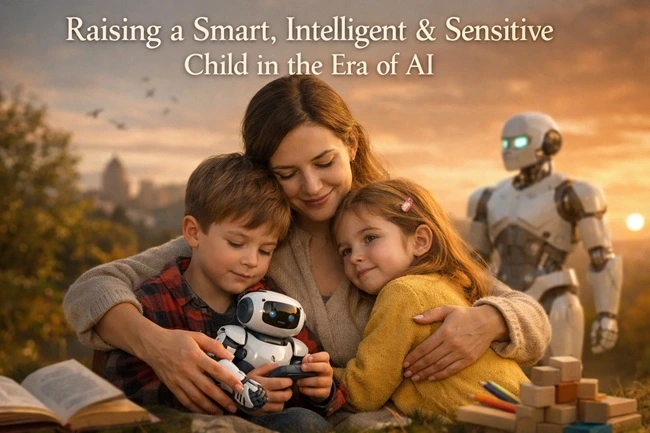
Parenting today feels very different from how it felt even ten years ago. Our children are growing up in a world where answers are instant, screens are everywhere and technology often speaks faster than emotions. As parents, many of us quietly worry:
1. Will my child be intelligent enough to succeed?
2.Will they remain kind, empathetic and emotionally strong?
3.Can they grow up smart without losing their sensitivity?
The truth is, raising a child in the era of AI is not about competing with machines. It is about raising humans who think deeply, feel genuinely and act consciously.
This journey is not about perfection. It is about balance.
What Does “Smart” Really Mean Today?
When we say we want a “smart” child, most parents do not mean just good marks or fast answers. Deep down, we want a child who can:
- Think independently
- Ask meaningful questions
- Solve real-world problems
- Adapt to change
- Learn continuously
In today’s world, intelligence is no longer about memorising facts. Information is everywhere. True intelligence lies in how children process, apply and question information.
A smart child today is one who knows how to think, not just what to think.
Why Sensitivity Is Not a Weakness
Somewhere along the way, sensitivity got misunderstood. Many parents worry that a sensitive child may be “too emotional” or “not strong enough.” But sensitivity is actually a powerful human trait.
Sensitive children often:
- Notice small emotional cues
- Show empathy and compassion
- Feel deeply and sincerely
- Build meaningful relationships
- Develop strong moral values
In an increasingly automated world, sensitivity is what keeps children human. It allows them to connect, understand others and develop emotional intelligence—something no machine can replace.
The goal is not to toughen children by suppressing emotions, but to teach them how to understand and manage those emotions.
The Real Challenge of Parenting in the AI Age
The biggest challenge is not technology itself. It is overexposure without guidance.
Children today are:
- Surrounded by screens
- Used to instant gratification
- Exposed to comparison at an early age
- Less comfortable with boredom
This environment can quietly reduce:
- Patience
- Attention span
- Deep thinking
- Emotional awareness
As parents, our role is not to ban technology completely, but to frame it correctly.
Teaching Children to Think, Not Just Consume
One of the most important skills you can give your child is critical thinking.
Instead of always giving answers, try asking questions:
- “What do you think will happen next?”
- “Why do you feel that way?”
- “What would you do differently?”
Encourage your child to:
- Question information
- Explore multiple viewpoints
- Make small decisions independently
When children learn to think for themselves, they become confident, curious and mentally agile.
Emotional Intelligence Starts at Home
Children do not learn emotional intelligence from lectures. They learn it by watching us.
If a parent:
- Listens without interrupting
- Accepts emotions without judgment
- Apologises when wrong
- Manages anger calmly
The child absorbs these behaviours naturally.
Create a home environment where:
- Feelings are acknowledged
- Mistakes are treated as learning opportunities
- Conversations are safe, not fearful
A child who feels emotionally safe at home grows into an adult who can handle the outside world with strength.
Balancing Screen Time Without Guilt
Screens are part of modern life. The problem is not screen time itself, but mindless screen time.
Instead of focusing only on “how many hours,” focus on:
- What content your child is consuming
- How it makes them feel
- Whether it sparks curiosity or dullness
Balance screens with:
- Reading physical books
- Free play without instructions
- Outdoor activities
- Family conversations
Children do not need constant stimulation. Boredom often leads to creativity.
Teaching Values That Technology Cannot Replace
No matter how advanced the world becomes, values will always matter.
Focus on nurturing:
- Honesty
- Kindness
- Respect
- Responsibility
- Gratitude
Teach these values through daily life, not sermons:
- Let your child see you helping others
- Involve them in small acts of kindness
- Encourage gratitude for simple things
Values become strong when they are lived, not preached.
Helping Children Build a Strong Inner Voice
In a world full of opinions, algorithms, and comparisons, children need a strong inner voice.
Encourage your child to:
- Trust their instincts
- Express disagreement respectfully
- Stand up for themselves
- Say no when something feels wrong
Praise effort, not just results.
Celebrate growth, not perfection.
A child who knows their worth does not need constant validation from the outside world.
Let Children Be Children
Sometimes, in the race to prepare children for the future, we forget the present.
Children need:
- Unstructured play
- Laughter without purpose
- Time to daydream
- Space to be imperfect
Childhood is not a preparation phase only. It is a valuable phase in itself.
A happy childhood builds emotionally stable adults.
Your Role as a Parent in the AI Era
You do not need to know everything about technology. What your child needs most is your presence.
Be involved, not intrusive.
Be guiding, not controlling.
Be available, not distracted.
Children remember how you made them feel, long after they forget what you taught them.
Conclusion: Raising Humans, Not Machines
The future belongs to children who are smart enough to think, sensitive enough to care, and confident enough to stay true to themselves.
Technology will keep evolving. Skills will keep changing. But empathy, curiosity, resilience, and emotional intelligence will always matter.
When you raise a child who can think deeply and feel honestly, you are not just preparing them for success—you are preparing them for life.
And that is the greatest gift a parent can give.
Frequently Asked Questions (FAQ)
1. Can a child be both intelligent and sensitive?
Yes. Intelligence and sensitivity complement each other. A child who understands emotions often makes better decisions and builds stronger relationships.
2. How can parents limit the negative impact of technology?
By guiding usage instead of banning it. Focus on meaningful content, set healthy boundaries and stay involved in your child’s digital life.
3. Is emotional sensitivity a disadvantage in competitive environments?
No. Emotional awareness helps children handle stress, teamwork, leadership and failure more effectively.
4. How early should parents start focusing on emotional intelligence?
From early childhood. Even toddlers benefit when emotions are named, acknowledged and respected.
5. What matters more: skills or values?
Skills help children earn a living. Values help them build a meaningful life. Both are important, but values create long-term stability.
For the latest Parenting Tips, Please Follow Popnewsblend.com

Hi, I’m Prashant Jain — a film enthusiast and critic who lives and breathes cinema. From big-screen releases to the latest drops on OTT, I watch extensively and review honestly, without hype or bias.
I believe a good review should go beyond just “good” or “bad.” It should help you understand what works, what doesn’t, and whether a film is truly worth your time. My reviews focus on storytelling, performances, direction, and overall impact — all through the lens of a genuine viewer.
I regularly cover new movie releases and trending web series across OTT, bringing clear, no-nonsense insights for audiences who want real opinions, not paid praise.
Through PopNewsBlend, I aim to cut through the noise and give you reviews you can trust — whether you’re deciding what to watch next or just love discussing cinema as much as I do.
Discover more from Popnewsblend
Subscribe to get the latest posts sent to your email.
Related posts:
 How to Reduce Screen Time for Kids Without Stress: A Friendly Parent’s Guide
 Mental Health of Kids: Are We Failing Them by Not Talking About It Early?
 How To Protect Kids From Bullying : A Parent’s Guide to Understanding, Preventing, and Responding the Right Way
 Helping Your Child Overcome Fear: A Parent’s Guide to Raising a Confident, Emotionally Secure Kid