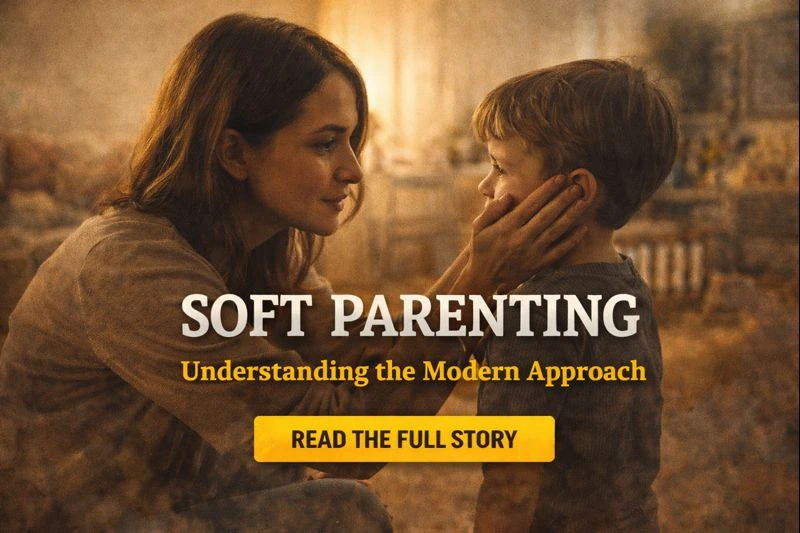
As a parent today, I often find myself caught between two worlds. One is the way we were raised — strict rules, clear boundaries, fear of consequences and very little emotional explanation. The other is this new term that seems to be everywhere right now, soft parenting. Friends discuss it, parenting reels promote it and experts debate it endlessly. Some praise it as the most emotionally healthy way to raise children, while others fear it is creating a generation that cannot handle the real world.
So what exactly is soft parenting? Is it truly helping our children grow stronger or are we unknowingly making them fragile? As a parent navigating this shift firsthand, here is an honest, balanced and real exploration of soft parenting — without judgment, without theory overload and rooted in everyday parenting realities.
What Is Soft Parenting?
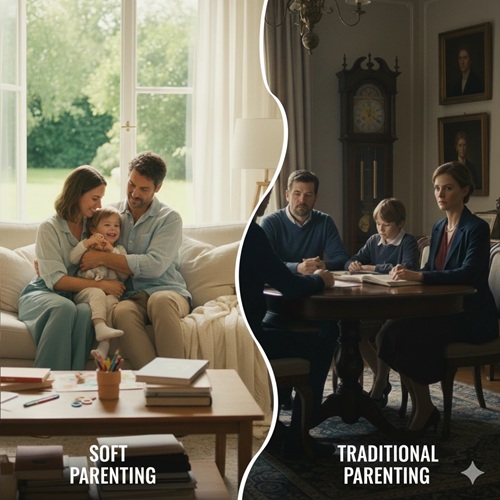
Soft parenting is a modern parenting approach that focuses on empathy, emotional understanding, communication and respect, rather than fear, punishment or authority-driven control. It does not mean being permissive or letting children do whatever they want. Instead, it emphasizes guiding children through emotions rather than suppressing them.
At its core, soft parenting believes that children are still learning how to process feelings, react to stress and make decisions. Instead of punishing mistakes, parents act as emotional coaches — helping children understand what they feel, why they feel it and how to respond better next time.
In simple words, soft parenting replaces “Because I said so” with “Let’s talk about why this happened.”
How Parenting Has Changed in Today’s Generation
Parenting today looks very different from what most of us experienced growing up. Earlier generations were raised in environments where obedience mattered more than expression. Emotional conversations were rare. Mental health was not discussed. Parents were authority figures, not emotional companions.
Today’s parents are more aware. We talk about anxiety, self-esteem, childhood trauma, emotional intelligence and mental well-being. We want our children to feel heard, safe and confident — something many of us lacked.
Some major shifts in modern parenting include:
- Parents now listen more and punish less
- Children are encouraged to express emotions instead of hiding them
- Mental health is taken seriously at an early age
- Communication is preferred over control
- Fear-based discipline is being replaced by explanation-based discipline
This shift did not happen randomly. It came from years of realizing that emotional neglect, harsh discipline and constant pressure leave deep scars that follow children into adulthood.
Why Soft Parenting Is Trending Right Now
Soft parenting has gained popularity because today’s world is far more complex and emotionally demanding than before. Children grow up exposed to screens, social pressure, academic competition and constant comparison. Emotional stress begins early.
Parents are realizing that toughness alone is not enough anymore. Emotional resilience matters just as much as discipline.
Many adults today are unlearning childhood patterns such as fear of authority, inability to express emotions and suppressed feelings. Naturally, they want better emotional tools for their children.
Soft parenting feels like a corrective response to the emotional gaps of the past.
What Soft Parenting Does Right
1. Builds Emotional Intelligence Early
Soft parenting helps children understand emotions — not just happiness, but anger, frustration, jealousy, sadness and disappointment. When children are taught to name and manage emotions instead of being punished for them, they grow into adults who can regulate themselves better.
Emotionally intelligent children often grow into adults who communicate better, handle stress calmly and build healthier relationships.
2. Creates Strong Parent-Child Bonds
Children raised with empathy feel safer opening up to parents. They talk about school stress, peer pressure, fears and mistakes. This trust becomes extremely valuable during teenage years, when many parents otherwise feel shut out.
A child who feels emotionally safe at home is less likely to seek validation in unhealthy spaces.
3. Reduces Fear-Based Behavior
Fear may bring short-term obedience, but it rarely builds understanding. Soft parenting replaces fear with clarity. Children learn consequences without humiliation. They understand why something is wrong, not just that it is wrong.
This often leads to better long-term behavior because actions are guided by awareness, not fear.
4. Encourages Confidence and Self-Worth
Children raised with respect tend to develop stronger self-worth. They feel valued not just for achievements, but for who they are. This confidence helps them face failures without feeling worthless.
Follow Our Youtube and Instagram Account for Daily Updates.
Where Soft Parenting Can Go Wrong
This is where honest parenting conversations are needed.
Soft parenting, when misunderstood or poorly implemented, can slide into over-accommodation. Many parents confuse empathy with the absence of boundaries. Children need structure as much as they need understanding.
1. Lack of Clear Boundaries
When rules are constantly negotiated, children may struggle with discipline outside the home. The real world does not always explain itself gently. Without boundaries, children may develop entitlement rather than emotional strength.
Soft parenting works best when empathy and boundaries coexist.
2. Avoiding Discomfort Instead of Teaching Resilience
Protecting children from every discomfort can limit their ability to cope. Frustration, failure, and disappointment are essential life lessons. If parents step in too quickly to smooth everything out, children may struggle when life is not gentle.
Emotional safety should not mean emotional avoidance.
3. Confusing Gentle Parenting With No Consequences
Soft parenting does not mean the absence of consequences. When consequences disappear completely, children may fail to understand responsibility.
The key difference is that consequences are explained calmly rather than delivered harshly.
Is Soft Parenting Making Kids Strong or Weak?
This is the most debated question — and the answer is not black or white.
Soft parenting does not inherently make children weak. When done correctly, it can actually build emotionally strong, self-aware, and resilient individuals. However, when softness replaces structure, it can create confusion and dependency.
Strength today is not just about toughness. It is about emotional regulation, adaptability, confidence, and problem-solving.
Children who are emotionally supported but also guided firmly tend to develop balanced strength — both emotionally and mentally.
How Today’s Parenting Is Shaping Child Development
Modern parenting approaches, including soft parenting, are shaping children in noticeable ways.
Positive impacts include:
->Better emotional awareness Higher empathy levels
->Stronger communication skills
->Reduced fear-based behavior
Challenges that parents must watch for:
->Lower frustration tolerance
->Difficulty handling rejection
->Over-reliance on parental validation
This means modern parenting requires more conscious effort than ever before. Parents must constantly self-reflect, adjust and balance warmth with discipline.
Finding the Middle Ground as a Parent
The most effective parenting today is not extreme. It is balanced.
Children need:
->Love and limits
->Empathy and expectations
->Freedom and responsibility
->Validation and correction
Soft parenting works best when combined with firm boundaries, age-appropriate responsibility, and consistent rules. Children should feel heard, but they should also understand that not every feeling leads to a changed rule.
A Parent’s Personal View
As a parent, I believe soft parenting is not about being soft on behavior — it is about being strong in connection. Yelling less does not mean caring less. Listening more does not mean losing authority.
Our children will face a demanding world. They need emotional tools, not emotional sheltering. They need guidance, not control. They need parents who are present, not perfect.
Soft parenting is powerful when it teaches children how to face life — not hide from it.
Conclusion: Is Soft Parenting the Future?
Soft parenting reflects a deeper understanding of human psychology and emotional development. It acknowledges that children are not machines to be controlled but individuals to be guided.
When done thoughtfully, soft parenting can raise emotionally strong, confident, and compassionate children. When misunderstood, it risks creating confusion and emotional dependency.
The future of parenting lies in balance — where empathy meets structure, and love meets leadership.
As parents, our role is not to make life easy for our children, but to make them ready for life — emotionally, mentally, and morally.
Frequently Asked Questions
What is soft parenting in simple words?
Soft parenting focuses on understanding a child’s emotions and guiding behavior through communication rather than punishment.
Is soft parenting the same as permissive parenting?
No. Soft parenting still involves rules and consequences. Permissive parenting avoids boundaries altogether.
Does soft parenting work for all age groups?
Yes, but the approach changes with age. Younger children need more guidance, while older children need more autonomy with accountability.
Can soft parenting discipline a child effectively?
Yes, discipline exists through explanation, consistency, and logical consequences rather than fear.
Are kids today emotionally stronger than before?
They are more emotionally aware, but resilience depends on how parents balance empathy with responsibility.

Hi, I’m Prashant Jain — a film enthusiast and critic who lives and breathes cinema. From big-screen releases to the latest drops on OTT, I watch extensively and review honestly, without hype or bias.
I believe a good review should go beyond just “good” or “bad.” It should help you understand what works, what doesn’t, and whether a film is truly worth your time. My reviews focus on storytelling, performances, direction, and overall impact — all through the lens of a genuine viewer.
I regularly cover new movie releases and trending web series across OTT, bringing clear, no-nonsense insights for audiences who want real opinions, not paid praise.
Through PopNewsBlend, I aim to cut through the noise and give you reviews you can trust — whether you’re deciding what to watch next or just love discussing cinema as much as I do.
Discover more from Popnewsblend
Subscribe to get the latest posts sent to your email.
Related posts:
 How to Reduce Screen Time for Kids Without Stress: A Friendly Parent’s Guide
 Mental Health of Kids: Are We Failing Them by Not Talking About It Early?
 How To Protect Kids From Bullying : A Parent’s Guide to Understanding, Preventing, and Responding the Right Way
 Helping Your Child Overcome Fear: A Parent’s Guide to Raising a Confident, Emotionally Secure Kid