Last updated: September 22, 2026
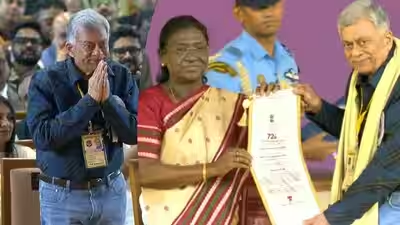
There’s something genuinely different about watching India’s biggest film honour get handed out at the foot of the Statue of Unity instead of a banquet hall in Delhi, and that’s exactly what happened this week. On September 22, 2026, President Droupadi Murmu presented the 72nd National Film Awards at Ekta Nagar in Kevadia, Gujarat, and the evening’s biggest moment belonged to a man who’s been quietly working in Indian cinema since before most of today’s award winners were born: veteran Kannada actor Anant Nag, who received the Dadasaheb Phalke Award.
If you’ve been searching for what exactly this award is, who won what this year, and why film Twitter has been buzzing since Tuesday evening, here’s the full picture, laid out properly.

What is the Dadasaheb Phalke Award, really?
Let’s start at the beginning, because a lot of people know the name without knowing the story behind it. The Dadasaheb Phalke Award is the highest honour in Indian cinema, instituted way back in 1969 by the Government of India. It’s not handed out for a single film or a single year’s performance — it’s a lifetime achievement recognition, awarded for outstanding contribution to the growth and development of Indian cinema as a whole.
The award is named after Dhundiraj Govind Phalke, more commonly known as Dadasaheb Phalke, the man widely regarded as the father of Indian cinema. Phalke made India’s first full-length feature film, Raja Harishchandra, back in 1913, at a time when filmmaking in India was essentially unheard of. He built cameras, developed his own film stock, and basically willed an entire industry into existence through sheer stubbornness and self-taught craft. Every year since 1969, the government has honoured someone whose body of work carries forward that same spirit of building and shaping Indian cinema, and the recipient is chosen by a dedicated Dadasaheb Phalke Award Selection Committee.
Past recipients read like a roll call of Indian film legends. The very first Dadasaheb Phalke Award, back in 1969, went to Devika Rani, often called the first lady of Indian cinema, remembered for founding Bombay Talkies and starring in India’s first English-language film. In more recent years, the honour has gone to Asha Parekh (for 2020), Mithun Chakraborty (for 2022), and Mohanlal (for 2023), before landing on Anant Nag this time around for the year 2024.
Who won the Dadasaheb Phalke Award in 2026, and why does it matter?
This year’s recipient is Anant Nag, a Kannada cinema veteran whose acting career has quietly spanned more than five decades. He’s appeared in over 300 films across Kannada, Hindi, and several other Indian languages, and beyond cinema, he’s built a substantial body of work in theatre and television too — a range that very few actors of his generation can genuinely claim.
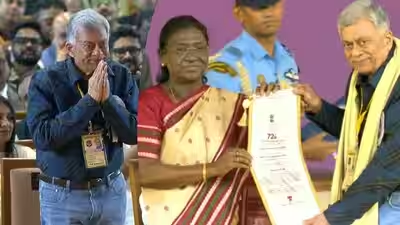
What made this presentation particularly meaningful was how President Murmu framed it during the ceremony. She described Nag’s acting as a synthesis of the finest elements of theatre and cinema, and specifically praised him for performances that are natural, restrained, and authentic — a description that fans of his work would probably say is exactly right. Nag isn’t an actor known for scenery-chewing or dramatic excess; his reputation has always rested on quiet, controlled performances that trust the material rather than fighting for attention.
This isn’t Nag’s first major recognition either. He was awarded the Padma Bhushan, one of India’s highest civilian honours, back in 2025, making the Dadasaheb Phalke Award the latest in what’s become a well-deserved victory lap for a career built almost entirely on consistency rather than stardom in the conventional sense.
Why this year’s ceremony itself was a big deal
Before we get to the other winners, it’s worth pausing on something that made headlines almost as much as the awards themselves: where the ceremony actually happened. For decades, the National Film Awards ceremony has been a New Delhi institution, typically hosted at Vigyan Bhavan. This year, for the first time in a very long time, the entire ceremony shifted location entirely, taking place at Ekta Nagar in Gujarat’s Narmada district, near the Statue of Unity. It’s a genuinely notable break from tradition, and it’s already generating its own share of conversation separate from who actually won what.
The awards recognised films certified by the Central Board of Film Certification through the calendar year 2024, and in total, 92 winners were honoured across every category the National Film Awards cover, from major feature films right down to non-feature and documentary work. The feature film jury for this edition was headed by veteran Malayalam filmmaker Jayaraj, and the full list of winners had actually been announced back in July 2026, with this ceremony serving as the formal, in-person presentation of those honours.
The other big winners you should know about
While the Dadasaheb Phalke Award understandably grabbed the headlines, the National Film Awards cover a huge amount of ground, and this year had some genuinely interesting results, including a rare tie in one of the most prestigious categories.
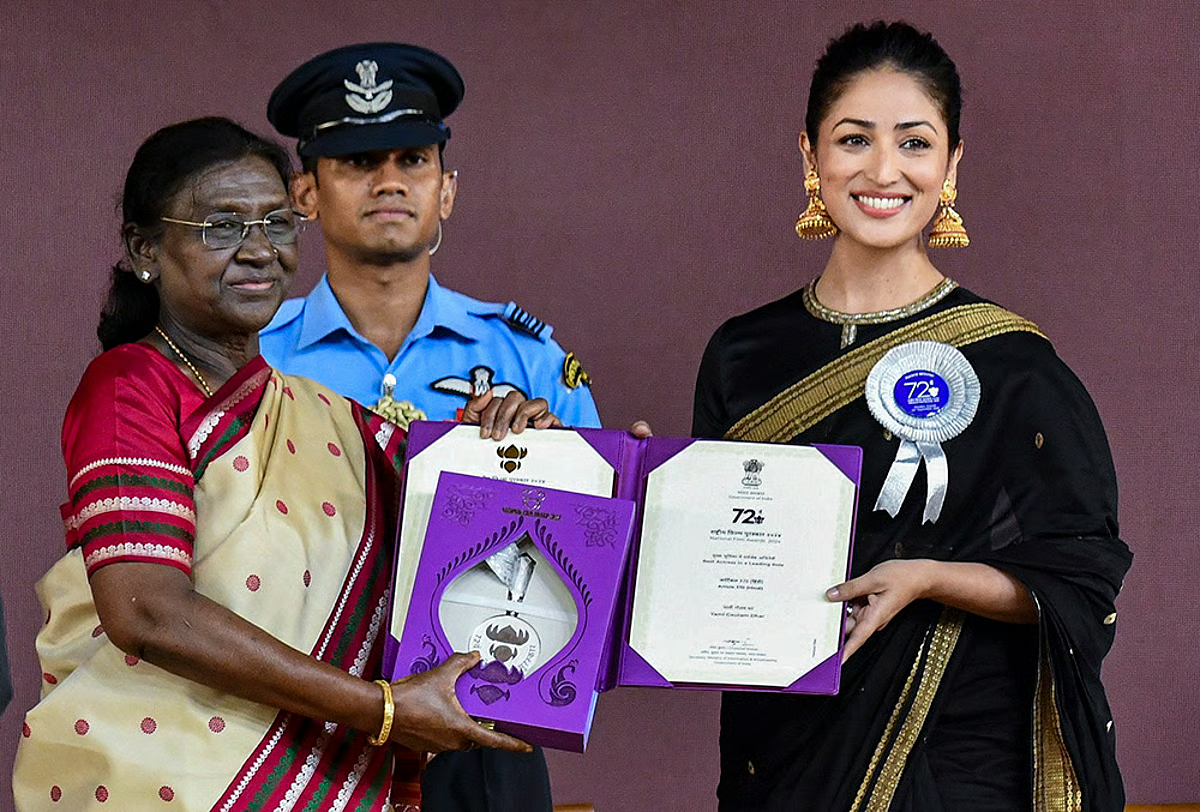
Article 370, directed by Aditya Suhas Jambhale, was the biggest winner of the night, taking home Best Feature Film. The same film also earned Yami Gautam the Best Actress award for her performance in it, making Article 370 the film with the most weight behind it this year.
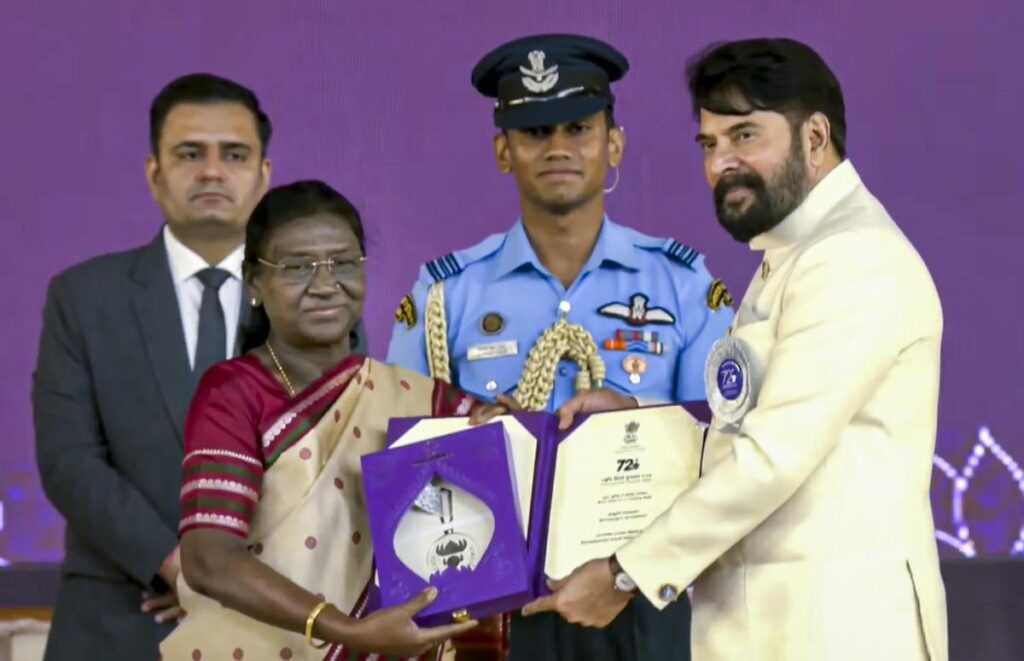
The Best Actor category ended in a tie, shared between two very different performances. Mammootty won for his role in the Malayalam film Bramayugam, while Kartik Aaryan won for his performance in Chandu Champion, a Hindi sports drama. It’s a genuinely interesting pairing, given how different those two films are in tone, scale, and industry, which is honestly part of what makes the National Film Awards distinct from more commercially-driven award shows.
Rajkumar Periasamy picked up Best Director for the Tamil film Amaran, and Randeep Hooda was recognised with the Best Debut Director award for Swatantrya Veer Savarkar, a film he also starred in. On the more mainstream, big-budget side of things, Kalki 2898 AD, directed by Naga Ashwin Singireddy, won Best Popular Film Providing Wholesome Entertainment, which is the category that typically recognises films that combined genuine commercial scale with quality. The ceremony also handed out Special Mentions to Dhanush for his work in Captain Miller and to Suren G for Meiyazhagan.
Malayalam cinema had a notably strong presence at this year’s ceremony too, with playback singer Vaikom Vijayalakshmi among those honoured, reflecting just how much ground these awards cover beyond the usual Hindi-cinema spotlight.
And it’s not just feature films
One thing casual followers of the National Film Awards often miss is just how much recognition goes to non-feature and documentary filmmaking, and this year was no exception. Bhangaar (Obsolete), a Marathi and English film directed by Sumira Roy, won Best Non-Feature Film. In the documentary space, a film examining cultural and social themes took the top documentary honour, while Main Nida, directed by Atul Pandey, was recognised as Best Arts and Culture Film. On the animation side, Touched as Water (Silent), directed and animated by Joshy Benedict, won Best Animation Film, and Hamsafar, directed by Abhijeet Arvind Dalvi, took Best Short Film in the under-30-minutes category. There was also a specific award for films promoting social and environmental values, which went to Piplantri: A Tale of Eco Feminism, directed by Suraj Kumar.
It’s easy to overlook this side of the ceremony when the big Bollywood and pan-India names are in the room, but honestly, this is where a lot of India’s most thoughtful, small-scale filmmaking gets its moment of national recognition, and it deserves to be part of the conversation too.
The bigger picture
Step back from the individual winners for a second, and what this year’s ceremony really represents is a genuine changing of the guard alongside a nod to continuity. You’ve got Anant Nag, an actor whose career started decades before most of the other winners on stage were even working, being honoured for a lifetime of restrained, theatre-informed craft. And right alongside him, you’ve got a Best Actor tie between a Malayalam horror drama and a mainstream Hindi sports biopic, a Tamil action film winning Best Director, and a Telugu sci-fi blockbuster taking the top popular-film honour. If there’s one thing this year’s National Film Awards made clear, it’s that Indian cinema’s biggest night genuinely reflects the entire country’s film industry now, not just one language or one region, and that’s arguably the most meaningful story here beyond any single trophy.
Frequently asked questions
What is the Dadasaheb Phalke Award? It’s the highest official honour in Indian cinema, a lifetime achievement award instituted by the Government of India in 1969, named after Dhundiraj Govind Phalke, who made India’s first feature film in 1913 and is widely considered the father of Indian cinema.
Who won the Dadasaheb Phalke Award in 2026? Veteran Kannada actor Anant Nag received the Dadasaheb Phalke Award for the year 2024, presented at the 72nd National Film Awards ceremony on September 22, 2026.
Why was Anant Nag chosen for this award? He was honoured for his contribution to Indian cinema across a career spanning more than five decades, including over 300 films in Kannada, Hindi, and other languages, along with significant work in theatre and television. President Droupadi Murmu specifically praised his natural, restrained, and authentic acting style.
Where was the 72nd National Film Awards ceremony held? It was held at Ekta Nagar in Kevadia, Gujarat’s Narmada district, near the Statue of Unity. This marked the first time in decades that the ceremony was held outside New Delhi.
Which film won Best Feature Film at the 72nd National Film Awards? Article 370, directed by Aditya Suhas Jambhale, won Best Feature Film. The same film also won Yami Gautam the Best Actress award.
Who won Best Actor at the 2026 National Film Awards? The award was shared between Mammootty, for his performance in the Malayalam film Bramayugam, and Kartik Aaryan, for his performance in the Hindi film Chandu Champion.
Who presented the awards this year? President of India Droupadi Murmu presented the 72nd National Film Awards, including personally conferring the Dadasaheb Phalke Award on Anant Nag.
Which films were certified for consideration this year? The 72nd National Film Awards recognised films certified by the Central Board of Film Certification between January 1 and December 31, 2024.
Has Anant Nag won other major honours? Yes. Beyond this award, he received the Padma Bhushan, one of India’s highest civilian honours, in 2025, in recognition of his contribution to the arts.
Disclaimer: This article is based on official announcements and news coverage of the 72nd National Film Awards ceremony as of September 22, 2026, including statements from the Ministry of Information and Broadcasting and the President’s Secretariat. Award details, winner names, and category names are accurate to the best of available public reporting at the time of publication and may be subject to minor corrections as further official records are released. This article is intended for general informational purposes only.

Hi, I’m Prashant Jain — a film enthusiast and critic who lives and breathes cinema. From big-screen releases to the latest drops on OTT, I watch extensively and review honestly, without hype or bias.
I believe a good review should go beyond just “good” or “bad.” It should help you understand what works, what doesn’t, and whether a film is truly worth your time. My reviews focus on storytelling, performances, direction, and overall impact — all through the lens of a genuine viewer.
I regularly cover new movie releases and trending web series across OTT, bringing clear, no-nonsense insights for audiences who want real opinions, not paid praise.
Through PopNewsBlend, I aim to cut through the noise and give you reviews you can trust — whether you’re deciding what to watch next or just love discussing cinema as much as I do.
Discover more from Popnewsblend
Subscribe to get the latest posts sent to your email.
Related posts:
 The Ultimate Guide to the Best Bollywood Comedy Movies Ever Made
 Fatima Bosch from Mexico Crowned Miss Universe 2025: Complete Highlights, Winner Breakdown, Runners-Up and India’s Final Position
 Asha Bhosle (1933–2026): A Voice That Defined Generations, A Legacy That Will Never Fade
 Anil Kapoor’s 24 Series on Jio Hotstar (April 24): Why This Iconic Thriller Is a Must-Watch Again