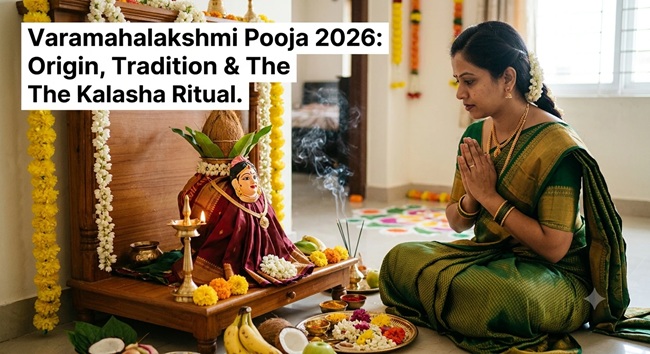
If you grew up in a South Indian household, chances are the second Friday of Shravana meant one thing in your house: your mother or grandmother was up before sunrise, the kitchen smelled of turmeric and fresh flowers, and by mid-morning there was a brass pot sitting in the puja room wearing a silk saree and gold jewellery like it was getting ready for a wedding. That is Varamahalakshmi Pooja, also called Varalakshmi Vratham, one of the most heartfelt and visually rich festivals in the Hindu calendar.
This article walks through everything about the festival in detail. The history behind it, why the goddess is worshipped in the form of a decorated pot, who actually performs the vrat, why it took root so deeply in South India, how the celebration changes as you move from Tamil Nadu to Karnataka to Andhra Pradesh, and how the rest of India relates to Lakshmi worship even without observing this exact festival.
When is Varamahalakshmi Pooja in 2026
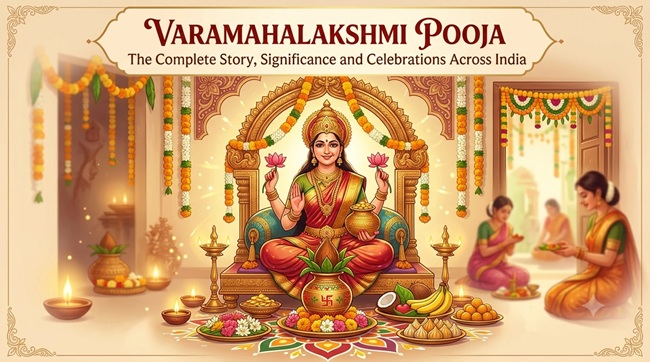
Varamahalakshmi Pooja or Vratham 2026 falls on Friday, August 28. The festival is always celebrated on the Friday that comes right before Shravana Purnima, the full moon day of the Shravana month, which usually places it somewhere in late July or August depending on the lunar calendar. Interestingly, this year the vrat lands on the same day as Shravana Purnima itself and Raksha Bandhan, something many families are treating as an especially auspicious coincidence.
The story behind the Varamahalakshmi Pooja
Every festival with this much devotion behind it has a story, and Varamahalakshmi’s story comes from the Skanda Purana. According to the legend, Lord Shiva once told his wife Parvati about a vrat that would bring immense benefit to women who observed it with sincerity. He described how Goddess Lakshmi, in her Varalakshmi form, grants boons to those who worship her on the Friday before the Shravana full moon.
The story most people actually grew up hearing, though, is about a woman named Charumati. She lived in a kingdom called Magadha and was known throughout the town for how devoted she was to her husband, her in-laws and to Goddess Lakshmi. One night, the goddess appeared to Charumati in a dream and told her to observe this vrat. Charumati did exactly as she was told, and she convinced the other women in her town to join her. As they worshipped the kalasha they had set up to represent the goddess, something remarkable happened. Their bangles began chiming on their own, almost like the goddess herself was blessing them in real time, and their households were filled with health, happiness and prosperity from that point on.
That is really the heart of why this festival still feels personal rather than performative even today. It was never handed down through a temple priest reading out instructions. It travelled through generations of women, told by grandmothers to daughters as they tied the sacred thread around the kalasham, which is part of why so many families still treat it as a home ritual first and a public event second.
Who is Goddess Varalakshmi
The name itself tells you what the goddess represents. Vara means boon, and Lakshmi is the goddess of wealth and abundance, so Varalakshmi literally means the goddess who grants boons. She is considered one of the gentler, more approachable forms of Mahalakshmi, believed to have emerged from the Kshira Sagara, the cosmic ocean of milk, during the churning that produced so many of the treasures and beings central to Hindu mythology.
What makes this particular festival theologically significant is a belief that worshipping Varalakshmi on this one day is the same as worshipping all eight forms of Lakshmi together, known as the Ashtalakshmi. These eight forms cover everything from spiritual wisdom and courage to grain, cattle, children and material wealth. So this is not a narrow ritual asking for money. It is a much broader prayer for wellbeing in every sense of the word, spiritual, physical, emotional and financial.
Where the festival is celebrated and by whom
Varamahalakshmi Pooja is, at its core, a South Indian festival. It is celebrated with the most fervour in Karnataka, Andhra Pradesh, Telangana and Tamil Nadu, and pockets of Maharashtra close to the Karnataka border also observe it, though it never became mainstream there the way Ganesh Chaturthi did.
Traditionally, the vrat was meant for married women, since so much of the ritual is built around praying for the husband’s long life and the family’s overall harmony, similar in spirit to how Karva Chauth functions in North India, even though the actual rituals look completely different. These days, most families and priests agree that unmarried women and even men can perform the vrat as long as it is done with genuine devotion. A lot of young unmarried women now do the pooja alongside their mothers, partly out of tradition and partly because they want the goddess’s blessings for their own future households.
Outside India, the festival has followed South Indian families wherever they have settled, from the US and UK to Singapore, Australia and the Gulf countries. It has become common now for families abroad to book guided online poojas performed by Vedic priests when setting up a full kalasha at home is not practical, so the ritual continues without losing its authenticity.
Why South India embraced this festival so strongly
A few things explain why this festival became such a deeply rooted South Indian tradition rather than a pan-Indian one.
The story of Charumati and the instructions in the Skanda Purana took particularly strong hold in Kannada, Telugu and Tamil speaking communities, where it settled naturally into the existing Shravana and Aavani month festival calendar alongside things like Naga Panchami and Raksha Bandhan.
It is also a ritual that does not need a temple or a priest. It can be done entirely at home by the woman of the house, which made it easy to pass down within families rather than depending on institutional religion to keep it alive.
There is a strong community angle too. Married women exchange small gifts with each other on this day in a custom called vayanam, usually bangles, blouse pieces or small trinket boxes, and neighbours and relatives are invited over to see the decorated kalasha. That social layer turned what could have been a quiet private ritual into something that strengthens friendships and family ties year after year.
And finally, the timing near Shravana Purnima matters. Friday is already considered Goddess Lakshmi’s day across most Hindu traditions, and the days around the Shravana full moon are widely regarded as auspicious for worship and new beginnings, which reinforced the festival’s place in the regional calendar over time.
How the Varamahalakshmi Pooja is actually performed
The exact steps vary a little from home to home, but most families follow a similar structure.
Women usually wake up before sunrise on the day of the vrat and start by cleaning the house and the puja area thoroughly. A brass or silver kalasha is then set up as the centrepiece of the ritual. It is filled with rice or water, along with coins, betel nuts and leaves, and a swastika symbol is drawn on it before it gets decorated with mango leaves and a coconut placed on top.
Then comes the part everyone associates with this festival, dressing the kalasha to look like the goddess herself. A face, often made of silver or shaped from turmeric and kumkum, is attached to the front of the pot. It is then draped in a silk saree and decorated with jewellery, sometimes a mangalsutra, bangles, jhumkas and a maang tikka, along with flowers and occasionally a small crown, until the pot genuinely looks like a bride ready for her wedding.
Once the kalasha is dressed, the actual puja begins with offerings of flowers like lotus, jasmine, rose and marigold, along with fruits and sweets, and brass lamps are lit around the altar. Many women observe a fast on this day too, though how strict it is really depends on the family, age and health, ranging from a full fast to just fruits and milk or a light sattvic meal.
Reading or listening to the Varalakshmi Vrat Katha, the story of Charumati, is considered an essential part of the ritual, since it is what ties the whole day back to its origin.
By evening, the vayanam gift exchange happens, and in many homes women gather to sing devotional songs to the goddess around the decorated kalasha before the puja concludes.
How the celebration differs by region
In Tamil Nadu, families draw elaborate kolam patterns at the entrance of the house, and the kalasham is dressed almost bridal style, complete with a silk saree, gold jewellery and fresh jasmine strung through in generous loops. The vayanam exchange with neighbours tends to be a bigger deal here than almost anywhere else.
In Karnataka, the kalasha decoration often becomes quite elaborate, sometimes multi tiered, and it is common now for these decorated setups to be photographed and shared within family WhatsApp groups and among friends. Apartment complexes and residential communities frequently host joint celebrations where multiple families set up their kalashas together.
In Andhra Pradesh and Telangana, the kalasha worship looks fairly similar, but the day is often paired with elaborate festive cooking, and many households have an evening gathering where women sing Lakshmi devi songs together around the pot.
How the rest of India relates to Lakshmi worship
Varamahalakshmi Pooja itself does not really exist as a mainstream festival in North India, but that does not mean Lakshmi worship is absent there. It just takes different forms and falls on different dates.
Diwali, or Lakshmi Puja, is the festival most of North, West and East India associates with the goddess. It falls on the new moon of the Kartik month and centres on inviting Lakshmi into a freshly cleaned, brightly lit home, which is a very different ritual structure compared to the kalasha based worship of Varamahalakshmi.
Sharad Purnima is another occasion, observed especially in Bengal as part of Kojagari Lakshmi Puja, where devotees stay awake through the night believing the goddess roams the earth blessing those who are still up in devotion.
Akshaya Tritiya is widely observed across the country as an auspicious day for buying gold and starting new ventures, again as a way of inviting Lakshmi’s blessings, though without the vrat and fasting structure that defines Varamahalakshmi.
So while South India has this one dedicated, home centred, women led festival for Varalakshmi specifically, the rest of the country channels similar devotion to the same goddess through different festivals scattered across the year. The reverence is universal even when the calendar and the rituals are not.
Why the festival still matters today
It would be easy to reduce Varamahalakshmi Pooja to just another ritual for wealth, but that misses most of what it actually represents. It is a prayer for comprehensive wellbeing, since worshipping Varalakshmi is believed to cover all eight forms of Lakshmi at once. It is a family centred ritual focused on the health and harmony of the household, particularly the husband and children. It is a social occasion, thanks to the vayanam exchange and the visits from friends and neighbours. And it is a piece of living cultural memory, passed down almost entirely through oral tradition from one generation of women to the next, which is increasingly rare at a time when so many rituals now come pre packaged with instructions from the internet.
Frequently asked questions
When is Varamahalakshmi Pooja in 2026?
Varamahalakshmi Pooja, also called Varalakshmi Vratham, falls on Friday, August 28, 2026.
Is Varamahalakshmi the same festival as Varalakshmi Vratham?
Yes, they are the same festival. Varamahalakshmi is the name more commonly used in Karnataka and Andhra Pradesh, while Varalakshmi Vratham is the term more commonly used in Tamil Nadu.
Why is the festival always celebrated on a Friday?
Friday is considered Goddess Lakshmi’s day in most Hindu traditions, and the vrat is specifically prescribed for the Friday that falls closest to Shravana Purnima, the full moon of the Shravana month.
Who is supposed to perform the Varamahalakshmi vrat?
It was traditionally observed by married women praying for the health and prosperity of their families, but today most priests and families agree that unmarried women and men can also perform the vrat with sincere devotion.
What is the significance of worshipping Goddess Varalakshmi?
Varalakshmi is a boon granting form of Mahalakshmi, and worshipping her on this day is believed to be equal to worshipping all eight forms of Lakshmi, the Ashtalakshmi, together. This makes the prayer one for overall wellbeing rather than wealth alone.
What is the kalasha used in the pooja?
The kalasha is a brass or silver pot filled with rice or water, coins, betel nuts and leaves, decorated with mango leaves and a coconut, and then dressed with a face, saree and jewellery to represent the goddess in human form.
Is fasting compulsory on Varamahalakshmi Pooja day?
No, fasting is traditional but flexible. Some women observe a complete fast, others eat only fruits and milk, and many simply eat a light sattvic meal before the puja, depending on personal health and family custom.
What is vayanam?
Vayanam is the custom of married women exchanging small gifts, usually bangles, blouse pieces or trinket boxes, with each other on the day of the festival. It is meant to symbolise shared blessings and strengthens social and family bonds.
Do North Indian families celebrate Varamahalakshmi Pooja?
It is not a mainstream festival in North India. North Indian communities generally worship Goddess Lakshmi through Diwali, Sharad Purnima and Akshaya Tritiya instead, which follow different ritual structures and calendar dates.
Can this festival be celebrated by families living outside India?
Yes. Many South Indian families abroad continue the tradition at home, and it has become increasingly common to book guided online poojas conducted by Vedic priests for families who cannot arrange a full kalasha setup themselves.
What colours are considered auspicious to wear for the pooja?
There is no strict rule, but red, yellow, green, pink and gold are considered especially auspicious, since they are associated with prosperity and the blessings of Goddess Lakshmi. Many women choose traditional silk sarees in these shades for the day.

Hi, I’m Prashant Jain — a film enthusiast and critic who lives and breathes cinema. From big-screen releases to the latest drops on OTT, I watch extensively and review honestly, without hype or bias.
I believe a good review should go beyond just “good” or “bad.” It should help you understand what works, what doesn’t, and whether a film is truly worth your time. My reviews focus on storytelling, performances, direction, and overall impact — all through the lens of a genuine viewer.
I regularly cover new movie releases and trending web series across OTT, bringing clear, no-nonsense insights for audiences who want real opinions, not paid praise.
Through PopNewsBlend, I aim to cut through the noise and give you reviews you can trust — whether you’re deciding what to watch next or just love discussing cinema as much as I do.
Discover more from Popnewsblend
Subscribe to get the latest posts sent to your email.
Related posts:
 International Yoga Day 2025: A Global Celebration of Mind-Body Harmony
 Is Diwali Only a Hindu Festival? Exploring the Universal Spirit of the Festival of Lights
 Vishu Festival 2026: Meaning, Significance, Rituals, Celebrations & Traditions Explained
 Char Dham Yatra 2026: A Divine Journey Begins on Akshaya Tritiya – A Shiv Bhakt’s Calling